Atnaf Aytenew, Oakes Ryan, Scodari Bruno T, Desta Kassu, Taye Bineyam, Tsegaye Aster
Department of Medical Laboratory Science, Debre Markos University, Debre Markos, Ethiopia.
Department of Medical Laboratory Sciences, Addis Ababa University, Addis Ababa, Ethiopia.
PLoS Negl Trop Dis. 2024 Dec 17;18(12):e0012732. doi: 10.1371/journal.pntd.0012732. eCollection 2024 Dec.
Podoconiosis is a geo-chemically induced, non-infectious, familial, chronic lymphedema of the legs that occurs among barefoot people in rural, farming communities with extreme poverty. Despite a growing body of research surrounding the disease, the pathogenesis of the disease is relatively unknown. This study aims to investigate the immunological and hematological profiles of individuals affected by podoconiosis in comparison to healthy controls.
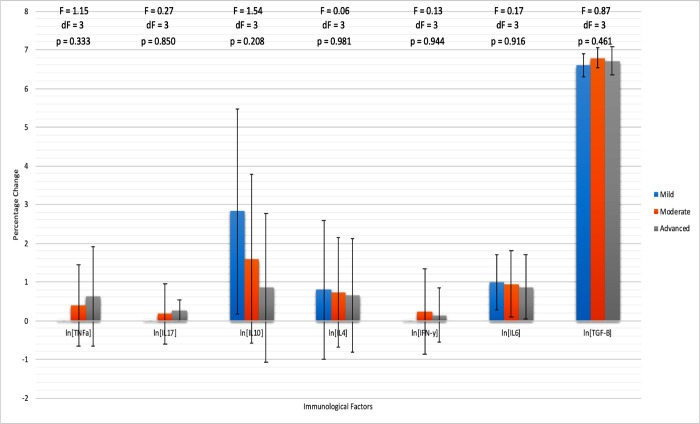
METHODOLOGY/PRINCIPAL FINDINGS: A comparative cross-sectional study was conducted in West Gojjam Zone of Ethiopia involving adult individuals clinically diagnosed with podoconiosis (n = 53) and healthy controls (n = 67) from the same area. A survey was conducted to gather information on sociodemographic, lifestyle characteristics, and clinical features of the disease. About nine ml whole blood samples were collected for hematological and immunological testing, which included IL-4, TNF-α, IL-6, IL-17, IL-10, TGF β and IFN-γ. Overall, we observed significant differences in hematological parameters between individuals with podoconiosis and healthy controls. Specifically, we found a notable reduction in white blood cell count, with an adjusted mean difference (AMD) of -1.15 (95% CI: -2.09 to -0.21; p = 0.017). Additionally, the differential white blood count showed a decrease in absolute neutrophils (AMD = -3.42, 95% CI: -4.15 to -2.69; p < 0.001) and absolute eosinophils (AMD = -0.20, 95% CI: -0.37 to -0.03; p = 0.019). Conversely, we noted an increase in absolute lymphocytes (AMD = 0.98, 95% CI: 0.50 to 1.46; p < 0.001) and monocytes (AMD = 0.54, 95% CI: 0.22 to 0.85; p = 0.001). However, we didn't observe a significant difference in cytokine profile between podoconiosis patients and healthy controls.
CONCLUSIONS/SIGNIFICANCE: The decrease in neutrophil counts among podoconiosis cases compared to healthy controls may provide insight into the potential disease pathogenesis, suggesting the involvement of autoimmune-related mechanisms, as it demonstrates a similar hematological profile to other autoimmune disorders.
地方性丝虫病是一种由地球化学因素诱发的、非传染性的、家族性的腿部慢性淋巴水肿,发生在极度贫困的农村农业社区中赤脚人群。尽管围绕该疾病的研究越来越多,但该疾病的发病机制仍相对不明。本研究旨在调查与健康对照相比,地方性丝虫病患者的免疫学和血液学特征。
方法/主要发现:在埃塞俄比亚的西戈贾姆地区进行了一项比较横断面研究,纳入了临床诊断为地方性丝虫病的成年个体(n = 53)和来自同一地区的健康对照(n = 67)。进行了一项调查,以收集有关社会人口统计学、生活方式特征和该疾病临床特征的信息。采集了约9毫升全血样本进行血液学和免疫学检测,检测项目包括白细胞介素-4、肿瘤坏死因子-α、白细胞介素-6、白细胞介素-17、白细胞介素-10、转化生长因子-β和干扰素-γ。总体而言,我们观察到地方性丝虫病患者和健康对照之间在血液学参数上存在显著差异。具体而言,我们发现白细胞计数显著降低,调整后平均差异(AMD)为-1.15(95%置信区间:-2.09至-0.21;p = 0.017)。此外,白细胞分类计数显示绝对中性粒细胞减少(AMD = -3.42,95%置信区间:-4.15至-2.69;p < 0.001)和绝对嗜酸性粒细胞减少(AMD = -0.20,95%置信区间:-0.37至-0.03;p = 0.019)。相反,我们注意到绝对淋巴细胞增加(AMD = 0.98,95%置信区间:0.50至1.46;p < 0.001)和单核细胞增加(AMD = 0.54,95%置信区间:0.22至0.85;p = 0.001)。然而,我们未观察到地方性丝虫病患者和健康对照之间在细胞因子谱方面存在显著差异。
结论/意义:与健康对照相比,地方性丝虫病患者中性粒细胞计数的降低可能为潜在的疾病发病机制提供线索,表明自身免疫相关机制的参与,因为它显示出与其他自身免疫性疾病相似的血液学特征。