Peruchet-Noray Laia, Dimou Niki, Cordova Reynalda, Fontvieille Emma, Jansana Anna, Gan Quan, Breeur Marie, Baurecht Hansjörg, Bohmann Patricia, Konzok Julian, Stein Michael J, Dahm Christina C, Zilhão Nuno R, Mellemkjær Lene, Tjønneland Anne, Kaaks Rudolf, Katzke Verena, Inan-Eroglu Elif, Schulze Matthias B, Masala Giovanna, Sieri Sabina, Simeon Vittorio, Matullo Giuseppe, Molina-Montes Esther, Amiano Pilar, Chirlaque María-Dolores, Gasque Alba, Atkins Joshua, Smith-Byrne Karl, Ferrari Pietro, Viallon Vivian, Agudo Antonio, Gunter Marc J, Bonet Catalina, Freisling Heinz, Carreras-Torres Robert
International Agency for Research on Cancer (IARC/WHO), Nutrition and Metabolism Branch, 69366, Lyon CEDEX 07, France; Department of Clinical Sciences, Faculty of Medicine, University of Barcelona, Barcelona, Spain.
International Agency for Research on Cancer (IARC/WHO), Nutrition and Metabolism Branch, 69366, Lyon CEDEX 07, France.
EBioMedicine. 2025 Jan;111:105510. doi: 10.1016/j.ebiom.2024.105510. Epub 2024 Dec 16.
Previous prediction models for adiposity gain have not yet achieved sufficient predictive ability for clinical relevance. We investigated whether traditional and genetic factors accurately predict adiposity gain.
A 5-year gain of ≥5% in body mass index (BMI) and waist-to-hip ratio (WHR) from baseline were predicted in mid-late adulthood individuals (median of 55 years old at baseline). Proportional hazards models were fitted in 245,699 participants from the European Prospective Investigation into Cancer and Nutrition (EPIC) cohort to identify robust environmental predictors. Polygenic risk scores (PRS) of 5 proxies of adiposity [BMI, WHR, and three body shape phenotypes (PCs)] were computed using genetic weights from an independent cohort (UK Biobank). Environmental and genetic models were validated in 29,953 EPIC participants.
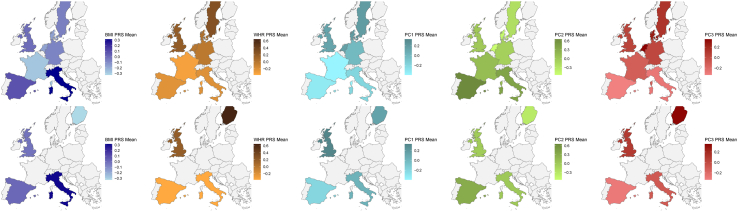
Environmental models presented a remarkable predictive ability (AUC: 0.69, 95% CI: 0.68-0.70; AUC: 0.75, 95% CI: 0.74-0.77). The genetic geographic distribution for WHR and PC1 (overall adiposity) showed higher predisposition in North than South Europe. Predictive ability of PRSs was null (AUC: ∼0.52) and did not improve when combined with environmental models. However, PRSs of BMI and PC1 showed some prediction ability for BMI gain from self-reported BMI at 20 years old to baseline observation (early adulthood) (AUC: 0.60-0.62).
Our study indicates that environmental models to discriminate European individuals at higher risk of adiposity gain can be integrated in standard prevention protocols. PRSs may play a robust role in predicting adiposity gain at early rather than mid-late adulthood suggesting a more important role of genetic factors in this life period.
French National Cancer Institute (INCA_N°2019-176) 1220, German Research Foundation (BA 5459/2-1), Instituto de Salud Carlos III (Miguel Servet Program CP21/00058).
先前用于预测肥胖增加的模型尚未达到具有临床相关性的足够预测能力。我们研究了传统因素和遗传因素是否能准确预测肥胖增加。
在成年中后期个体(基线时年龄中位数为55岁)中预测从基线起5年内体重指数(BMI)和腰臀比(WHR)增加≥5%的情况。对来自欧洲癌症与营养前瞻性调查(EPIC)队列的245,699名参与者拟合比例风险模型,以确定可靠的环境预测因素。使用来自独立队列(英国生物银行)的遗传权重计算5种肥胖指标[BMI、WHR和三种体型表型(主成分)]的多基因风险评分(PRS)。在29,953名EPIC参与者中对环境模型和遗传模型进行验证。
环境模型具有显著的预测能力(AUC:0.69,95%置信区间:0.68 - 0.70;AUC:0.75,95%置信区间:0.74 - 0.77)。WHR和PC1(总体肥胖)的遗传地理分布显示,北欧比南欧的易感性更高。PRS的预测能力为零(AUC:约0.52),与环境模型结合时也未得到改善。然而,BMI和PC1的PRS对从20岁时自我报告的BMI到基线观察(成年早期)的BMI增加显示出一定的预测能力(AUC:0.60 - 0.62)。
我们的研究表明,用于区分肥胖增加风险较高的欧洲个体的环境模型可纳入标准预防方案。PRS可能在预测成年早期而非成年中后期的肥胖增加方面发挥有力作用,这表明遗传因素在这一生命阶段发挥更重要的作用。
法国国家癌症研究所(INCA_N°2019 - 176)1220、德国研究基金会(BA 5459/2 - 1)、卡洛斯三世健康研究所(米格尔·塞尔维特计划CP21/00058)。