Dementias Platform UK, Department of Psychiatry, University of Oxford Warneford Hospital, Oxford, UK.
Centre for Cognitive Ageing and Cognitive Epidemiology (CCACE), Department of Psychology, University of Edinburgh, Edinburgh, UK.
Sci Rep. 2019 Jan 23;9(1):363. doi: 10.1038/s41598-018-36629-0.
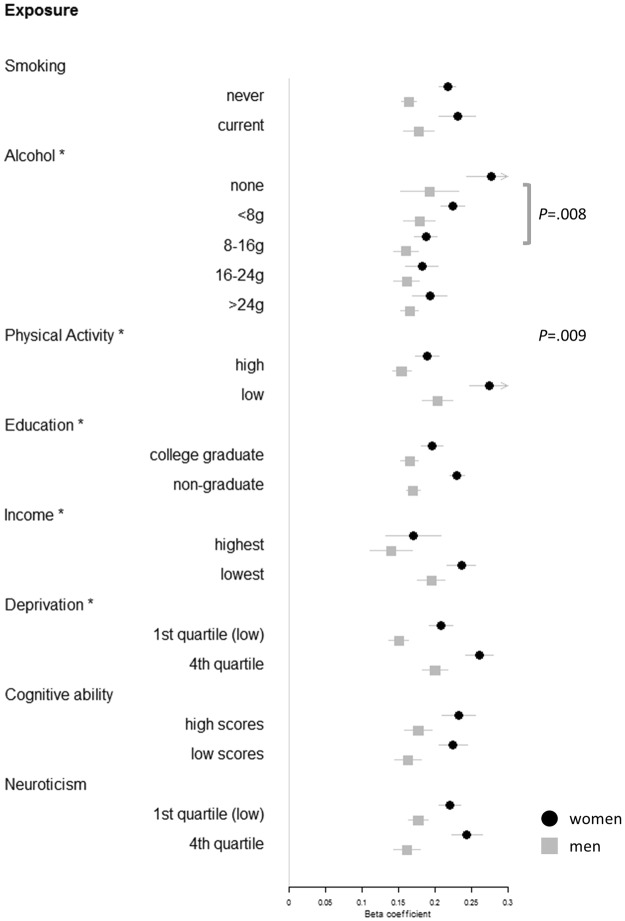
Evidence suggests that lifestyle factors, e.g. physical activity, moderate the manifestation of genetic susceptibility to obesity. The present study uses UK Biobank data to investigate interaction between polygenic scores (PGS) for two obesity indicators, and lifestyle and psychosocial factors in the prediction of the two indicators, with attention to sex-specific effects. Analyses were of 112 151 participants (58 914 females; 40 to 73 years) whose genetic data passed quality control. Moderation effects were analysed in linear regression models predicting body mass index (BMI) and waist-to-hip ratio (WHR), including interaction terms for PGS and each exposure. Greater physical activity, more education, higher income, moderate vs low alcohol consumption, and low material deprivation were each associated with a relatively lower risk for manifestation of genetic susceptibility to obesity (p < 0.001); the moderating effects of physical activity and alcohol consumption were greater in women than men (three-way interaction: p = 0.009 and p = 0.008, respectively). More income and less neuroticism were related to reduced manifestation of genetic susceptibility to high WHR (p = 0.007; p = 0.003); the effect of income was greater in women (three-way interaction: p = 0.001). Lifestyle and psychosocial factors appear to offset genetic risk for adiposity in mid to late adulthood, with some sex-specific associations.
有证据表明,生活方式因素,如体育活动,可以调节肥胖遗传易感性的表现。本研究利用英国生物库的数据,调查了两种肥胖指标的多基因评分(PGS)与生活方式和心理社会因素在预测这两种指标中的相互作用,同时注意到性别特异性效应。分析对象为 112151 名参与者(58914 名女性;年龄在 40 至 73 岁之间),其遗传数据通过了质量控制。在预测体重指数(BMI)和腰臀比(WHR)的线性回归模型中分析了调节效应,包括 PGS 与每个暴露因素的交互项。更高的体育活动量、更多的教育程度、更高的收入、适度饮酒而不是低度饮酒,以及较低的物质匮乏程度,都与肥胖遗传易感性表现的相对较低风险相关(p<0.001);体育活动和饮酒的调节作用在女性中大于男性(三向交互作用:p=0.009 和 p=0.008)。更高的收入和较低的神经质与较低的 WHR 遗传易感性表现相关(p=0.007;p=0.003);收入的影响在女性中更大(三向交互作用:p=0.001)。生活方式和心理社会因素似乎可以抵消中年后期肥胖的遗传风险,并且存在一些性别特异性关联。