Rahman Md Abdur, Zereen Farah, Rana Md Liton, Hossain Md Golzar, Shimada Masaru, Saha Sukumar
Department of Microbiology and Hygiene, Bangladesh Agricultural University, Mymensingh-2202, Bangladesh; Gono Bishwabidyalay, Dhaka, Bangladesh.
University of Chinese Academy of Sciences, Beijing 100049, China.
Virus Res. 2025 Jan;351:199514. doi: 10.1016/j.virusres.2024.199514. Epub 2024 Dec 19.
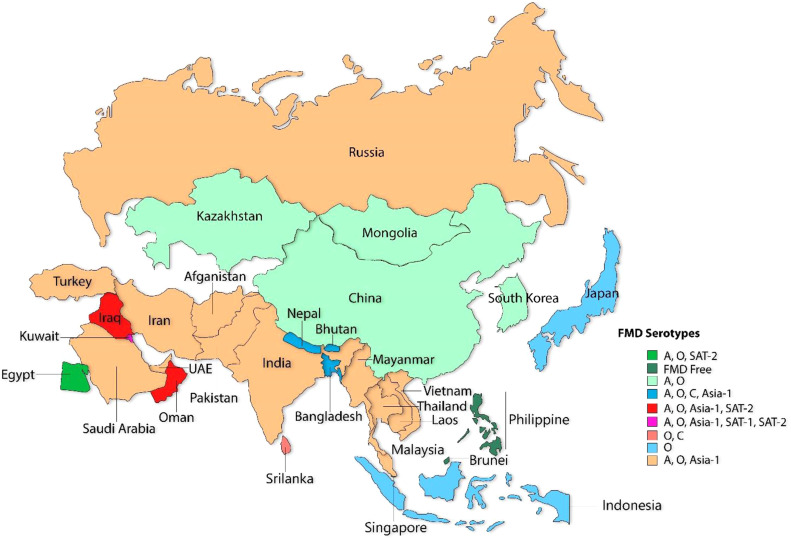
Foot-and-mouth disease (FMD) is a highly contagious transboundary disease prevalent across the Asian continent, affecting both wild and domestic artiodactyls. The disease is caused by a virus belonging to the Aphthovirus genus of the Picornaviridae family which is categorized into seven serotypes: C, O, A, SAT1, SAT2, SAT3, and Asia1. The virus spreads through direct and indirect contact, including semen, meat, fomites, ingestion, and aerosols. FMD has a severe economic impact due to the high morbidity and mortality, especially in young animals. Prevention of the disease relies on vaccination with the prevalent serotype(s) or the slaughter and destruction of affected animals. This review discusses the prevalence of various FMD virus (FMDV) serotypes across Asia, along with the transmission modes, pathogenesis, immune response, and immune suppression by FMDV. Additionally, the review explores FMD diagnosis, prevention, and control strategies, and highlights future opportunities for research aimed at developing strain-specific viral and bacterial combined vaccines.
口蹄疫(FMD)是一种高度传染性的跨界疾病,在亚洲大陆广泛流行,影响野生和家养偶蹄动物。该疾病由属于小核糖核酸病毒科口疮病毒属的一种病毒引起,该病毒分为七种血清型:C、O、A、SAT1、SAT2、SAT3和Asia1。病毒通过直接和间接接触传播,包括精液、肉类、污染物、摄入和气溶胶。由于发病率和死亡率高,尤其是在幼畜中,口蹄疫具有严重的经济影响。预防该疾病依赖于用流行血清型进行疫苗接种或对受感染动物进行屠宰和销毁。本综述讨论了亚洲各地各种口蹄疫病毒(FMDV)血清型的流行情况,以及FMDV的传播方式、发病机制、免疫反应和免疫抑制。此外,本综述探讨了口蹄疫的诊断、预防和控制策略,并强调了未来开发菌株特异性病毒和细菌联合疫苗的研究机会。