Kariyawasam Thamali, Petkovich Martin, Vriens Bas
Department of Geological Sciences and Engineering, Queen's University, Kingston, Ontario, Canada.
Beaty Water Research Center, Queen's University, Kingston, Ontario, Canada.
Microbiologyopen. 2024 Dec;13(6):e70013. doi: 10.1002/mbo3.70013.
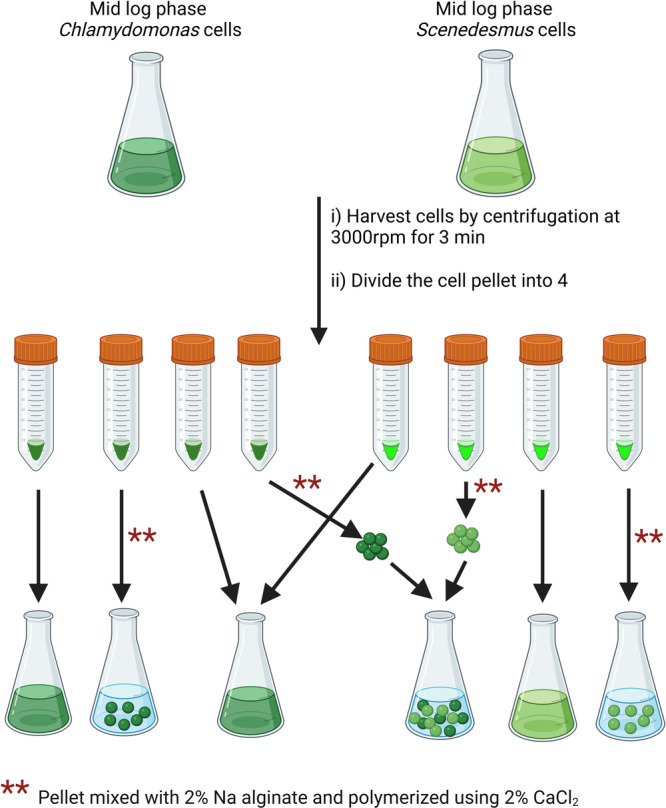
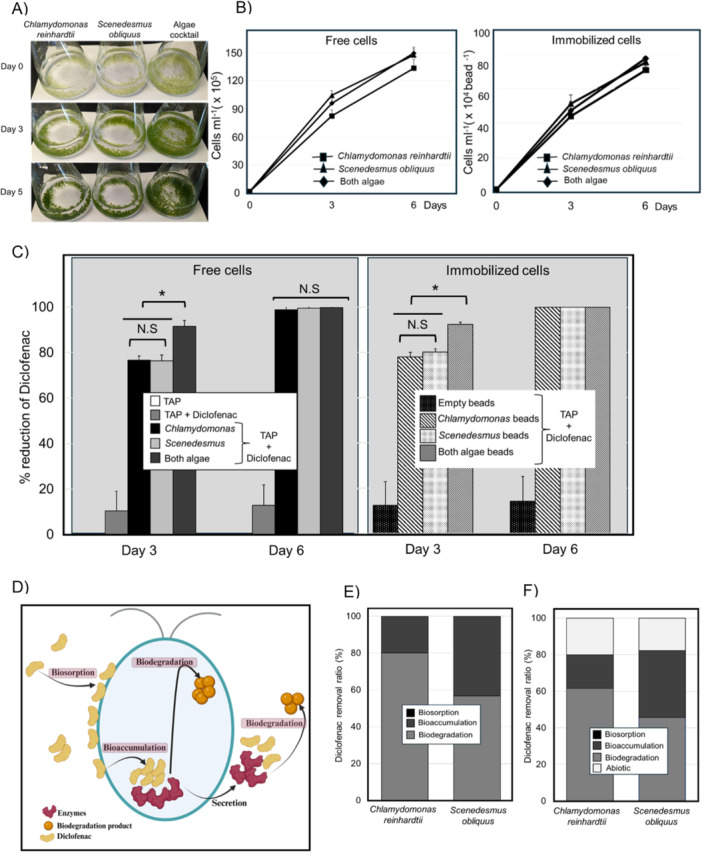
Diclofenac (DCF), a commonly used anti-inflammatory medication, presents environmental concerns due to its presence in water bodies, resistance to conventional wastewater treatment methods, and detection at increasing concentrations (ng/L to µg/L) that highlight DCF as a global emerging pollutant. While microalgae have been effective in degrading DCF in wastewater, immobilization into a matrix offers a promising approach to enhance treatment retention and efficiency. This study aimed to evaluate the efficacy of DCF removal using immobilized freshwater microalgae. Two algal species, Chlamydomonas reinhardtii (Chlamydomonas) and Scenedesmus obliquus (Scenedesmus), were tested for 6 days in both free and immobilized forms to determine if immobilized algae could degrade DCF comparably to free cells. The findings indicate that by Day 3, immobilized Chlamydomonas and Scenedesmus removed 78.0% and 80.1% of DCF, outperforming free-cell cultures. Mixed cultures demonstrated synergistic effects, with removal amounts of 91.4% for free and 92.3% for immobilized systems. By Day 6, all conditions achieved complete DCF removal (100%). Mechanistic analysis showed 80.0% biodegradation and 20.0% bioaccumulation in free Chlamydomonas and 56.8% biodegradation with 43.2% bioaccumulation in Scenedesmus. Immobilization shifted pathways slightly: in Chlamydomonas, 61.6% of DCF removal occurred via biodegradation, 18.3% via bioaccumulation, and 20.1% via abiotic degradation. For Scenedesmus, immobilization achieved 45.6% biodegradation, 36.6% bioaccumulation, and 17.8% abiotic degradation, enhancing abiotic degradation while maintaining biodegradation efficiency. This research serves as a proof of concept for utilizing immobilized algae in DCF removal and suggests an avenue for improved wastewater treatment of emerging contaminants.
双氯芬酸(DCF)是一种常用的抗炎药物,因其存在于水体中、对传统废水处理方法具有抗性,且检测到的浓度不断增加(从纳克/升到微克/升),这凸显了DCF作为一种全球新兴污染物令人担忧的环境问题。虽然微藻已被证明能有效降解废水中的DCF,但固定在基质中是一种有前景的方法,可以提高处理的保留率和效率。本研究旨在评估使用固定化淡水微藻去除DCF的效果。两种藻类,莱茵衣藻(Chlamydomonas reinhardtii,简称衣藻)和斜生栅藻(Scenedesmus obliquus,简称栅藻),以游离和固定化形式进行了6天的测试,以确定固定化藻类是否能与游离细胞一样有效地降解DCF。研究结果表明,到第3天,固定化的衣藻和栅藻分别去除了78.0%和80.1%的DCF,表现优于游离细胞培养物。混合培养显示出协同效应,游离体系的去除量为91.4%,固定化体系为92.3%。到第6天,所有条件下DCF均实现了完全去除(100%)。机理分析表明,游离衣藻中80.0%的DCF通过生物降解去除,20.0%通过生物积累去除;而栅藻中56.8%通过生物降解去除,43.2%通过生物积累去除。固定化略微改变了去除途径:在衣藻中,61.6%的DCF去除是通过生物降解,18.3%通过生物积累,20.1%通过非生物降解。对于栅藻,固定化实现了45.6%的生物降解、36.6%的生物积累和17.8%的非生物降解,在保持生物降解效率的同时提高了非生物降解效率。本研究为利用固定化藻类去除DCF提供了概念验证,并为改进新兴污染物的废水处理提供了一条途径。