Liu Bingwen, Chang Jianye, Hou Dengfeng, Pan Yuchen, Li Dengao, Ruan Jue
College of Computer Science and Technology (College of Data Science), Taiyuan University of Technology, Taiyuan 030024, Shanxi, China.
Shenzhen Branch, Guangdong Laboratory for Lingnan Modern Agriculture, Genome Analysis Laboratory of the Ministry of Agriculture and Rural Affairs, Agricultural Genomics Institute at Shenzhen, Chinese Academy of Agricultural Sciences, 518120 Shenzhen, China.
Plant Phenomics. 2024 Jul 9;6:0199. doi: 10.34133/plantphenomics.0199. eCollection 2024.
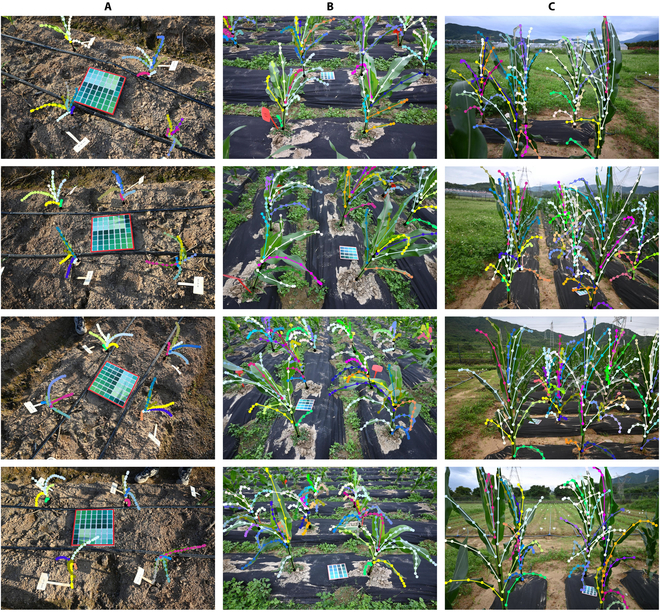
Plant phenotype detection plays a crucial role in understanding and studying plant biology, agriculture, and ecology. It involves the quantification and analysis of various physical traits and characteristics of plants, such as plant height, leaf shape, angle, number, and growth trajectory. By accurately detecting and measuring these phenotypic traits, researchers can gain insights into plant growth, development, stress tolerance, and the influence of environmental factors, which has important implications for crop breeding. Among these phenotypic characteristics, the number of leaves and growth trajectory of the plant are most accessible. Nonetheless, obtaining these phenotypes is labor intensive and financially demanding. With the rapid development of computer vision technology and artificial intelligence, using maize field images to fully analyze plant-related information can greatly eliminate repetitive labor and enhance the efficiency of plant breeding. However, it is still difficult to apply deep learning methods in field environments to determine the number and growth trajectory of leaves and stalks due to the complex backgrounds and serious occlusion problems of crops in field environments. To preliminarily explore the application of deep learning technology to the acquisition of the number of leaves and stalks and the tracking of growth trajectories in field agriculture, in this study, we developed a deep learning method called Point-Line Net, which is based on the Mask R-CNN framework, to automatically recognize maize field RGB images and determine the number and growth trajectory of leaves and stalks. The experimental results demonstrate that the object detection accuracy (mAP50) of our Point-Line Net can reach 81.5%. Moreover, to describe the position and growth of leaves and stalks, we introduced a new lightweight "keypoint" detection branch that achieved a magnitude of 33.5 using our custom distance verification index. Overall, these findings provide valuable insights for future field plant phenotype detection, particularly for datasets with dot and line annotations.
植物表型检测在理解和研究植物生物学、农业和生态学方面发挥着至关重要的作用。它涉及对植物各种物理性状和特征的量化与分析,如株高、叶片形状、角度、数量以及生长轨迹等。通过准确检测和测量这些表型性状,研究人员能够深入了解植物的生长、发育、抗逆性以及环境因素的影响,这对作物育种具有重要意义。在这些表型特征中,植物的叶片数量和生长轨迹最易于获取。然而,获取这些表型需要耗费大量人力且成本高昂。随着计算机视觉技术和人工智能的快速发展,利用玉米田图像全面分析与植物相关的信息能够极大地减少重复性劳动并提高植物育种效率。然而,由于田间环境中作物背景复杂且遮挡严重,将深度学习方法应用于田间环境以确定叶片和茎秆的数量及生长轨迹仍然困难重重。为了初步探索深度学习技术在田间农业中叶片和茎秆数量获取以及生长轨迹跟踪方面的应用,在本研究中,我们基于Mask R-CNN框架开发了一种名为点线网络(Point-Line Net)的深度学习方法,用于自动识别玉米田RGB图像并确定叶片和茎秆的数量及生长轨迹。实验结果表明,我们的点线网络的目标检测准确率(mAP50)可达81.5%。此外,为了描述叶片和茎秆的位置及生长情况,我们引入了一个新的轻量级“关键点”检测分支,使用我们自定义的距离验证指标,该分支达到了33.5的量级。总体而言,这些发现为未来的田间植物表型检测提供了有价值的见解,特别是对于具有点和线注释的数据集。