Weber Stefan Fabian, Wolf Peter, Wetzstein Nils, Küpper-Tetzel Claus, Vehreschild Maria, Suárez Isabelle, Rybniker Jan, Klingmüller Angela, Weber Tim, Güttlein Maximilian, Tobian Frank, Koeppel Lisa, Beck Julia Selena, Wolf Rebecca, Manten Katharina, Zimmermann Stefan, Christopher Devasahayam Jesudas, Herth Felix, Bélard Sabine, Denkinger Claudia M
Department for Infectious Disease and Tropical Medicine, University Hospital Heidelberg, Heidelberg, Germany.
Department for Parasitology, University Hospital Heidelberg, Heidelberg, Germany.
Open Forum Infect Dis. 2024 Dec 9;11(12):ofae651. doi: 10.1093/ofid/ofae651. eCollection 2024 Dec.
There is limited evidence on point-of-care ultrasound for tuberculosis (TB), but studies suggest high sensitivity, especially for lung ultrasound (LUS). However, insufficient data are available on specificity of the examination and its generalizability to a broader patient population.
Our study aimed to establish accuracy for lung, chest, and abdominal ultrasound, individually and in combination, for TB diagnosis.
We conducted a prospective diagnostic accuracy study among consecutive adult out- and inpatients with probable TB in three German referral hospitals. We applied a comprehensive standardized ultrasound protocol. TB diagnosis was established by a microbiological reference standard including polymerase chain reaction and culture.
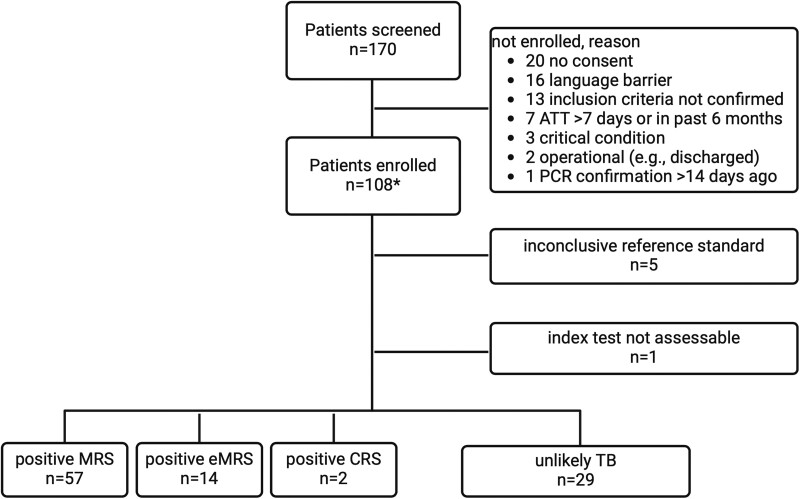
A total of 102 participants originating from 30 different countries were enrolled. HIV prevalence was 7/99 (7%) and 73/102 (72%) had confirmed TB. TB was limited to the lungs in 15/34 (44%) of refugees and 27/39 (69%) in nonrefugees. Focused assessment with sonography for HIV-associated tuberculosis had a sensitivity of 40% (95% confidence interval [CI], 30-52) and specificity of 55% (95% CI, 38-72). Additional findings, such as small subpleural consolidations on LUS had a high sensitivity (88%; 95% CI, 78-93), but a low specificity (17%; 95% CI, 8-35). Larger consolidations in the lung apices had a sensitivity of 19% (95% CI, 12-30) and a specificity of 97% (95% CI, 83-100).
Our study establishes the first data on LUS performance against a comprehensive reference standard. Overall, our data suggest that ultrasound does not meet the requirements for triage but previously described and novel ultrasound targets in combination could aid in the clinical decision making.Registry: DRKS00026636.
关于即时超声诊断结核病(TB)的证据有限,但研究表明其敏感性较高,尤其是肺部超声(LUS)。然而,关于该检查特异性及其在更广泛患者群体中的可推广性的数据不足。
我们的研究旨在确定肺部、胸部和腹部超声单独及联合用于结核病诊断的准确性。
我们在德国三家转诊医院对连续的成年疑似结核病的门诊和住院患者进行了一项前瞻性诊断准确性研究。我们应用了全面的标准化超声检查方案。结核病诊断通过包括聚合酶链反应和培养的微生物学参考标准确定。
共纳入了来自30个不同国家的102名参与者。HIV感染率为7/99(7%),73/102(72%)确诊为结核病。15/34(44%)的难民结核病局限于肺部,非难民中为27/39(69%)。针对HIV相关结核病的超声重点评估敏感性为40%(95%置信区间[CI],30 - 52),特异性为55%(95%CI,38 - 72)。其他发现,如LUS上的小胸膜下实变敏感性高(88%;95%CI,78 - 93),但特异性低(17%;95%CI,8 - 35)。肺尖较大实变的敏感性为19%(95%CI,12 - 30),特异性为97%(95%CI,83 - 100)。
我们的研究建立了关于LUS相对于全面参考标准表现的首批数据。总体而言,我们的数据表明超声不符合分诊要求,但先前描述的和新的超声靶点联合使用可能有助于临床决策。注册信息:DRKS00026636。