Amir Offer, Elbaz-Greener Gabby, Carasso Shemy, Claggett Brian, Barbarash Olga, Zaman Azfar, Christersson Christina, Kiatchoosakun Songsak, Anonuevo John, Opolski Grzegorz, Vaghaiwalla Mody F, van der Meer Peter, Zhou Yinong, Mann Douglas L, Kober Lars, Steg Gabriel, Jering Karola, Kulac Ian, De Pasquale Carmine G, McMurray John J V, Pfeffer Marc A
Department of Cardiology, Hadassah Medical Center, Jerusalem, Israel.
Faculty of Medicine, Hebrew University of Jerusalem, Jerusalem, Israel.
Eur J Heart Fail. 2025 Mar;27(3):558-565. doi: 10.1002/ejhf.3542. Epub 2024 Dec 18.
The relationship between body mass index (BMI) and clinical outcomes in patients with cardiovascular disease, including acute heart failure (AHF) and acute myocardial infarction (AMI), remains debated. This study investigates the association between BMI and clinical outcomes within the PARADISE-MI cohort, while also evaluating the impact of angiotensin receptor-neprilysin inhibitor (ARNI) versus angiotensin-converting enzyme inhibitor (ACE-I) treatment on this relationship.
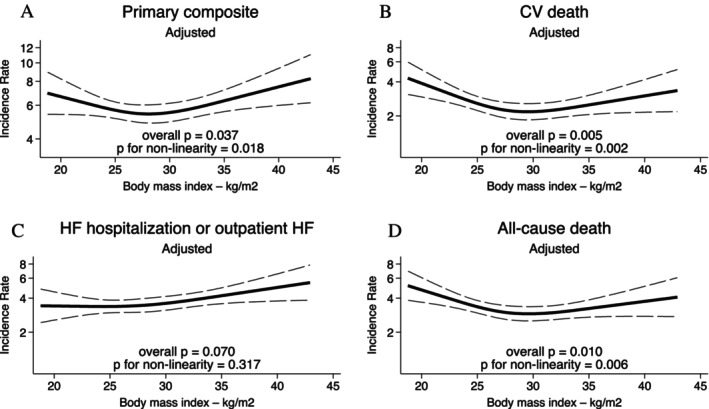
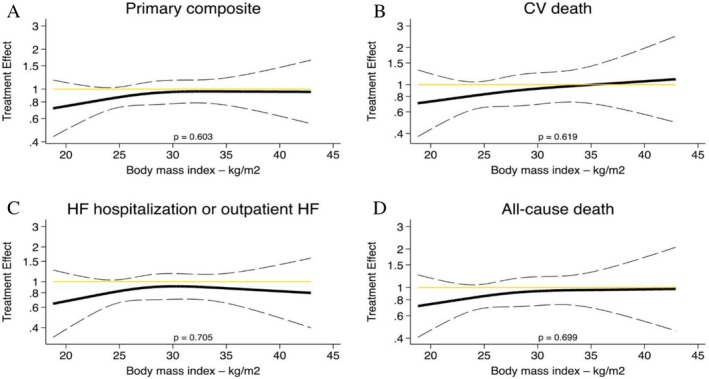
The analysis included 5589 patients from the PARADISE-MI study with available baseline BMI data. The cohort comprised patients with AMI and pulmonary congestion and/or left ventricular ejection fraction ≤40%. Patients were categorized into six World Health Organization BMI subgroups. The primary outcome of interest was the composite endpoint of cardiovascular death, heart failure (HF)-associated hospitalization, and outpatient symptomatic HF episodes. The mean baseline BMI of the cohort was 28.1 ± 5.0 kg/m. The lowest rate of the primary composite endpoint (6.2/100 patient-years) was observed in overweight patients (BMI 25-29.9 kg/m), while the highest rates were found in the lowest and highest BMI subgroups (8.4/100 patient-years for BMI <18.5 kg/m and 9.7/100 patient-years for BMI >40 kg/m). There was no significant interaction between BMI and the treatment effect of ARNI versus ACE-I on the primary composite outcome (p = 0.73). Additionally, no significant differences in the incidence of adverse events or serious adverse events were noted across the BMI subgroups.
In AMI with AHF patients, the relationship between BMI and the primary composite outcome is non-linear, with the lowest event rates observed in overweight individuals. Outcomes and safety profiles for ARNI and ACE-I treatments were similar across BMI subgroups.
体重指数(BMI)与心血管疾病患者(包括急性心力衰竭(AHF)和急性心肌梗死(AMI))临床结局之间的关系仍存在争议。本研究调查了PARADISE-MI队列中BMI与临床结局之间的关联,同时还评估了血管紧张素受体脑啡肽酶抑制剂(ARNI)与血管紧张素转换酶抑制剂(ACE-I)治疗对这种关系的影响。
分析纳入了PARADISE-MI研究中5589例有可用基线BMI数据的患者。该队列包括患有AMI且有肺充血和/或左心室射血分数≤40%的患者。患者被分为六个世界卫生组织BMI亚组。主要关注的结局是心血管死亡、心力衰竭(HF)相关住院和门诊症状性HF发作的复合终点。该队列的平均基线BMI为28.1±5.0kg/m²。在超重患者(BMI 25-29.9kg/m²)中观察到主要复合终点的发生率最低(6.2/100患者年),而在最低和最高BMI亚组中发生率最高(BMI<18.5kg/m²为8.4/100患者年,BMI>40kg/m²为9.7/100患者年)。BMI与ARNI与ACE-I治疗对主要复合结局的治疗效果之间没有显著交互作用(p = 0.73)。此外,在BMI亚组中,不良事件或严重不良事件的发生率没有显著差异。
在伴有AHF的AMI患者中,BMI与主要复合结局之间的关系是非线性的,超重个体的事件发生率最低。ARNI和ACE-I治疗在BMI亚组中的结局和安全性相似。