Frișan Alexandra-Cătălina, Simonescu Marius, Lazăr Mihai-Andrei, Crișan Simina, Mornoș Aniko, Șoșdean Raluca, Morar Andreea-Roxana, Brie Daniel-Miron, Luca Constantin-Tudor, Mornoș Cristian
Cardiology Department, "Victor Babeș" University of Medicine and Pharmacy, 2 Eftimie Murgu Square, 300041 Timișoara, Romania.
Research Center of the Institute of Cardiovascular Diseases Timisoara, 13A Gheorghe Adam Street, 300310 Timișoara, Romania.
Diagnostics (Basel). 2025 Jun 14;15(12):1512. doi: 10.3390/diagnostics15121512.
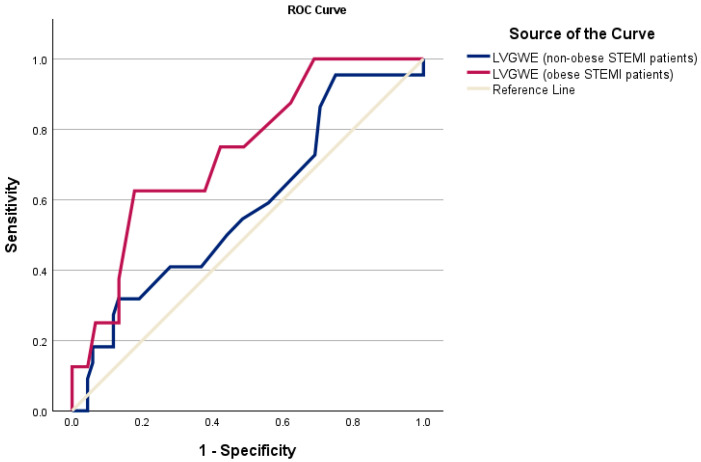
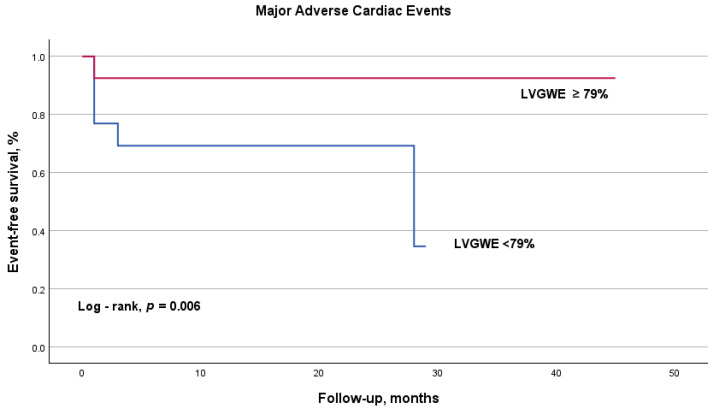
Obesity is increasingly common among patients with acute ST-segment elevation myocardial infarction (STEMI), potentially influencing both clinical evaluation and outcomes. Traditional echocardiographic metrics may be suboptimal for prognosis estimation in this population. Left ventricular myocardial work (LVMW) represents an emerging, load-adjusted marker of myocardial performance. This study aimed to assess the prognostic relevance of LVMW in obese STEMI patients. A total of 143 patients presenting with STEMI were prospectively enrolled and categorized based on their obesity status (body mass index ≥30 kg/m). LVMW parameters were measured using echocardiography within 72 ± 24 h of hospital admission. The patients were monitored for major adverse cardiovascular events (MACE), defined as cardiovascular death, malignant ventricular arrhythmias, or unplanned hospitalizations due to heart failure or acute coronary syndrome. During a median follow-up of 13 months (interquartile range: 6-28 months), MACE occurred in 30 patients (21%). Among obese individuals, left ventricular global work efficiency (LVGWE) emerged as the most robust predictor of adverse events, with an area under the receiver operating characteristic curve of 0.736 (95% confidence interval [CI]: 0.559-0.914; = 0.009). A threshold value of 79% for LVGWE was identified as optimal for predicting MACE. Kaplan-Meier analysis revealed significantly lower event rates in obese patients with LVGWE ≥79% (log-rank = 0.006). In univariate Cox regression analysis, LVGWE <79% was associated with a markedly elevated risk of MACE in obese patients (hazard ratio [HR] = 5.59; 95% CI: 1.33-23.50; = 0.019), and remained a significant predictor in the overall cohort (HR = 2.73; 95% CI: 1.26-5.90; = 0.010). LVGWE demonstrates strong prognostic utility in STEMI, particularly among obese patients. The incorporation of myocardial work indices into routine evaluation may enhance risk stratification and guide management in this high-risk subgroup.
肥胖在急性ST段抬高型心肌梗死(STEMI)患者中越来越常见,可能会影响临床评估和预后。传统的超声心动图指标在评估该人群的预后时可能并不理想。左心室心肌做功(LVMW)是一种新兴的、经负荷调整的心肌功能标志物。本研究旨在评估LVMW在肥胖STEMI患者中的预后相关性。前瞻性纳入了143例STEMI患者,并根据其肥胖状况(体重指数≥30kg/m²)进行分类。在入院72±24小时内使用超声心动图测量LVMW参数。对患者进行主要不良心血管事件(MACE)监测,MACE定义为心血管死亡、恶性室性心律失常或因心力衰竭或急性冠状动脉综合征而进行的非计划性住院治疗。在中位随访13个月(四分位间距:6 - 28个月)期间,30例患者(21%)发生了MACE。在肥胖个体中,左心室整体做功效率(LVGWE)成为不良事件最有力的预测指标,其受试者工作特征曲线下面积为0.736(95%置信区间[CI]:0.559 - 0.914;P = 0.009)。LVGWE的阈值为79%被确定为预测MACE的最佳值。Kaplan - Meier分析显示,LVGWE≥79%的肥胖患者事件发生率显著较低(对数秩检验P = 0.006)。在单因素Cox回归分析中,LVGWE <79%与肥胖患者发生MACE的风险显著升高相关(风险比[HR] = 5.59;95% CI:1.33 - 23.50;P = 0.019),并且在整个队列中仍然是一个显著的预测指标(HR = 2.73;95% CI:1.26 - 5.90;P = 0.010)。LVGWE在STEMI患者中具有很强的预后评估价值,尤其是在肥胖患者中。将心肌做功指标纳入常规评估可能会改善该高危亚组的风险分层并指导治疗。