Li Siyue, Wong Thomson W L, Ng Shamay S M
Department of Rehabilitation Sciences, The Hong Kong Polytechnic University, Hong Kong, SAR, China.
CNS Neurosci Ther. 2024 Dec;30(12):e70142. doi: 10.1111/cns.70142.
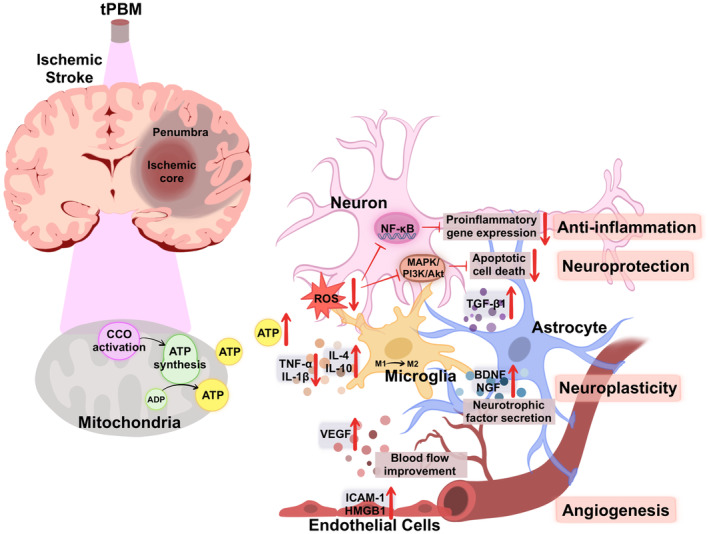
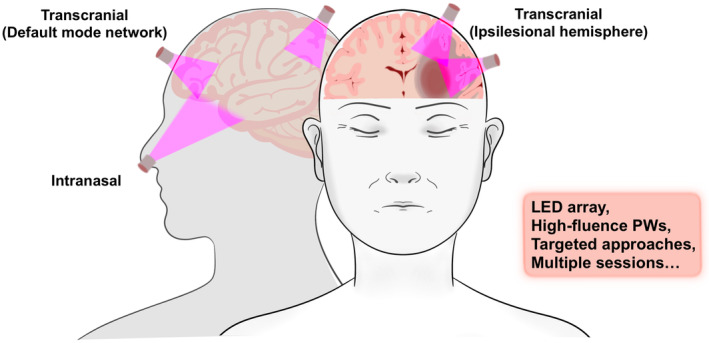
Photobiomodulation (PBM), also known as low-level laser therapy, employs red or near-infrared light emitted from a laser or light-emitting diode for the treatment of various conditions. Transcranial PBM (tPBM) is a form of PBM that is delivered to the head to improve brain health, as tPBM enhances mitochondrial function, improves antioxidant responses, reduces inflammation, offers protection from apoptosis, improves blood flow, increases cellular energy production, and promotes neurogenesis and neuroplasticity. As such, tPBM holds promise as a treatment for stroke. This review summarizes recent findings on tPBM as a treatment for stroke, presenting evidence from both animal studies and clinical trials that demonstrate its efficacy. Additionally, it discusses the potential and challenges encountered in the translation process. Furthermore, it proposes new technologies and directions for the development of light-delivery methods and emphasizes the need for extensive studies to validate and widen the application of tPBM in future treatments for stroke.
光生物调节疗法(PBM),也称为低强度激光疗法,采用激光或发光二极管发出的红色或近红外光来治疗各种病症。经颅光生物调节疗法(tPBM)是光生物调节疗法的一种形式,通过作用于头部来改善大脑健康,因为经颅光生物调节疗法可增强线粒体功能、改善抗氧化反应、减轻炎症、提供抗细胞凋亡保护、改善血流、增加细胞能量生成,并促进神经发生和神经可塑性。因此,经颅光生物调节疗法有望成为治疗中风的一种方法。本综述总结了经颅光生物调节疗法治疗中风的最新研究结果,展示了来自动物研究和临床试验的证据,证明了其有效性。此外,还讨论了转化过程中遇到的潜力和挑战。此外,提出了光传递方法开发的新技术和方向,并强调需要进行广泛研究,以验证和扩大经颅光生物调节疗法在未来中风治疗中的应用。