Zhao Lianzi, Zhang Louzheng, Hu Yiwen, Zhong Yang
Department of Radiation Oncology, Fudan University Shanghai Cancer Center, Shanghai, China.
Department of Oncology, Shanghai Medical College, Fudan University, Shanghai, China.
J Appl Clin Med Phys. 2025 Apr;26(4):e14619. doi: 10.1002/acm2.14619. Epub 2024 Dec 18.
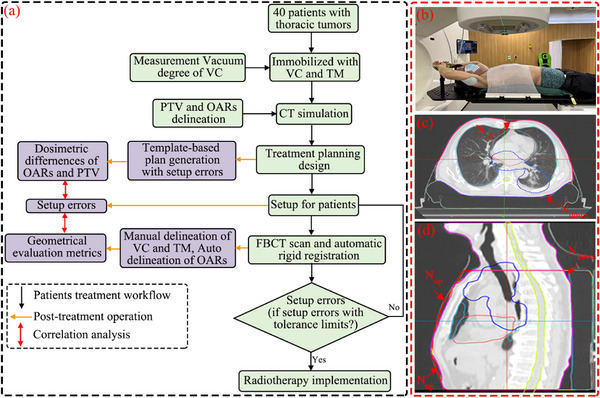
Immobilization devices are essential for maintaining accurate and repeatable patient positioning in radiotherapy. This study aimed to evaluate the setup errors and dosimetric deviation induced by the deformation of immobilization devices in thoracic cancer radiotherapy using CT-linac.
A retrospective analysis was conducted on 40 thoracic cancer patients who underwent radiotherapy, using vacuum cushion (VC) and thermoplastic mask (TM) for immobilization. A total of 206 weekly Fan-beam CT (FBCT) images (4-7 per patient) were analyzed to manually delineate immobilization devices and assess their geometric deformations against setup errors. Dosimetric deviations between the clinical plan (CT-plan) and the delivered plan (FBCT-plan) were compared for planning target volume (PTV) and organs at risk (OARs). Correlations between dose variations and setup errors were analyzed in lateral (LAT), longitudinal (LNG), and vertical (VRT) axes.
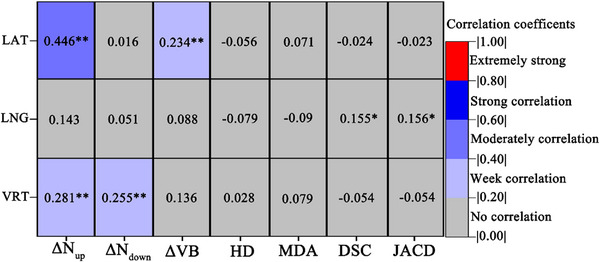
The conformity of the VC (N) and TM (N) with the patient in simulation CT exhibited moderate to strong correlations with VRT setup errors (N: r = -0.484, p < 0.01;N: r = -0.697, p < 0.01). However, intra-fraction deformation of immobilization devices (in FBCT) showed no significant correlation with setup errors. In the dosimetric analysis of OARs, lung dose parameters (D, V, V) and heart D exhibited a consistent absolute difference with increasing setup errors. Dose variation decreased significantly when errors exceeded 5 mm, particularly in the VRT direction for most PTV indices, with the exception of CI and HI. Spinal cord D variation correlated significantly with setup accuracy along the LNG axis, but not along other axes.
The conformity of immobilization devices in simulation CT exhibits a stronger correlation with setup accuracy than the deformation of these devices in intra-fraction FBCT. FBCT is recommended for improving treatment precision through dosimetric assessment and planning adjustments.
在放射治疗中,固定装置对于维持患者精确且可重复的体位至关重要。本研究旨在评估使用CT直线加速器进行胸段癌放疗时,固定装置变形所引起的摆位误差和剂量学偏差。
对40例行放疗的胸段癌患者进行回顾性分析,使用真空垫(VC)和热塑性面罩(TM)进行固定。共分析了206张每周的扇形束CT(FBCT)图像(每位患者4 - 7张),以手动勾勒固定装置并评估其相对于摆位误差的几何变形。比较了临床计划(CT计划)与实际照射计划(FBCT计划)在计划靶区(PTV)和危及器官(OARs)方面的剂量学偏差。分析了在横向(LAT)轴、纵向(LNG)轴和垂直(VRT)轴上剂量变化与摆位误差之间的相关性。
在模拟CT中,VC(N)和TM(N)与患者的贴合度与VRT摆位误差呈现中度至高度相关性(N:r = -0.484,p < 0.01;N:r = -0.697,p < 0.01)。然而,固定装置在分次内(FBCT中)的变形与摆位误差无显著相关性。在OARs的剂量学分析中,肺剂量参数(D、V、V)和心脏D随着摆位误差增加呈现一致的绝对差异。当误差超过5 mm时,剂量变化显著降低,特别是对于大多数PTV指标在VRT方向上,CI和HI除外。脊髓D变化与LNG轴方向的摆位精度显著相关,但与其他轴无关。
模拟CT中固定装置的贴合度与摆位精度的相关性比分次内FBCT中这些装置的变形更强。建议使用FBCT通过剂量学评估和计划调整来提高治疗精度。