Raj Desh, Nair Abhilash Vijay, Singh Anmol, Basu Swarnali, Sarkar Kabita, Sharma Jyotsna, Sharma Shiva, Sharma Sanmi, Rathore Manisha, Singh Shriya, Prakash Shakti, Sahu Shikha, Kaushik Aman Chandra, Siddiqi Mohammad Imran, Ghoshal Uday C, Chandra Tulika, Bhosale Vivek, Dasgupta Arunava, Gupta Shashi Kumar, Verma Sonia, Guha Rajdeep, Chakravortty Dipshikha, Ammanathan Veena, Lahiri Amit
Pharmacology Division, CSIR-Central Drug Research Institute, Lucknow, India.
Academy of Scientific and Innovative Research (AcSIR), Ghaziabad, India.
EMBO Rep. 2025 Feb;26(3):656-689. doi: 10.1038/s44319-024-00328-x. Epub 2024 Dec 18.
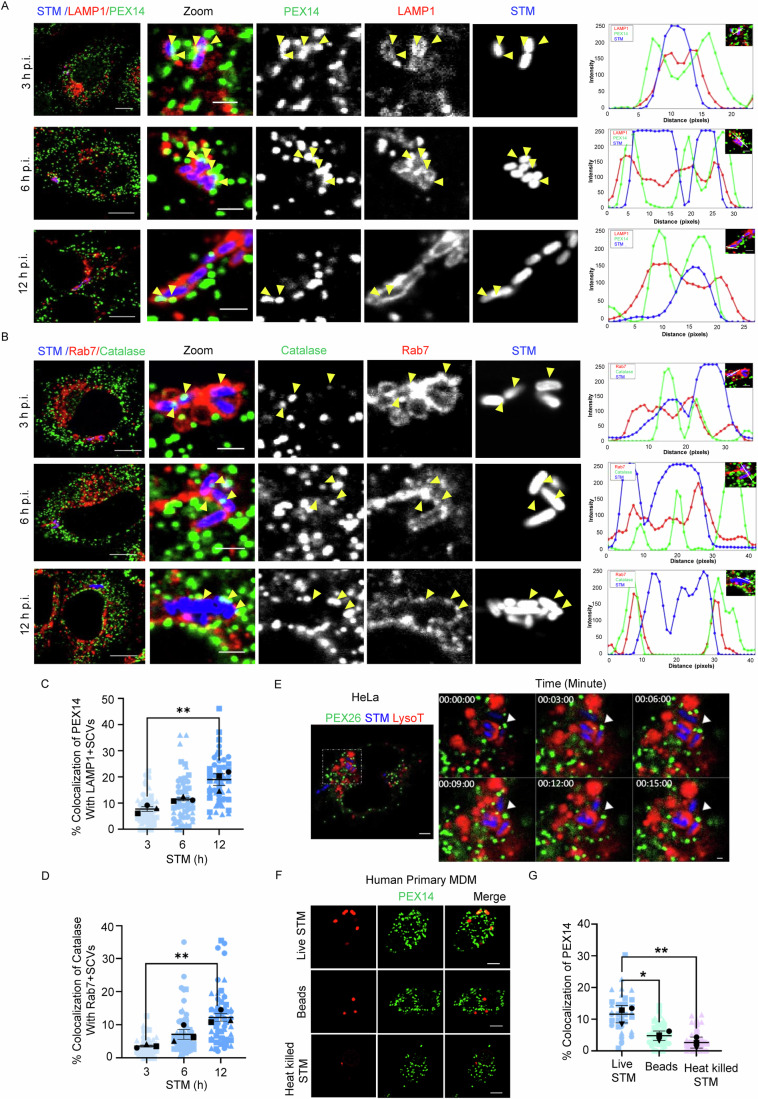
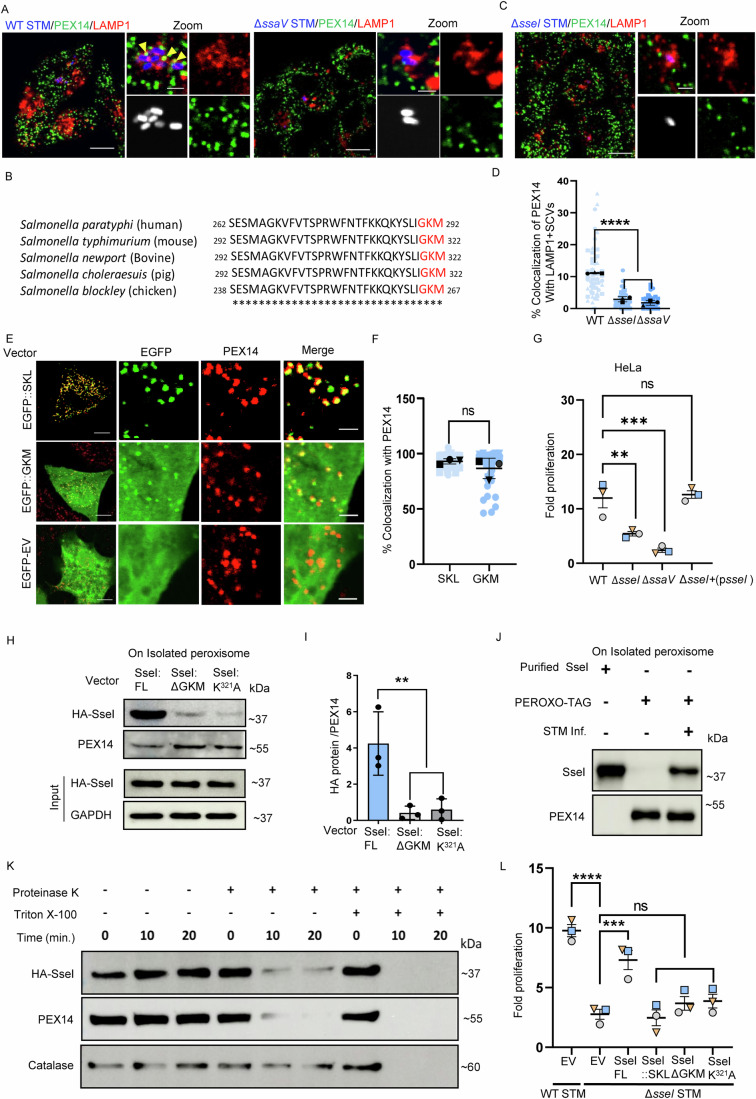
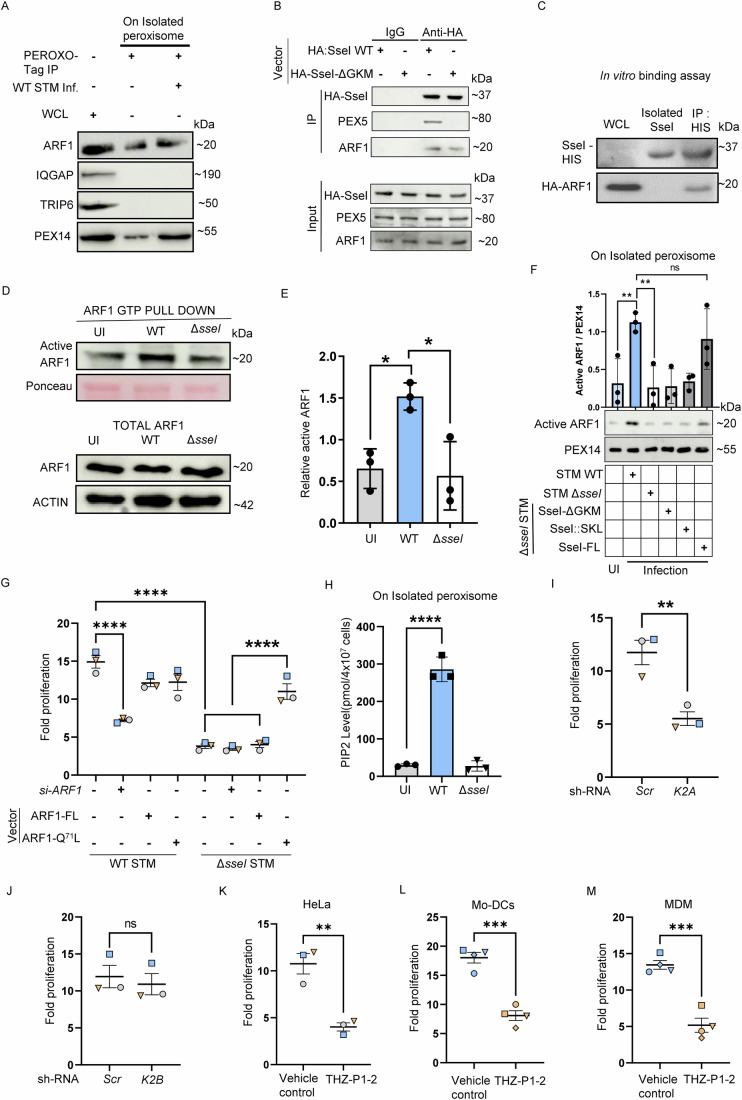
Salmonella enterica serotype Typhimurium (Salmonella) resides and multiplies intracellularly in cholesterol-rich compartments called Salmonella-containing vacuoles (SCVs) with actin-rich tubular extensions known as Salmonella-induced filaments (SIFs). SCV maturation depends on host-derived cholesterol, but the transport mechanism of low-density lipoprotein (LDL)-derived cholesterol to SCVs remains unclear. Here we find that peroxisomes are recruited to SCVs and function as pro-bacterial organelle. The Salmonella effector protein SseI is required for the interaction between peroxisomes and the SCV. SseI contains a variant of the PTS1 peroxisome-targeting sequence, GKM, localizes to the peroxisomes and activates the host Ras GTPase, ADP-ribosylation factor-1 (ARF-1). Activation of ARF-1 leads to the recruitment of phosphatidylinsolitol-5-phosphate-4 kinase and the generation of phosphatidylinsolitol-4-5-bisphosphate on peroxisomes. This enhances the interaction of peroxisomes with lysosomes and allows for the transfer of lysosomal cholesterol to SCVs using peroxisomes as a bridge. Salmonella infection of peroxisome-depleted cells leads to the depletion of cholesterol on the SCVs, resulting in reduced SIF formation and bacterial proliferation. Taken together, our work identified peroxisomes as a target of Salmonella secretory effectors, and as conveyance of host cholesterol to enhance SCV stability, SIF integrity, and intracellular bacterial growth.
肠炎沙门氏菌血清型鼠伤寒沙门氏菌(沙门氏菌)在富含胆固醇的区室中定殖并在细胞内繁殖,这些区室称为含沙门氏菌液泡(SCV),具有富含肌动蛋白的管状延伸,称为沙门氏菌诱导的细丝(SIF)。SCV的成熟取决于宿主来源的胆固醇,但低密度脂蛋白(LDL)衍生的胆固醇向SCV的转运机制仍不清楚。在这里,我们发现过氧化物酶体被招募到SCV并作为促细菌细胞器发挥作用。过氧化物酶体与SCV之间的相互作用需要沙门氏菌效应蛋白SseI。SseI包含PTS1过氧化物酶体靶向序列的变体GKM,定位于过氧化物酶体并激活宿主Ras GTP酶、ADP-核糖基化因子-1(ARF-1)。ARF-1的激活导致磷脂酰肌醇-5-磷酸-4激酶的募集以及过氧化物酶体上磷脂酰肌醇-4,5-二磷酸的生成。这增强了过氧化物酶体与溶酶体的相互作用,并允许使用过氧化物酶体作为桥梁将溶酶体胆固醇转移到SCV。过氧化物酶体缺失细胞的沙门氏菌感染导致SCV上胆固醇的消耗,导致SIF形成减少和细菌增殖。综上所述,我们的工作确定过氧化物酶体是沙门氏菌分泌效应器的靶标,并且作为宿主胆固醇的转运载体以增强SCV稳定性、SIF完整性和细胞内细菌生长。