Atherly Adam, van den Broek-Altenburg Eline, Jacobs Alicia, Mueller Josiah, Wulfman Carrie, van Eeghen Constance
Department of Health Administration, College of Health Professions, Virginia Commonwealth University, 900 E. Leigh St, Richmond, VA, 23219, USA.
Department of Radiology, Larner College of Medicine, University of Vermont, Burlington, VT, USA.
BMC Health Serv Res. 2024 Dec 18;24(1):1562. doi: 10.1186/s12913-024-11983-0.
Most approaches to healthcare reform envision an enhanced role for primary care providers, supported by innovative payment methodology and improved resources. However, there are currently no instruments to measure providers' ability and willingness to work with existing tools provided by payers, such as Accountable Care Organizations (ACO). In this study, we develop and psychometrically test a new instrument to measure provider engagement with ACOs.
METHODOLOGY/ APPROACH: The instrument was developed based on a self-efficacy theory of the adoption of innovations. We hypothesized two underlying constructs: Ease of Use ("Ease") and Perceived Usefulness ("Usefulness"). Constructs were tested using confirmatory factor analysis. Reliability was assessed with Cronbach's Alpha and convergent and divergent validity. Survey subjects were Primary Care Providers engaged with an ACO.
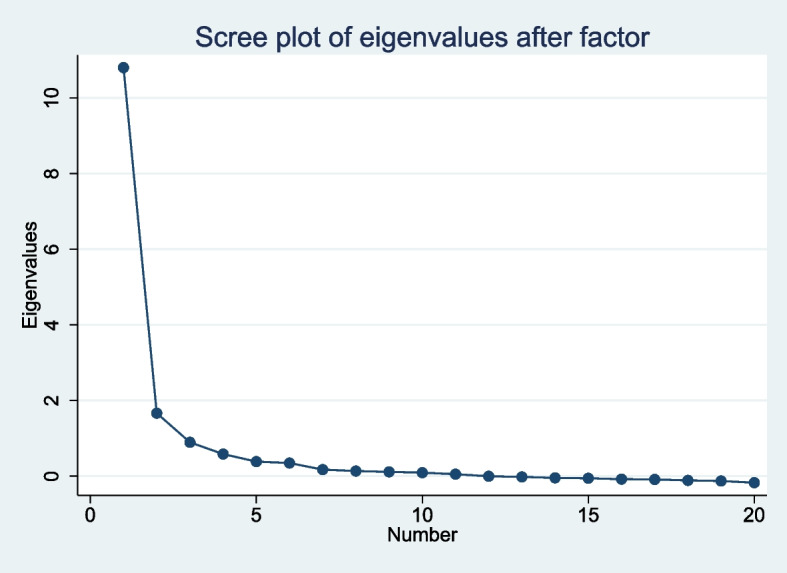
Eigenvalue and scree plots indicated the hypothesized two factor model was appropriate. Four questions failed to load onto a single factor - three from Ease and one from Usefulness. Both scales have outstanding reliability, with an Alpha of 0.951 for Usefulness and 0.831 for Ease. For validity, the results are consistent with our prior hypotheses for convergent and divergent validity.
The new instrument is a valid and reliable measure of providers' ability to work with and gain value from ACO participation.
The success of any health care reform will be highly dependent on primary care providers' willingness and ability to engage with payers. This instrument provides a new tool to measure the value and difficulty of that engagement by primary care providers.
大多数医疗改革方法都设想通过创新的支付方式和改善资源,增强初级保健提供者的作用。然而,目前尚无工具来衡量提供者使用诸如 accountable care organizations(ACO)等支付方提供的现有工具的能力和意愿。在本研究中,我们开发并对一种新工具进行了心理测量测试,以衡量提供者与ACO的合作情况。
方法/途径:该工具基于创新采用的自我效能理论开发。我们假设了两个潜在结构:易用性(“易用性”)和感知有用性(“有用性”)。使用验证性因子分析对结构进行测试。使用Cronbach's Alpha评估可靠性以及收敛效度和区分效度。调查对象是参与ACO的初级保健提供者。
特征值和碎石图表明假设的双因素模型是合适的。有四个问题未能加载到单个因素上——三个来自易用性,一个来自有用性。两个量表都具有出色的可靠性,有用性量表的Alpha值为0.951,易用性量表的Alpha值为0.831。对于效度,结果与我们先前关于收敛效度和区分效度的假设一致。
新工具是衡量提供者与ACO合作并从中获得价值的能力的有效且可靠的指标。
任何医疗改革的成功都将高度依赖于初级保健提供者与支付方合作的意愿和能力。该工具提供了一种新方法来衡量初级保健提供者这种合作的价值和难度。