Rangel Juliana Melo Linhares, do Nascimento André Luiz Borba, Ramos Marcelo Alves
Departamento de Biologia, Programa de Pós-Graduação Em Etnobiologia E Conservação da Natureza, Universidade Federal Rural de Pernambuco, Rua Dom Manuel de Medeiros, Recife, PE, 52171-900, Brazil.
Laboratório de Estudos Etnobiológicos, Departamento de Ciências Biológicas, Universidade de Pernambuco, Rua Amaro Maltês de Farias, Nazaré da Mata, PE, 55800-000, Brazil.
J Ethnobiol Ethnomed. 2024 Dec 18;20(1):106. doi: 10.1186/s13002-024-00747-z.
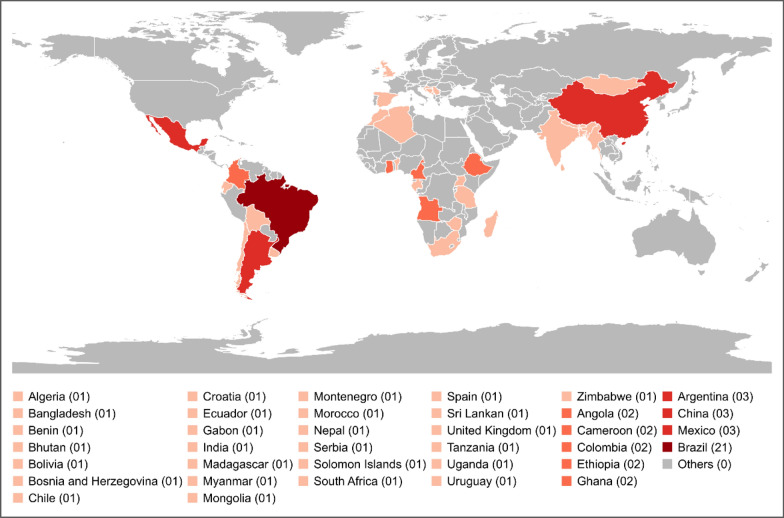
Urbanization is a complex and multifaceted process studied across various scientific disciplines. However, in ethnobiology, research on the impacts of urbanization on local ecological knowledge (LEK) often lacks standardization and tends to focus primarily on local scales. This study aims to systematically characterize how researchers address urbanization in ethnobiology and assess its effects on LEK globally. We conducted a systematic review using the PRISMA protocol and selected 66 studies from the Web of Science and Scopus databases for analysis. Our findings reveal that researchers often do not adopt a consistent definition of urbanization, frequently framing their study areas within a simplistic urban-rural dichotomy. Although some studies used urbanization indicators, our qualitative analyses, including a correlation matrix, showed that these indicators were largely independent of each other. Additionally, principal component analysis (PCA) with clustering identified four groupings among the indicators, yet with low correlations between them. A t test analysis of the 66 papers shows that urbanization generally has a negative impact on LEK. Based on these findings, we emphasize the critical need for standardized urbanization indicators in ethnobiological studies and propose a new approach for characterizing urbanization, which will enhance the precision and relevance of future research in this field.
城市化是一个复杂且多面的过程,各个科学学科都在对其进行研究。然而,在民族生物学中,关于城市化对地方生态知识(LEK)影响的研究往往缺乏标准化,并且主要集中在地方层面。本研究旨在系统地描述民族生物学领域的研究人员如何探讨城市化问题,并评估其在全球范围内对地方生态知识的影响。我们使用PRISMA协议进行了一项系统综述,并从科学网和Scopus数据库中选取了66项研究进行分析。我们的研究结果表明,研究人员通常没有采用一致的城市化定义,经常在简单的城乡二分法框架内界定其研究区域。尽管一些研究使用了城市化指标,但我们包括相关矩阵在内的定性分析表明,这些指标在很大程度上相互独立。此外,通过聚类进行的主成分分析(PCA)在指标中识别出四个分组,但它们之间的相关性较低。对这66篇论文的t检验分析表明,城市化总体上对地方生态知识有负面影响。基于这些发现,我们强调民族生物学研究中对标准化城市化指标的迫切需求,并提出一种描述城市化的新方法,这将提高该领域未来研究的准确性和相关性。