Silva Patrick J, Rahimzadeh Vasiliki, Powell Reid, Husain Junaid, Grossman Scott, Hansen Adam, Hinkel Jennifer, Rosengarten Rafael, Ory Marcia G, Ramos Kenneth S
Texas A&M Health, School of Medicine, Health Professions Education Building 8447 Riverside Pkwy, Bryan, TX, 77807, United States of America.
Texas A&M Institute for Bioscience and Technology, 2121 W. Holcombe Blvd, Houston, TX, 77030, United States of America.
Health Res Policy Syst. 2024 Dec 19;22(1):170. doi: 10.1186/s12961-024-01258-9.
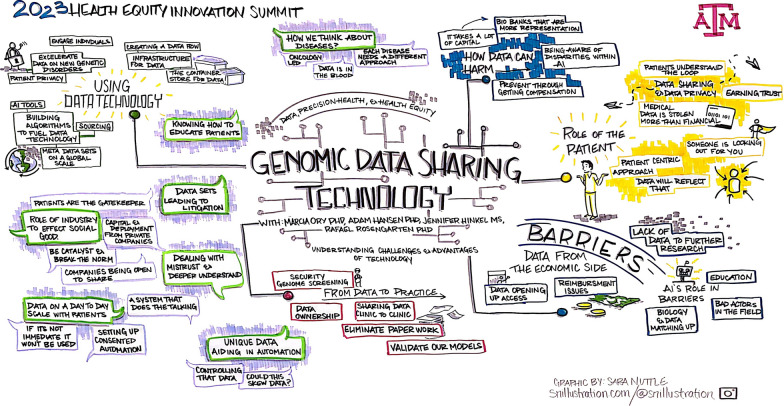
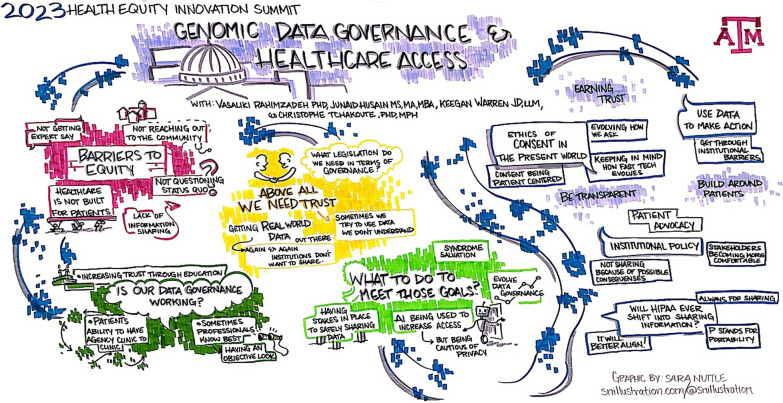
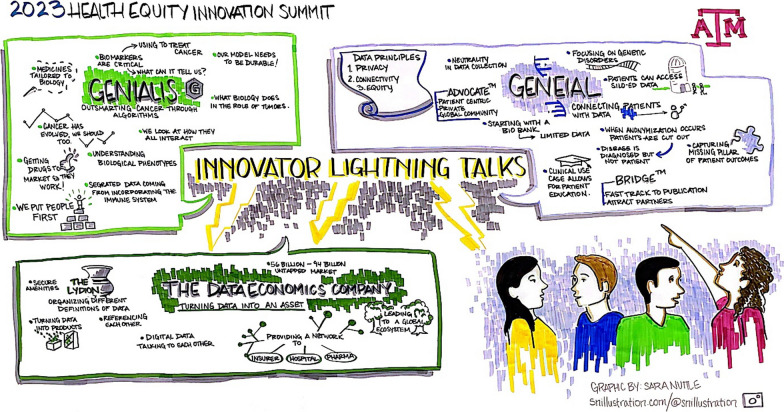
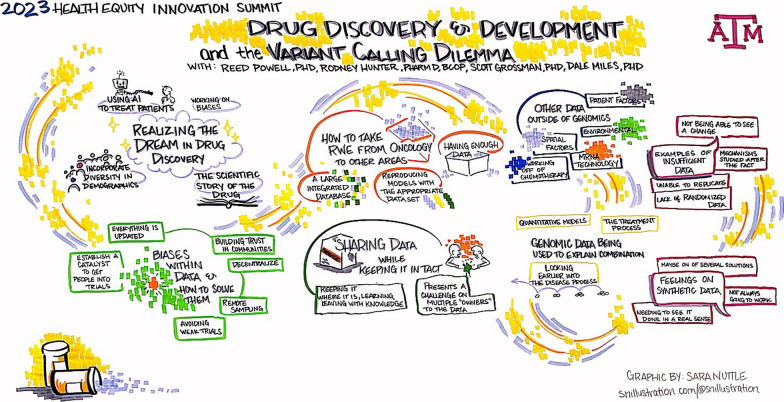
Most forms of clinical research examine a very minute cross section of the patient journey. Much of the knowledge and evidence base driving current genomic medicine practice entails blind spots arising from underrepresentation and lack of research participation in clinicogenomic databases. The flaws are perpetuated in AI models and clinical practice guidelines that reflect the lack of diversity in data being used. Participation in clinical research and biobanks is impeded in many populations due to a variety of factors that include knowledge, trust, healthcare access, administrative barriers, and technology gaps. A recent symposium brought industry, clinical, and research participants in clinicogenomics to discuss practical challenges and potential for new data sharing models that are patient centric and federated in nature and can address health disparities that might be perpetuated by lack of diversity in clinicogenomic research, biobanks, and datasets. Clinical data governance was recognized as a multiagent problem, and governance practices need to be more patient centric to address most barriers. Digital tools that preserve privacy, document provenance, and enable the management of data as intellectual property have great promise. Policy updates realigning and rationalizing clinical data governance practices are warranted.
大多数形式的临床研究只考察了患者就医过程中非常微小的一个横截面。目前推动基因组医学实践的许多知识和证据基础存在盲点,这些盲点源于临床基因组数据库代表性不足以及缺乏研究参与。这些缺陷在人工智能模型和临床实践指南中持续存在,反映出所使用数据缺乏多样性。由于包括知识、信任、医疗服务可及性、行政障碍和技术差距等多种因素,许多人群参与临床研究和生物样本库的积极性受到阻碍。最近的一次研讨会汇聚了临床基因组学领域的行业、临床和研究参与者,讨论以患者为中心、本质上是联合式的新数据共享模型所面临的实际挑战和潜力,这些模型能够解决因临床基因组研究、生物样本库和数据集缺乏多样性而可能长期存在的健康差异问题。临床数据治理被视为一个多主体问题,治理实践需要更加以患者为中心,以克服大多数障碍。能够保护隐私、记录数据来源并实现数据作为知识产权进行管理的数字工具具有巨大潜力。有必要更新政策,调整和理顺临床数据治理实践。