Stanaway Ian B, Morrell Eric D, Mabrey F Linzee, Sathe Neha A, Bailey Zoie, Speckmaier Sarah, Lo Jordan, Zelnick Leila R, Himmelfarb Jonathan, Mikacenic Carmen, Evans Laura, Wurfel Mark M, Bhatraju Pavan K
Division of Nephrology, Department of Medicine, Kidney Research Institute, University of Washington Medical Center, 325 9th Avenue, Seattle, WA, 98104, USA.
Sepsis Center of Research Excellence, SCORE-UW), University of Washington, Seattle, WA, USA.
Crit Care. 2024 Dec 18;28(1):419. doi: 10.1186/s13054-024-05202-9.
Patients with sepsis-induced AKI can be classified into two distinct sub-phenotypes (AKI-SP1, AKI-SP2) that differ in clinical outcomes and response to treatment. The biologic mechanisms underlying these sub-phenotypes remains unknown. Our objective was to understand the underlying biology that differentiates AKI sub-phenotypes and associations with kidney outcomes.
We prospectively enrolled 173 ICU patients with sepsis from a suspected respiratory infection (87 without AKI and 86 with AKI on enrollment). Among the AKI patients, 66 were classified as AKI-SP1 and 20 as AKI-SP2 using a three-plasma biomarker classifier. Aptamer-based proteomics assessed 5,212 proteins in urine collected on ICU admission. We compared urinary protein abundances between AKI sub-phenotypes, conducted pathway analyses, tested associations with risk of RRT and blood bacteremia, and predicted AKI-SP2 class membership using LASSO.
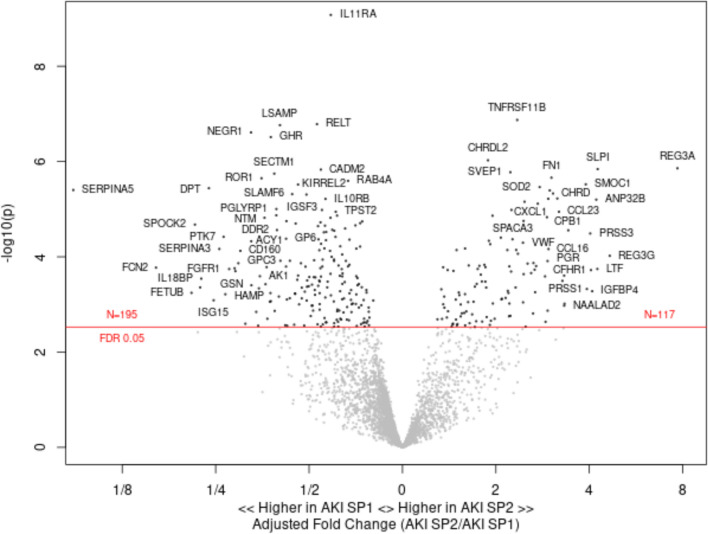
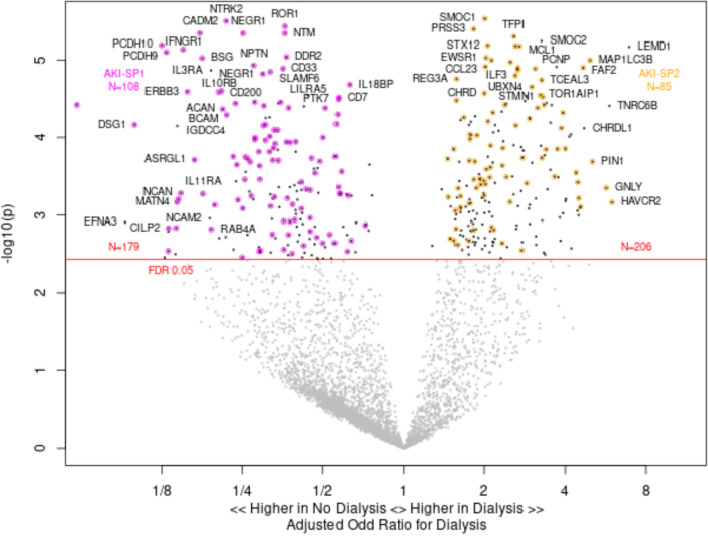
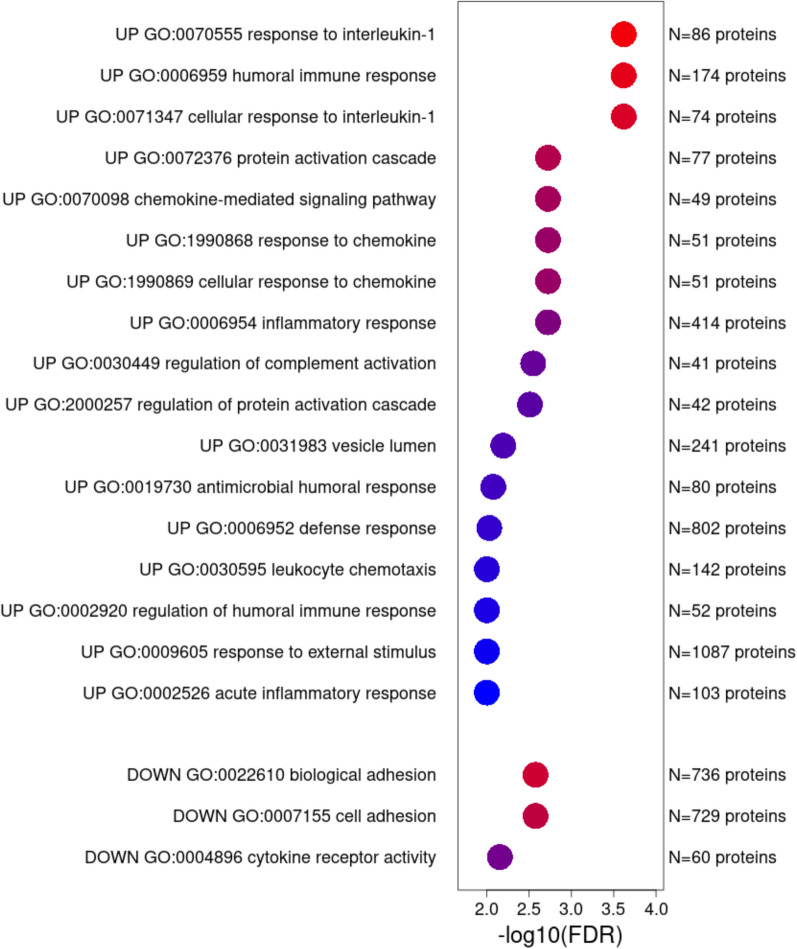
In total, 117 urine proteins were higher in AKI-SP2, 195 were higher in AKI-SP1 (FDR < 0.05). Urinary proteins involved in inflammation and chemoattractant of neutrophils and monocytes (CXCL1 and REG3A) and oxidative stress (SOD2) were abundant in AKI-SP2, while proteins involved in collagen deposition (GP6), podocyte derived (SPOCK2), proliferation of mesenchymal cells (IL11RA), anti-inflammatory (IL10RB and TREM2) were abundant in AKI-SP1. Pathways related to immune response, complement activation and chemokine signaling were upregulated in AKI-SP2 and pathways of cell adhesion were upregulated in AKI-SP1. Overlap was present between urinary proteins that differentiated AKI sub-phenotypes and proteins that differentiated risk of RRT during hospitalization. Variable correlation was found between top aptamers and ELISA based protein assays. A LASSO derived urinary proteomic model to classify AKI-SP2 had a mean AUC of 0.86 (95% CI: 0.69-0.99).
Our findings suggest AKI-SP1 is characterized by a reparative, regenerative phenotype and AKI-SP2 is characterized as an immune and inflammatory phenotype associated with blood bacteremia. We identified shared biology between AKI sub-phenotypes and eventual risk of RRT highlighting potential therapeutic targets. Urine proteomics may be used to non-invasively classify SP2 participants.
脓毒症诱导的急性肾损伤患者可分为两种不同的亚表型(AKI-SP1、AKI-SP2),其临床结局和对治疗的反应有所不同。这些亚表型背后的生物学机制尚不清楚。我们的目标是了解区分急性肾损伤亚表型的潜在生物学机制及其与肾脏结局的关联。
我们前瞻性纳入了173例因疑似呼吸道感染入住重症监护病房(ICU)的脓毒症患者(87例入院时无急性肾损伤,86例入院时患有急性肾损伤)。在急性肾损伤患者中,使用三种血浆生物标志物分类器将66例归类为AKI-SP1,20例归类为AKI-SP2。基于适体的蛋白质组学评估了ICU入院时收集尿液中的5212种蛋白质。我们比较了急性肾损伤亚表型之间的尿蛋白丰度,进行了通路分析,测试了与肾脏替代治疗(RRT)风险和血行菌血症的关联,并使用套索回归(LASSO)预测AKI-SP2的类别归属。
总体而言,AKI-SP2中有117种尿蛋白含量较高,AKI-SP1中有195种尿蛋白含量较高(错误发现率<0.05)。参与炎症、中性粒细胞和单核细胞趋化作用(CXCL1和REG3A)以及氧化应激(SOD2)的尿蛋白在AKI-SP2中含量丰富,而参与胶原蛋白沉积(GP6)、足细胞衍生(SPOCK2)、间充质细胞增殖(IL11RA)、抗炎(IL10RB和TREM2)的蛋白在AKI-SP1中含量丰富。与免疫反应、补体激活和趋化因子信号传导相关的通路在AKI-SP2中上调,而细胞黏附通路在AKI-SP1中上调。区分急性肾损伤亚表型的尿蛋白与区分住院期间肾脏替代治疗风险的蛋白之间存在重叠。在顶级适体与基于酶联免疫吸附测定(ELISA)的蛋白质检测之间发现了可变相关性。一种用于分类AKI-SP2的基于套索回归衍生的尿蛋白组学模型的平均曲线下面积(AUC)为0.86(95%置信区间:0.69-0.99)。
我们的研究结果表明,AKI-SP1的特征是具有修复、再生表型,而AKI-SP2的特征是与血行菌血症相关的免疫和炎症表型。我们确定了急性肾损伤亚表型与最终肾脏替代治疗风险之间的共同生物学机制,突出了潜在的治疗靶点。尿蛋白组学可用于对SP2参与者进行无创分类。