Liu Guixiang, Wen Jing, Lv Chunyi, Liu Mingjie, Li Min, Fang Kexia, Fei Jianwen, Zhang Nannan, Li Xuehua, Wang Huarui, Sun Yuanyuan, Zhu Ling
Department of Respiratory and Critical Care Medicine, Shandong Provincial Hospital Affiliated to Shandong First Medical University, 9677 Jing Shi Road, Jinan, 250000, Shandong, China.
Department of Pulmonary and Critical Care Medicine, Center of Respiratory Medicine, China-Japan Friendship Hospital, Chinese Academy of Medical Sciences & Peking Union Medical College, Beijing, China.
Respir Res. 2024 Dec 18;25(1):432. doi: 10.1186/s12931-024-03067-8.
Acute pulmonary embolism (APE) is a critical disease with a high mortality rate, some of the surviving patients may develop chronic thromboembolic pulmonary disease (CTEPD), which affects the patient's prognosis. However, the research on the early diagnosis of CTEPD is limited. This study aimed to establish a prediction model for earlier identification of CTEPD.
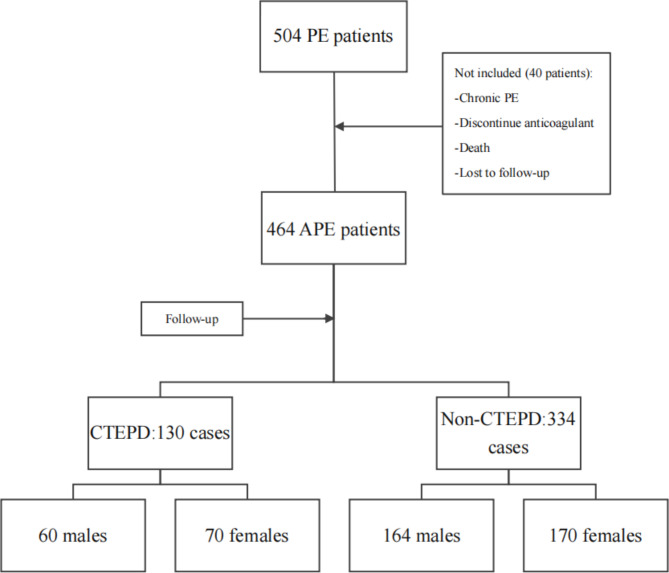
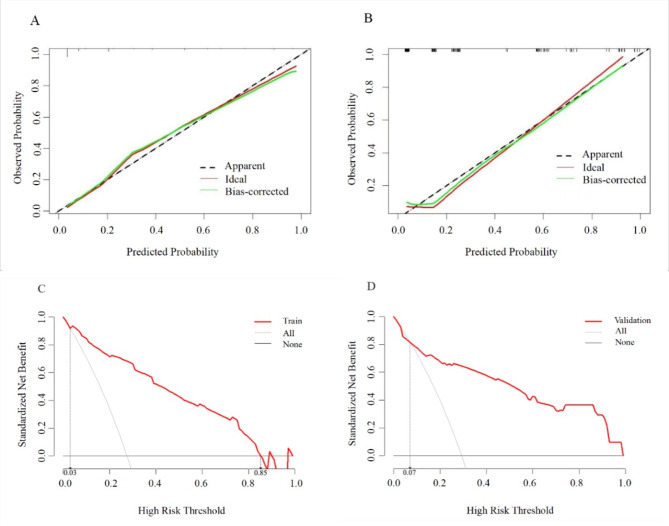
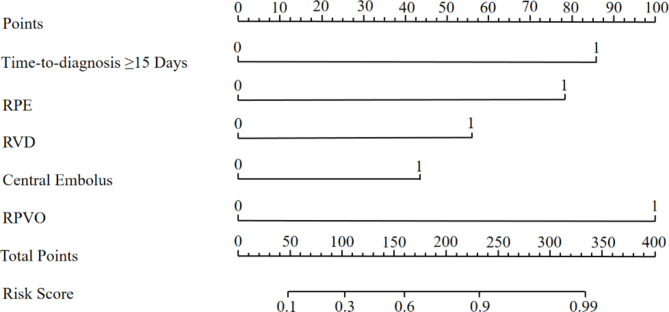
This prospective study included 464 consecutive patients with APE confirmed between January 2020 and September 2023, at 7 centers from China. After follow-up for at least 3 months, the patients were divided into the CTEPD and non-CTEPD groups based on symptoms and computed tomography pulmonary angiography (CTPA) or pulmonary ventilation perfusion (V/Q) scans showing residual thrombosis. The independent risk factors for CTEPD were identified via univariate and multivariate logistic regression analyses. Next, a nomogram of predictive model was established, and validation was completed via decision curve analysis (DCA) and receiver operating characteristic curve analysis.
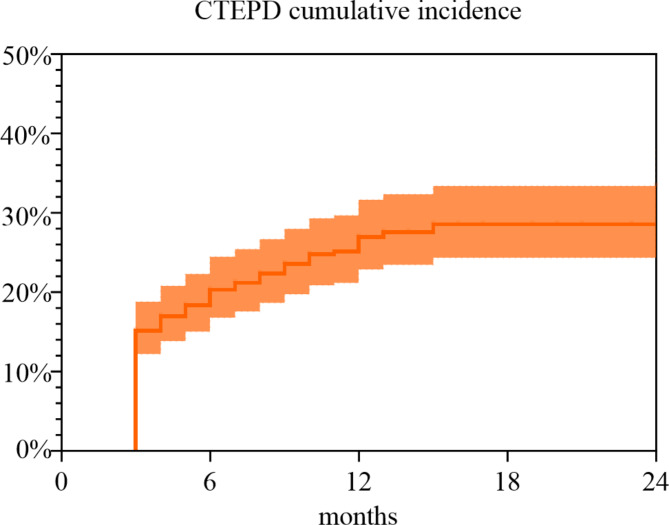
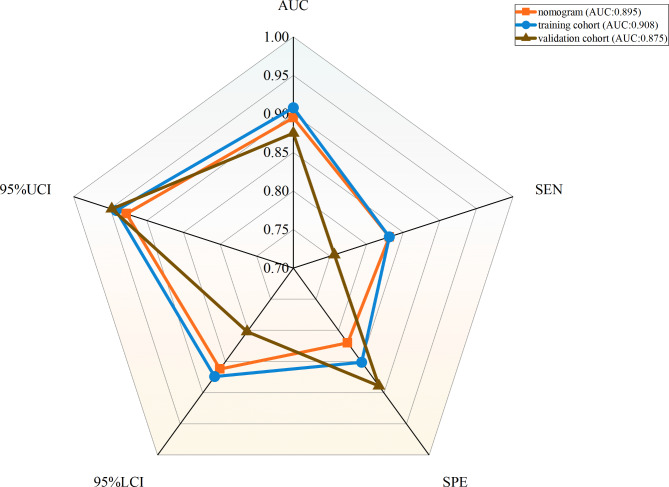
In total, 130 (28%) patients presented with CTEPD, 17% (22/130) of CTEPD patients developed chronic thromboembolic pulmonary hypertension (CTEPH). Based on the multivariate analysis, a time interval from symptoms onset to diagnosis (time-to-diagnosis) ≥ 15 days (95% confidence interval [CI]: 3.392-14.972, p < 0.001), recurrent pulmonary embolism (RPE) (95%CI: 1.560-17.300, p = 0.007), right ventricular dysfunction (RVD) (95%CI: 1.042-6.437, p = 0.040), central embolus (95%CI: 1.776-7.383, p < 0.001) and residual pulmonary vascular obstruction (RPVO) > 10% (95%CI: 4.884-21.449, p < 0.001) were identified as the independent predictors of CTEPD. Then, A prediction model with a C-index of 0.895 (95% CI 0.863-0.927) was established for high-risk patients. The nomogram had an excellent predictive performance for earlier identification of CTEPD, with an area under the curve of 0.908 (95%CI: 0.875-0.941) in the training cohort and 0.875 (95%CI: 0.803-0.947) in the validation cohort.
The current study established and validated a reliable nomogram for predicting CTEPD, which would assist clinicians identify the high-risk patients for CTEPD earlier.
急性肺栓塞(APE)是一种死亡率高的危急疾病,部分存活患者可能会发展为慢性血栓栓塞性肺疾病(CTEPD),这会影响患者的预后。然而,关于CTEPD早期诊断的研究有限。本研究旨在建立一个预测模型,以便更早地识别CTEPD。
这项前瞻性研究纳入了2020年1月至2023年9月期间在中国7个中心确诊的464例连续的APE患者。经过至少3个月的随访后,根据症状以及计算机断层扫描肺动脉造影(CTPA)或肺通气灌注(V/Q)扫描显示的残余血栓,将患者分为CTEPD组和非CTEPD组。通过单因素和多因素逻辑回归分析确定CTEPD的独立危险因素。接下来,建立预测模型的列线图,并通过决策曲线分析(DCA)和受试者工作特征曲线分析完成验证。
共有130例(28%)患者出现CTEPD,其中17%(22/130)的CTEPD患者发展为慢性血栓栓塞性肺动脉高压(CTEPH)。基于多因素分析,症状出现至诊断的时间间隔(诊断时间)≥15天(95%置信区间[CI]:3.392 - 14.972,p < 0.001)、复发性肺栓塞(RPE)(95%CI:1.560 - 17.300,p = 0.007)、右心室功能障碍(RVD)(95%CI:1.042 - 6.437,p = (此处原文有误,应为p = 0.040))、中心型栓子(95%CI:1.776 - 7.383,p < 0.001)和残余肺血管阻塞(RPVO)>10%(95%CI:4.884 - 21.449,p < 0.001)被确定为CTEPD的独立预测因素。然后,为高危患者建立了一个C指数为0.895(95%CI 0.863 - 0.927)的预测模型。该列线图对早期识别CTEPD具有出色的预测性能,在训练队列中的曲线下面积为0.908(95%CI:0.875 - 0.941),在验证队列中的曲线下面积为0.875(95%CI:0.803 - 0.947)。
本研究建立并验证了一个可靠的预测CTEPD的列线图,这将有助于临床医生更早地识别CTEPD的高危患者。