Fossum Siri Ødegaard, Gonzalez Marianne Thorsen, Lundqvist Lars-Olov, Moen Øyfrid Larsen, Schröder Agneta, Skundberg-Kletthagen Hege
Faculty of Medicine and Health, Institute of Health Sciences, Norwegian University of Science and Technology (NTNU), P.O box 191, N-2802, Gjøvik, Norway.
Faculty of Health and Social Sciences, Department of Nursing and Health Sciences, University of South-Eastern Norway (USN), Drammen, Norway.
BMC Health Serv Res. 2024 Dec 18;24(1):1575. doi: 10.1186/s12913-024-11973-2.
Validated instruments measuring the quality of mental healthcare from patients' perspectives are scarce, and available instruments have been requested. One of the few instruments measuring the quality of care from a patient's perspective is the Swedish Quality in Psychiatric Care-In-Patient (QPC-IP). This cross-sectional study aimed to translate and adapt the QPC-IP instrument for a Norwegian context and assess its psychometric properties.
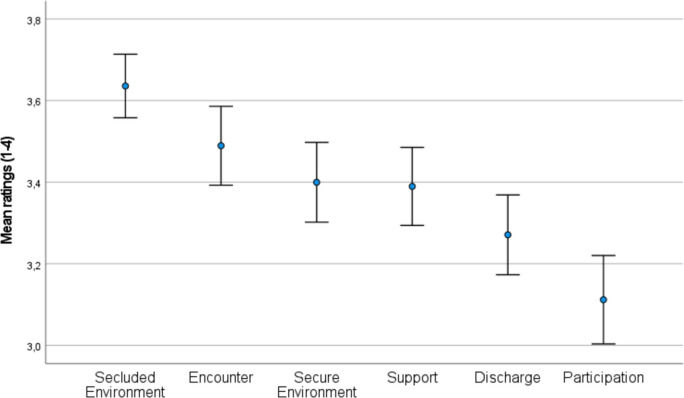
The QPC-IP was translated and adapted to a Norwegian context using a translation back-translation process model. A total of 169 inpatients from specialised mental health services responded to the questionnaire. The QPC-IP comprises six dimensions: Encounter (eight items), Participation (eight items), Discharge (four items), Support (four items), Secluded Environment (three items), and Secure Environment (three items), totalling 30 items. Confirmatory factor analysis was conducted to assess the instrument's factor structure. Additionally, Cronbach's alpha was used to establish the instrument's internal consistency.
The results indicated that the Norwegian adaptation of the QPC-IP possesses good psychometric properties, including internal consistency, content, and construct validity, as confirmed by the confirmatory factor analysis results. The confirmatory factor analysis demonstrated an adequate fit for the six-factor structure, consistent with the original Swedish instrument.
The QPC-IP is a user-friendly and easily implementable tool that assesses various dimensions of the quality of inpatient mental healthcare from a patient's perspective. Moreover, the Norwegian QPC-IP holds potential for use in comparative, cross-cultural studies within mental healthcare services to monitor the quality of the provided services.
从患者角度衡量精神卫生保健质量的经过验证的工具稀缺,因此需要可用的工具。从患者角度衡量护理质量的少数工具之一是瑞典住院精神科护理质量量表(QPC-IP)。这项横断面研究旨在将QPC-IP工具翻译成挪威语并进行改编,并评估其心理测量特性。
使用翻译-回译过程模型将QPC-IP翻译成挪威语并进行改编。共有169名来自专业精神卫生服务机构的住院患者对问卷进行了回复。QPC-IP包括六个维度:接触(8个项目)、参与(8个项目)、出院(4个项目)、支持(4个项目)、隔离环境(3个项目)和安全环境(3个项目),共30个项目。进行验证性因素分析以评估该工具的因素结构。此外,使用Cronbach's alpha系数来确定该工具的内部一致性。
结果表明,挪威改编版的QPC-IP具有良好的心理测量特性,包括内部一致性、内容和结构效度,验证性因素分析结果证实了这一点。验证性因素分析表明,六因素结构拟合良好,与原始瑞典工具一致。
QPC-IP是一个用户友好且易于实施的工具,可从患者角度评估住院精神卫生保健质量的各个维度。此外,挪威版QPC-IP在精神卫生保健服务的比较性、跨文化研究中具有用于监测所提供服务质量的潜力。