González Pérez María I, Faulhaber Bastian, Williams Mark, Encarnaçao Joao, Villalonga Pancraç, Aranda Carles, Busquets Núria
IRTA. Programa de Sanitat Animal. Centre de Recerca en Sanitat Animal (CReSA), Campus de la Universitat Autònoma de Barcelona (UAB), Bellaterra, Catalonia, Spain.
Unitat Mixta d'Investigació IRTA-UAB en Sanitat Animal. Centre de Recerca en Sanitat Animal (CReSA). Campus de La Universitat Autònoma de Barcelona (UAB), Bellaterra, Catalonia, Spain.
Parasit Vectors. 2024 Dec 18;17(1):510. doi: 10.1186/s13071-024-06606-w.
The age distribution of a mosquito population is a major determinant of its vectorial capacity. To contribute to disease transmission, a competent mosquito vector, carrying a pathogen, must live longer than the extrinsic incubation period of that pathogen to enable transmission to a new host. As such, determining the age of female mosquitoes is of significant interest for vector-borne diseases surveillance and control programs.
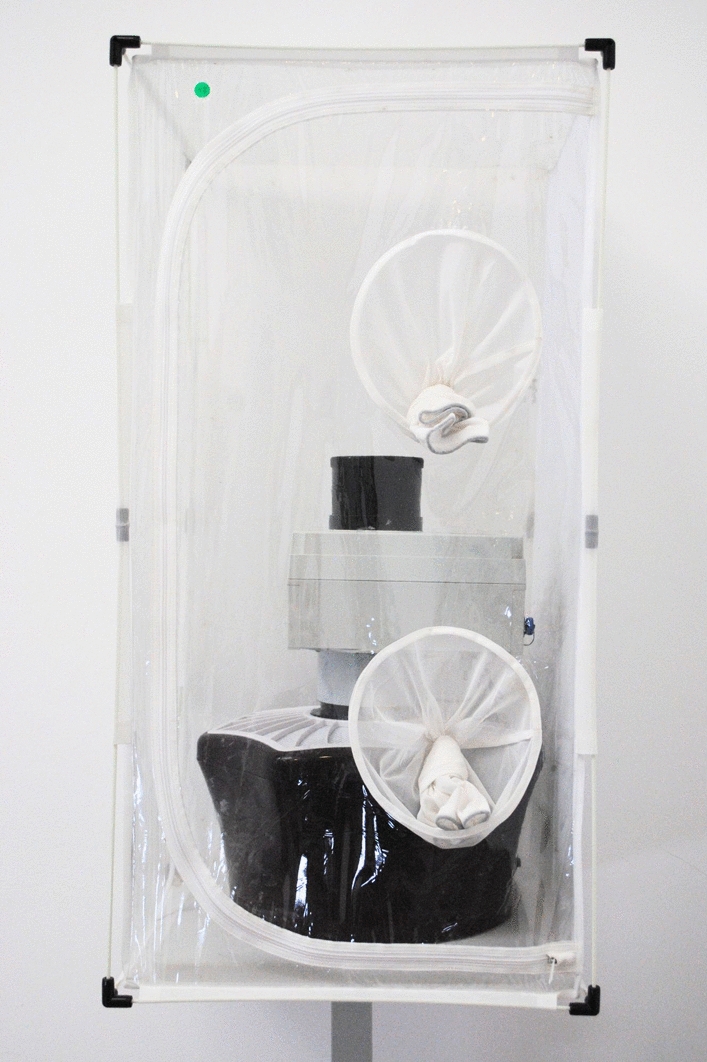
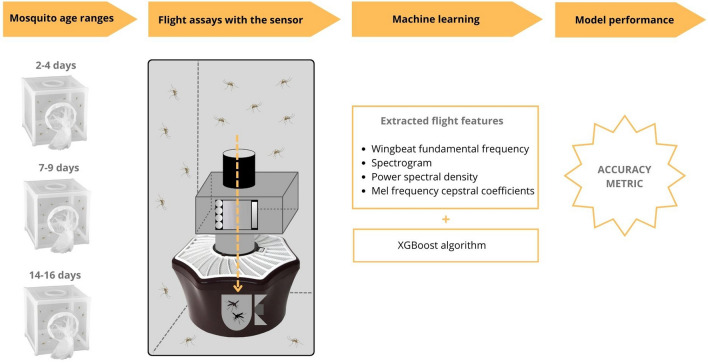
In this contribution, an automated age-grading system was developed to classify the age of female Culex pipiens, which is the primary vector of West Nile virus and other pathogens of medical and veterinary importance in northern latitudes. The system comprises an optical wingbeat sensor coupled to the entrance of a mosquito trap and a machine learning model. Three age classes were used in the study: young (2-4 days), middle (7-9 days) and old (14-16 days). From a balanced dataset of flight data, four features were extracted: wingbeat fundamental frequency, spectrogram, power spectral density and Mel frequency cepstral coefficients. The features were used for training with the XGBoost algorithm to generate a model for age classification.
The best performing model was trained with the power spectral density feature on two age classes, ≤ 4 days old and ≥ 7 days old, and had an accuracy of 71.8%.
An automated mosquito age-grading system was applied for the first time to our knowledge for automated age classification in mosquitoes; and complements the mosquito genus and sex classification capability of the system reported in our previous work. The system may find use in mosquito-borne disease surveillance and control to help to discriminate young mosquitoes (≤ 4 days old) from older mosquitoes, which may act as vectors of arboviruses.
蚊虫种群的年龄分布是其传播能力的主要决定因素。为了传播疾病,携带病原体的合格蚊虫媒介必须存活的时间长于该病原体的外在潜伏期,以便能够将病原体传播给新宿主。因此,确定雌蚊的年龄对于媒介传播疾病的监测和控制计划具有重要意义。
在本研究中,开发了一种自动年龄分级系统,用于对淡色库蚊雌蚊的年龄进行分类,淡色库蚊是西尼罗河病毒以及北纬地区其他具有医学和兽医学重要性的病原体的主要传播媒介。该系统包括一个与诱蚊器入口相连的光学拍翅传感器和一个机器学习模型。研究中使用了三个年龄类别:年轻(2 - 4天)、中年(7 - 9天)和老年(14 - 16天)。从飞行数据的平衡数据集中提取了四个特征:拍翅基频、频谱图、功率谱密度和梅尔频率倒谱系数。这些特征用于使用XGBoost算法进行训练,以生成年龄分类模型。
表现最佳的模型是使用功率谱密度特征对两个年龄类别(≤4天龄和≥7天龄)进行训练的,准确率为71.8%。
据我们所知,一种自动蚊虫年龄分级系统首次应用于蚊虫的自动年龄分类;并补充了我们之前工作中报道的系统对蚊虫属和性别的分类能力。该系统可用于蚊媒疾病的监测和控制,以帮助区分年轻蚊虫(≤4天龄)和可能作为虫媒病毒传播媒介的老年蚊虫。