
电子健康素养对大学生情绪管理能力的影响:同伴关系和运动自我效能感的中介作用
The impact of electronic health literacy on emotional management ability among college students: the mediating roles of peer relationships and exercise self-efficacy.
作者信息
Zhu Weidong, Liu Jun, Lou Hu, Mu Fanzheng, Li Bo
机构信息
College of Sports Science, Nantong University, Nantong, 226019, China.
出版信息
BMC Psychol. 2024 Dec 18;12(1):747. doi: 10.1186/s40359-024-02276-6.
OBJECTIVE
This study aims to explore electronic health literacy's impact on college students' emotional management ability and analyze the chained mediating effects of peer relationships and exercise self-efficacy.
METHODS
The study used stratified, cluster, and staged sampling methods to collect demographic information. Electronic health literacy, peer relationships, exercise self-efficacy, and emotional management ability data were collected among college students using the Questionnaire Star software. A total of 30,105 valid questionnaires were obtained, with a valid response rate of 98.7%. Using Process Model 6, investigated how electronic health literacy sequentially influences emotional management ability through mediators such as peer relationships and exercise self-efficacy.
RESULTS
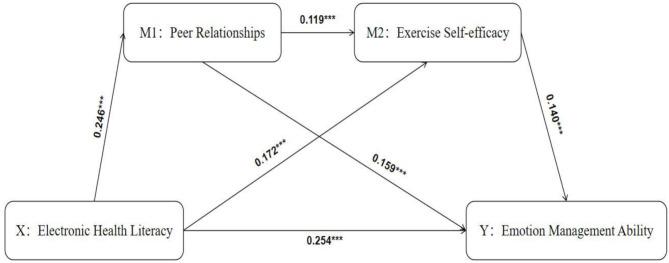
There was a significant positive correlation between electronic health literacy and emotional management ability (r = 0.496, P < 0.01), between electronic health literacy and peer relationships (r = 0.226, P < 0.01), and between electronic health literacy and exercise self-efficacy (r = 0.180, P < 0.01). Peer relationships were significantly positively correlated with exercise self-efficacy (r = 0.142, P < 0.01) and emotional management ability (r = 0.396, P < 0.01). Exercise self-efficacy was significantly positively correlated with emotional management ability (r = 0.339, P < 0.01). Electronic health literacy significantly and positively predicted emotional management ability (β = 0.254, P < 0.001). There was a mediating effect of peer relationships between electronic health literacy and emotional management ability, accounting for 58.2% of the impact, 95%CI: [0.036,0.042]. Exercise self-efficacy also mediated the relationship between electronic health literacy and emotional management ability, accounting for 61.5% of the effect, 95%CI: [0.022,0.027]. Moreover, a chained mediating effect of peer relationships and exercise self-efficacy was observed between electronic health literacy and emotional management ability, accounting for 17.1% of the effect, 95%CI: [0.004,0.005].
CONCLUSION
Electronic health literacy among college students can positively predict emotional management ability. Both peer relationships and exercise self-efficacy play a chained mediating role between electronic health literacy and emotional management ability.
目的
本研究旨在探讨电子健康素养对大学生情绪管理能力的影响,并分析同伴关系和运动自我效能感的链式中介作用。
方法
本研究采用分层、整群和阶段抽样方法收集人口统计学信息。使用问卷星软件收集大学生的电子健康素养、同伴关系、运动自我效能感和情绪管理能力数据。共获得有效问卷30105份,有效回收率为98.7%。使用Process Model 6,研究电子健康素养如何通过同伴关系和运动自我效能感等中介变量依次影响情绪管理能力。
结果
电子健康素养与情绪管理能力之间存在显著正相关(r = 0.496,P < 0.01),电子健康素养与同伴关系之间存在显著正相关(r = 0.226,P < 0.01),电子健康素养与运动自我效能感之间存在显著正相关(r = 0.180,P < 0.01)。同伴关系与运动自我效能感之间存在显著正相关(r = 0.142,P < 0.01),同伴关系与情绪管理能力之间存在显著正相关(r = 0.396,P < 0.01)。运动自我效能感与情绪管理能力之间存在显著正相关(r = 0.339,P < 0.01)。电子健康素养显著正向预测情绪管理能力(β = 0.254,P < 0.001)。同伴关系在电子健康素养和情绪管理能力之间存在中介作用,占总影响的58.2%,95%CI:[0.036,0.042]。运动自我效能感也在电子健康素养和情绪管理能力之间起中介作用,占总效应的61. ~ 5%,95%CI:[0.022,0.027]。此外,在电子健康素养和情绪管理能力之间观察到同伴关系和运动自我效能感的链式中介作用,占总效应的17.1%,95%CI:[0.004,0.005]。
结论
大学生的电子健康素养能够正向预测情绪管理能力。同伴关系和运动自我效能感在电子健康素养和情绪管理能力之间均起链式中介作用。

 Zotero 插件