Ye Yu-Peng, Qin Guo-You, Zhang Xinyu, Han Shan-Shan, Li Bo, Zhou Ning, Liu Qi, Li Chen-Xi, Zhang Yang-Sheng, Shao Qian-Qian
School of physical education, Jing-gang-shan University, Ji'an, China.
School of Physical Education, Hanjiang Normal University, Shiyan, China.
PLoS One. 2025 Jun 9;20(6):e0325835. doi: 10.1371/journal.pone.0325835. eCollection 2025.
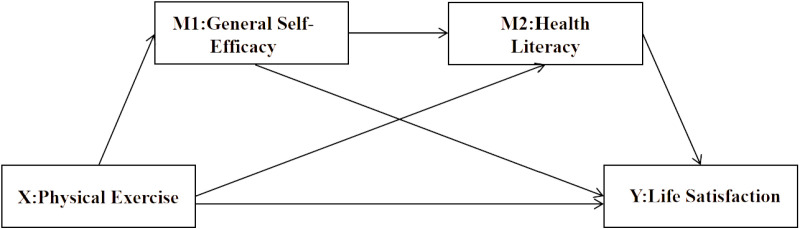
This study aims to explore the impact of physical exercise on university students' life satisfaction and analyses the chain mediation effect of general self-efficacy and health literacy, providing empirical reference and theoretical foundation for the comprehensive enhancement and optimization of students' mental health.
Based on data from the "China University Student Physical Activity and Health Tracking Survey" (CPAHLS-CS) 2024, the measurement scales used included the Physical Activity Rating Scale (PARS-3), the Satisfaction with Life Scale (SWLS), the General Self-Efficacy Scale (GSES), and the 9-item Short Form Health Literacy Scale (HLS-SF9). A total of 4575 valid samples were analyzed.
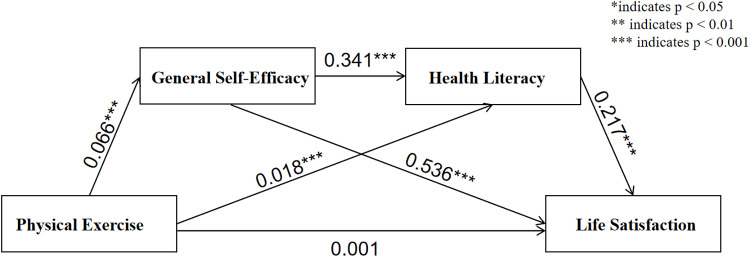
A significant positive correlation was found between physical exercise and life satisfaction (r = 0.137, P < 0.01). The total effect of physical exercise on university students' life satisfaction was significant, with an effect value of 0.045 (95%CI = [0.035, 0.054]). The chain mediation effect of general self-efficacy and health literacy in the relationship between physical exercise and life satisfaction was significant, with an effect value of 0.005 (95%CI = [0.004, 0.006]), accounting for 11.4% of the total effect. The direct effect of physical exercise on life satisfaction had a standardized regression coefficient of 0.001, which was not significant.
University students' life satisfaction is closely related to physical exercise, general self-efficacy, and health literacy. General self-efficacy and health literacy play a full mediating role in the effect of physical exercise on life satisfaction.
本研究旨在探讨体育锻炼对大学生生活满意度的影响,并分析一般自我效能感和健康素养的链式中介作用,为全面提升和优化学生心理健康提供实证参考和理论依据。
基于2024年“中国大学生体育活动与健康追踪调查”(CPAHLS-CS)的数据,使用的测量量表包括体育活动等级量表(PARS-3)、生活满意度量表(SWLS)、一般自我效能感量表(GSES)和9项简短健康素养量表(HLS-SF9)。共分析了4575个有效样本。
体育锻炼与生活满意度之间存在显著正相关(r = 0.137,P < 0.01)。体育锻炼对大学生生活满意度的总效应显著,效应值为0.045(95%CI = [0.035, 0.054])。一般自我效能感和健康素养在体育锻炼与生活满意度关系中的链式中介效应显著,效应值为0.005(95%CI = [0.004, 0.006]),占总效应的11.4%。体育锻炼对生活满意度的直接效应标准化回归系数为0.001,不显著。
大学生的生活满意度与体育锻炼、一般自我效能感和健康素养密切相关。一般自我效能感和健康素养在体育锻炼对生活满意度的影响中起完全中介作用。