Ashman Michael, Clibbens Nicola, Thompson Jill, Gilburt Helen, Thompson Elissa, Khalid Yaseen
The School of Healthcare, Worsley Building, University of Leeds, Leeds, LS2 9JT, UK.
Northumbria University, Coach Lane Campus, Newcastle-Upon-Tyne, NE7 7TR, UK.
Res Involv Engagem. 2024 Dec 18;10(1):130. doi: 10.1186/s40900-024-00662-3.
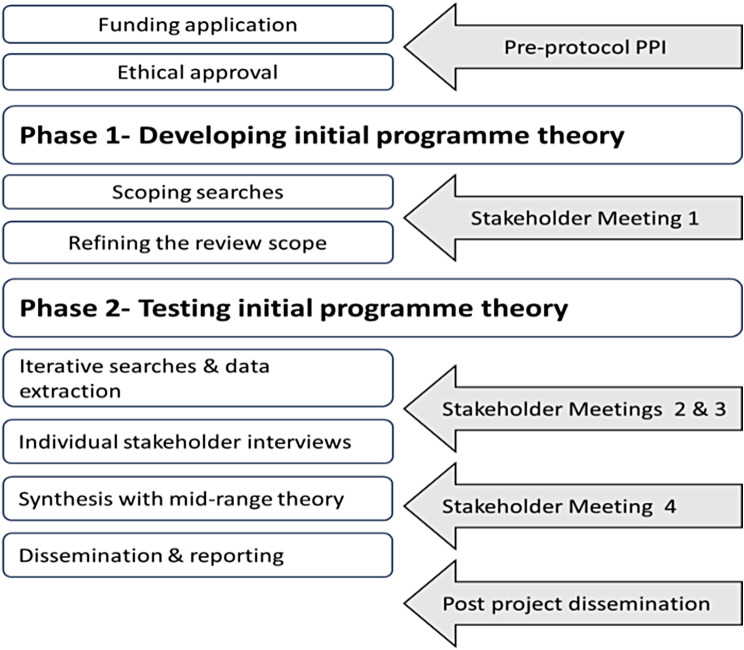
Patient and Public Involvement (PPI) is considered good practice in all health research including literature reviews. Reporting of involvement practice in realist reviews has been inconsistent leaving gaps in understanding of best practice. Realist reviews are theory driven and explain how interventions work, for whom and in which circumstances. PPI in realist reviews provides a link between programme theory and real-world experiences and can be achieved through a 'stakeholder group' bringing lived and professional experience together. This paper discusses experiences of a stakeholder group with seven members with lived experience and eight members with professional experience in a realist review focused on how community mental health crisis services work. A mental health crisis is a time of distress when people need urgent support. Many different agencies can respond to mental health crises, but despite this, people often find it hard to navigate to the right help at the right time. Reflections on involvement in four stakeholder meetings alongside practical examples of involvement activities used during the realist review are discussed. Having two researchers co-lead the stakeholder group from both lived and professional experience perspectives provided a bridge between the different expertise within the stakeholder group. Engagement with a voluntary organisation provided support to lived experience stakeholders, which sustained their involvement over time. Social connectedness was needed to establish trust between stakeholders. This required informal social contact between stakeholders that needed to be planned, especially for online meetings. To maintain the emotional wellbeing of the stakeholders during their involvement, safe spaces for discussion are needed and these are best planned in partnership with the stakeholders. We concluded that consideration of ways to provide opportunity for informal contact in online meetings may improve the experience of the stakeholders. Careful consideration of ways to sustain stakeholders' contribution over time are needed. The emotional impact of involvement should be considered when planning realist reviews. This may include built in flexibility in the involvement to include small expertise specific breakout groups, individual meetings, and should be planned in partnership with the stakeholders.
患者及公众参与(PPI)在包括文献综述在内的所有健康研究中都被视为良好实践。在现实主义综述中,对参与实践的报告一直不一致,这使得对最佳实践的理解存在差距。现实主义综述以理论为驱动,解释干预措施如何发挥作用、针对哪些人以及在何种情况下发挥作用。现实主义综述中的患者及公众参与在项目理论与现实世界经验之间建立了联系,并且可以通过一个“利益相关者群体”来实现,该群体将生活经验和专业经验结合在一起。本文讨论了一个利益相关者群体的经验,该群体由七名有生活经验的成员和八名有专业经验的成员组成,他们参与了一项关于社区心理健康危机服务如何运作的现实主义综述。心理健康危机是人们需要紧急支持时的痛苦时期。许多不同的机构都可以应对心理健康危机,但尽管如此,人们往往很难在正确的时间找到正确的帮助。本文讨论了对参与四次利益相关者会议的反思,以及现实主义综述期间使用的参与活动的实际例子。由两位研究人员从生活经验和专业经验的角度共同领导利益相关者群体,在利益相关者群体内部的不同专业知识之间架起了一座桥梁。与一个志愿组织的合作参与为有生活经验的利益相关者提供了支持,随着时间的推移维持了他们的参与。利益相关者之间需要社会联系来建立信任。这需要计划好利益相关者之间的非正式社交接触,特别是对于在线会议。为了在利益相关者参与期间维持他们的情绪健康,需要有讨论的安全空间,并且最好与利益相关者合作来规划这些空间。我们得出结论,考虑在在线会议中提供非正式接触机会的方法可能会改善利益相关者的体验。需要仔细考虑如何随着时间的推移维持利益相关者的贡献。在规划现实主义综述时应考虑参与的情感影响。这可能包括在参与过程中具有灵活性,以纳入小型的特定专业知识分组讨论、个别会议,并且应该与利益相关者合作来规划。