Hatoum Amaani H, Burton Amy L, Abbott Maree J
School of Psychology, University of Sydney, Level 2, 94 Mallet Street, Camperdown, NSW, 2006, Australia.
Graduate School of Health, University of Technology Sydney, Sydney, NSW, Australia.
J Eat Disord. 2024 Dec 18;12(1):203. doi: 10.1186/s40337-024-01167-w.
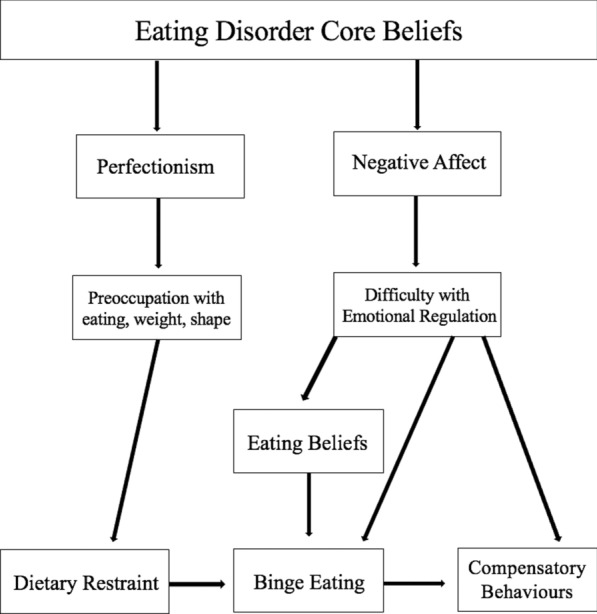
At present there is no clear, cohesive, and comprehensive theoretical understanding of the role of core beliefs in the development of disordered eating. The present study aimed to develop and test a theoretical model outlining important processes and pathways from core beliefs to eating disorder (ED) behaviours. It also aimed to explore potential differences (or similarities) in contributions of four core belief dimensions to the development and maintenance of ED symptomatology.
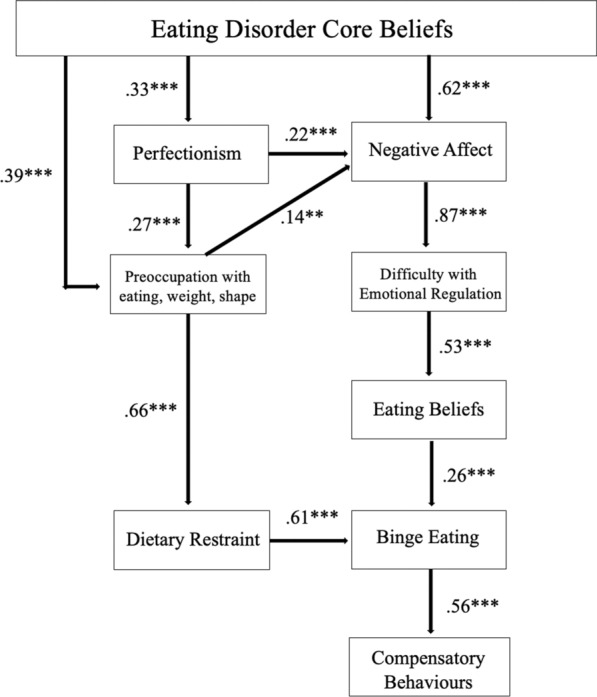
Data were collected from a sample of 800 non-clinical participants. Path analysis was conducted to test general and multi-dimensional models. Indirect effects were calculated for all possible pathways from ED core beliefs to dietary restraint, objective binge eating, and compensatory behaviours.
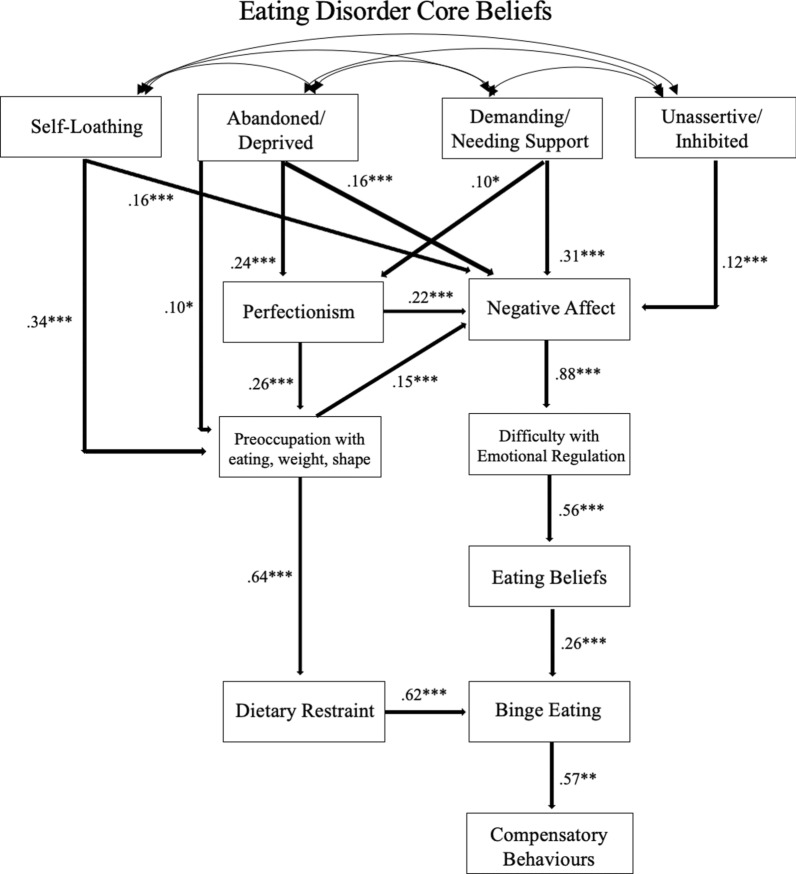
The hypothesised model demonstrated poor to acceptable fit to the data. Modifications were made to the general model to improve fit, remove non-significant paths and add theoretically and statistically relevant paths. All indirect effects of possible pathways from core beliefs to ED behaviours were significant. A multi-dimensional version of the model was tested with four core belief dimensions. This model identified differences in pathways from each core belief dimension to ED symptoms.
This study extends the current understanding of the role of core beliefs in the development and maintenance of disordered eating, by building upon previous theoretical models and empirical literature. We present a general core beliefs model of disordered eating, and preliminary findings regarding differences in the processes and pathways from four key core belief dimensions to ED behaviours.
目前,对于核心信念在饮食失调发展过程中的作用,尚无清晰、连贯且全面的理论认识。本研究旨在构建并检验一个理论模型,该模型概述了从核心信念到饮食失调(ED)行为的重要过程和途径。研究还旨在探索四个核心信念维度对饮食失调症状的发展和维持所起作用的潜在差异(或相似之处)。
从800名非临床参与者的样本中收集数据。进行路径分析以检验一般模型和多维度模型。计算从饮食失调核心信念到饮食限制、客观暴饮暴食和代偿行为的所有可能途径的间接效应。
假设模型对数据的拟合度从较差到尚可。对一般模型进行了修改以提高拟合度,去除无显著意义的路径,并添加理论上和统计上相关的路径。从核心信念到饮食失调行为的所有可能途径的间接效应均具有显著性。用四个核心信念维度对该模型的多维度版本进行了检验。该模型确定了从每个核心信念维度到饮食失调症状的途径差异。
本研究在先前的理论模型和实证文献基础上,扩展了当前对核心信念在饮食失调发展和维持中作用的理解。我们提出了一个饮食失调的一般核心信念模型,以及关于从四个关键核心信念维度到饮食失调行为的过程和途径差异的初步研究结果。