Pehlivan Davut, Bengtsson Jesse D, Bajikar Sameer S, Grochowski Christopher M, Lun Ming Yin, Gandhi Mira, Jolly Angad, Trostle Alexander J, Harris Holly K, Suter Bernhard, Aras Sukru, Ramocki Melissa B, Du Haowei, Mehaffey Michele G, Park KyungHee, Wilkey Ellen, Karakas Cemal, Eisfeldt Jesper J, Pettersson Maria, Liu Lynn, Shinawi Marwan S, Kimonis Virginia E, Wiszniewski Wojciech, Mckenzie Kyle, Roser Timo, Vianna-Morgante Angela M, Cornier Alberto S, Abdelmoity Ahmed, Hwang James P, Jhangiani Shalini N, Muzny Donna M, Mitani Tadahiro, Muramatsu Kazuhiro, Nabatame Shin, Glaze Daniel G, Fatih Jawid M, Gibbs Richard A, Liu Zhandong, Lindstrand Anna, Sedlazeck Fritz J, Lupski James R, Zoghbi Huda Y, Carvalho Claudia M B
Department of Pediatrics, Section of Neurology and Developmental Neuroscience, Baylor College of Medicine, Houston, TX, 77030, USA.
Department of Molecular and Human Genetics, Baylor College of Medicine, Houston, TX, 77030, USA.
Genome Med. 2024 Dec 18;16(1):146. doi: 10.1186/s13073-024-01411-7.
MECP2 Duplication Syndrome, also known as X-linked intellectual developmental disorder Lubs type (MRXSL; MIM: 300260), is a neurodevelopmental disorder caused by copy number gains spanning MECP2. Despite varying genomic rearrangement structures, including duplications and triplications, and a wide range of duplication sizes, no clear correlation exists between DNA rearrangement and clinical features. We had previously demonstrated that up to 38% of MRXSL families are characterized by complex genomic rearrangements (CGRs) of intermediate complexity (2 ≤ copy number variant breakpoints < 5), yet the impact of these genomic structures on regulation of gene expression and phenotypic manifestations have not been investigated.
To study the role of the genomic rearrangement structures on an individual's clinical phenotypic variability, we employed a comprehensive genomics, transcriptomics, and deep phenotyping analysis approach on 137 individuals affected by MRXSL. Genomic structural information was correlated with transcriptomic and quantitative phenotypic analysis using Human Phenotype Ontology (HPO) semantic similarity scores.
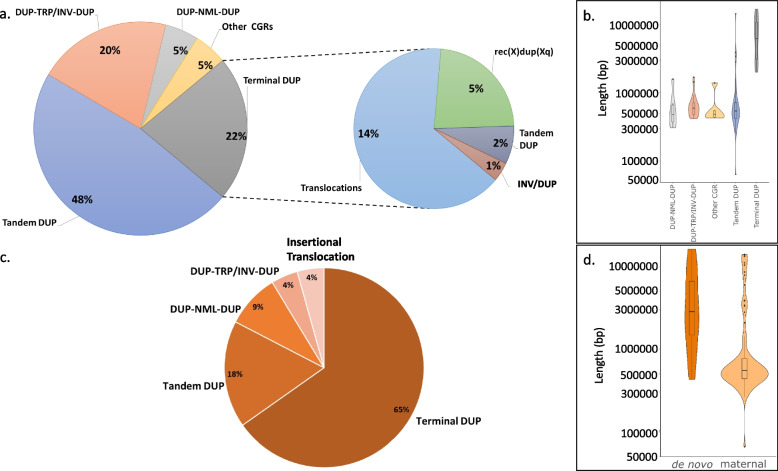
Duplication sizes in the cohort ranging from 64.6 kb to 16.5 Mb were classified into four categories comprising of tandem duplications (48%), terminal duplications (22%), inverted triplications (20%), and other CGRs (10%). Most of the terminal duplication structures consist of translocations (65%) followed by recombinant chromosomes (23%). Notably, 65% of de novo events occurred in the Terminal duplication group in contrast with 17% observed in Tandem duplications. RNA-seq data from lymphoblastoid cell lines indicated that the MECP2 transcript quantity in MECP2 triplications is statistically different from all duplications, but not between other classes of genomic structures. We also observed a significant (p < 0.05) correlation (Pearson R = 0.6, Spearman p = 0.63) between the log-transformed MECP2 RNA levels and MECP2 protein levels, demonstrating that genomic aberrations spanning MECP2 lead to altered MECP2 RNA and MECP2 protein levels. Genotype-phenotype analyses indicated a gradual worsening of phenotypic features, including overall survival, developmental levels, microcephaly, epilepsy, and genitourinary/eye abnormalities in the following order: Tandem duplications, Other complex duplications, Terminal duplications/Translocations, and Triplications encompassing MECP2.
In aggregate, this combined analysis uncovers an interplay between MECP2 dosage, genomic rearrangement structure and phenotypic traits. Whereas the level of MECP2 is a key determinant of the phenotype, the DNA rearrangement structure can contribute to clinical severity and disease expression variability. Employing this type of analytical approach will advance our understanding of the impact of genomic rearrangements on genomic disorders and may help guide more targeted therapeutic approaches.
MECP2重复综合征,也称为X连锁智力发育障碍卢布斯型(MRXSL;MIM:300260),是一种由跨越MECP2的拷贝数增加引起的神经发育障碍。尽管基因组重排结构各不相同,包括重复和三倍体,且重复大小范围广泛,但DNA重排与临床特征之间不存在明确的相关性。我们之前已经证明,高达38%的MRXSL家族具有中等复杂性(2≤拷贝数变异断点<5)的复杂基因组重排(CGRs),然而这些基因组结构对基因表达调控和表型表现的影响尚未得到研究。
为了研究基因组重排结构对个体临床表型变异性的作用,我们对137名受MRXSL影响的个体采用了全面的基因组学、转录组学和深度表型分析方法。使用人类表型本体(HPO)语义相似性评分将基因组结构信息与转录组和定量表型分析相关联。
队列中的重复大小从64.6 kb到16.5 Mb分为四类,包括串联重复(48%)、末端重复(22%)、反向三倍体(20%)和其他CGRs(10%)。大多数末端重复结构由易位(65%)组成,其次是重组染色体(23%)。值得注意的是,6毛%的新生事件发生在末端重复组,而串联重复组中观察到的为17%。来自淋巴母细胞系的RNA测序数据表明,MECP2三倍体中的MECP2转录本数量与所有重复在统计学上不同,但在其他基因组结构类别之间没有差异。我们还观察到对数转换后的MECP2 RNA水平与MECP2蛋白水平之间存在显著(p<0.05)相关性(Pearson R = 0.6,Spearman p = 0.63),表明跨越MECP2的基因组畸变导致MECP2 RNA和MECP2蛋白水平改变。基因型-表型分析表明,表型特征逐渐恶化,包括总体生存率、发育水平、小头畸形、癫痫以及泌尿生殖系统/眼部异常,顺序如下:串联重复、其他复杂重复、末端重复/易位以及包含MECP2的三倍体。
总体而言,这种综合分析揭示了MECP2剂量、基因组重排结构和表型特征之间的相互作用。虽然MECP2的水平是表型的关键决定因素,但DNA重排结构可导致临床严重程度和疾病表达变异性。采用这种分析方法将推进我们对基因组重排对基因组疾病影响的理解,并可能有助于指导更具针对性的治疗方法。