Hua Yunqi, Luo Shuang, Li Qian, Song Ge, Tian Xiaoling, Wang Peng, Zhu Hongwei, Lv Shuang, Zhang Xinyi, Yang Zixuan, Ku Geoffrey, Shao Guo
Department of Public Health, International College, Krirk University, Bangkok, Thailand.
Baotou Medical College, Inner Mongolia University of Science and Technology, Baotou, China.
Transl Cancer Res. 2024 Nov 30;13(11):6336-6346. doi: 10.21037/tcr-24-2151. Epub 2024 Nov 27.
The response of gastric cancer (GC) patients to first-line programmed cell death 1 (PD-1) blockade and S-1 plus oxaliplatin (SOX) chemotherapy varies considerably, and the underlying mechanisms driving this variability remain elusive. Exosomal microRNAs (miRNAs or miRs) have emerged as potential biomarkers for efficacy prediction due to their roles in GC biology and stable expression in serum. In this study, we aimed to identify biomarkers to predict patients' response to anti-PD-1 therapy and further elucidate the potential mechanisms by which these exosomal miRNAs modulate the immune response in GC.
Serum exosomes were extracted from 11 GC patients (five in the primary cohort and six in the validation cohort) treated with SOX and camrelizumab (a PD-1 inhibitor). High-throughput sequencing was performed to identify miRNA expression profiles, after which hierarchical clustering and a differential expression analysis were conducted. Functional enrichment analyses of the target genes for the significantly upregulated miRNAs were performed using the Gene Ontology (GO) and Kyoto Encyclopedia of Genes and Genomes (KEGG) databases. The validation of the candidate miRNAs was carried out by quantitative polymerase chain reaction (qPCR) in an independent cohort.
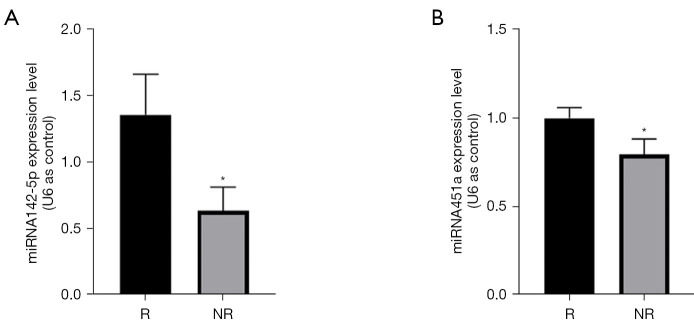
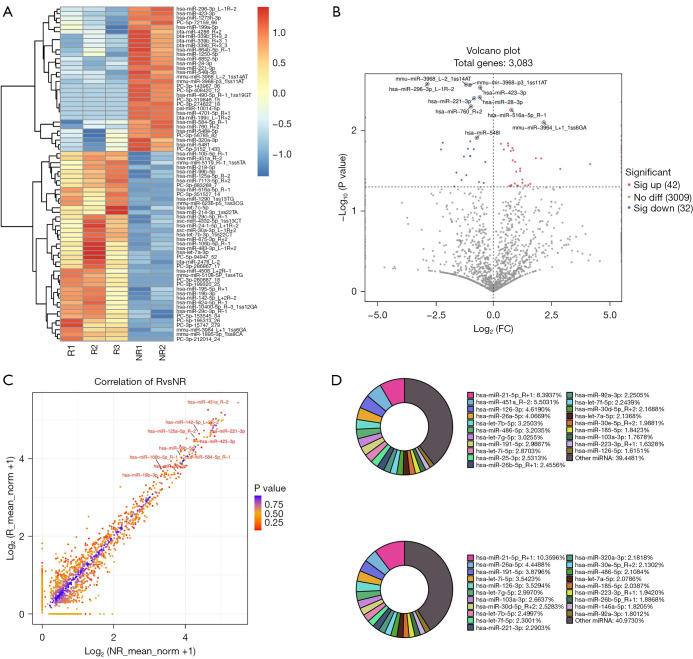
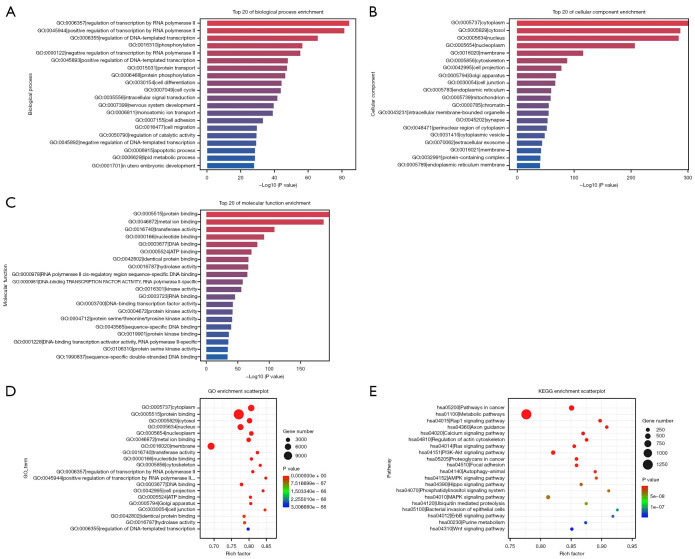
MiRNA sequencing identified 3,083 miRNAs, of which 74 (42 upregulated and 32 downregulated) were differentially expressed between the responders and non-responders. The GO and KEGG pathway analyses of the top 20 upregulated miRNAs indicated that the target genes were significantly involved in transcription regulation, cytoplasmic processes, and protein binding, and that key pathways included the PI3K-AKT, MAPK, RAP1, and RAS signaling pathways. Consistent with the sequencing findings, the qPCR validation results showed significant differences in the expression levels of miRNA451a and miRNA142-5p between the responders and non-responders.
This study identified specific plasma exosomal miRNAs in GC patients that differ between responders and non-responders to PD-1 monoclonal antibody therapy combined with chemotherapy. These miRNAs could serve as predictive biomarkers, paving the way for precision medicine and personalized therapy in the treatment of GC.
胃癌(GC)患者对一线程序性细胞死亡蛋白1(PD-1)阻断疗法及S-1联合奥沙利铂(SOX)化疗的反应差异很大,而导致这种差异的潜在机制仍不清楚。外泌体微小RNA(miRNA或miR)因其在GC生物学中的作用以及在血清中的稳定表达,已成为疗效预测的潜在生物标志物。在本研究中,我们旨在鉴定预测患者对抗PD-1治疗反应的生物标志物,并进一步阐明这些外泌体miRNA调节GC免疫反应的潜在机制。
从11例接受SOX和卡瑞利珠单抗(一种PD-1抑制剂)治疗的GC患者(5例在主要队列,6例在验证队列)中提取血清外泌体。进行高通量测序以鉴定miRNA表达谱,随后进行层次聚类和差异表达分析。使用基因本体论(GO)和京都基因与基因组百科全书(KEGG)数据库对显著上调的miRNA的靶基因进行功能富集分析。通过定量聚合酶链反应(qPCR)在独立队列中对候选miRNA进行验证。
miRNA测序鉴定出3083种miRNA,其中74种(42种上调和32种下调)在反应者和无反应者之间差异表达。对上调最显著的20种miRNA进行的GO和KEGG通路分析表明,靶基因显著参与转录调控、细胞质过程和蛋白质结合,关键通路包括PI3K-AKT、MAPK、RAP1和RAS信号通路。与测序结果一致,qPCR验证结果显示反应者和无反应者之间miRNA451a和miRNA142-5p的表达水平存在显著差异。
本研究鉴定出GC患者血浆中特定的外泌体miRNA,它们在接受PD-1单克隆抗体治疗联合化疗的反应者和无反应者之间存在差异。这些miRNA可作为预测性生物标志物,为GC治疗中的精准医学和个性化治疗铺平道路。