Bueno Andrew N, Stein Mark N, Runcie Karie
Department of Medicine, Columbia University Vagelos College of Physicians and Surgeons, New York, NY, USA.
Division of Hematology and Oncology, Department of Medicine, Columbia University Irving Medical Center, New York, NY, USA.
Transl Cancer Res. 2024 Nov 30;13(11):6448-6462. doi: 10.21037/tcr-23-2247. Epub 2024 Aug 12.
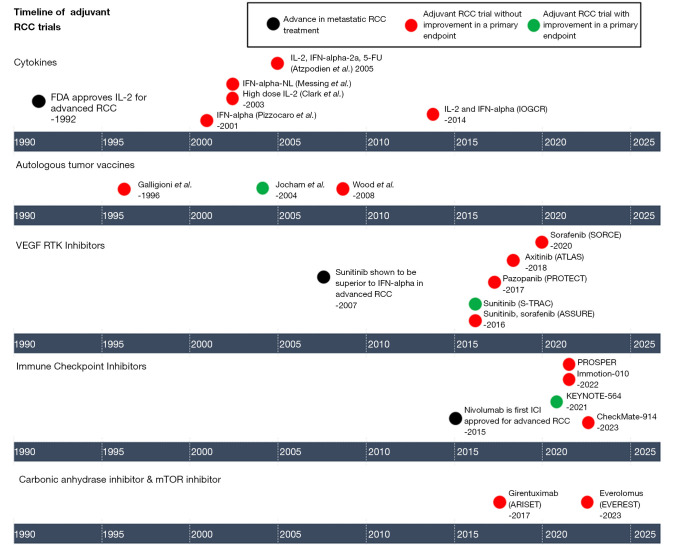
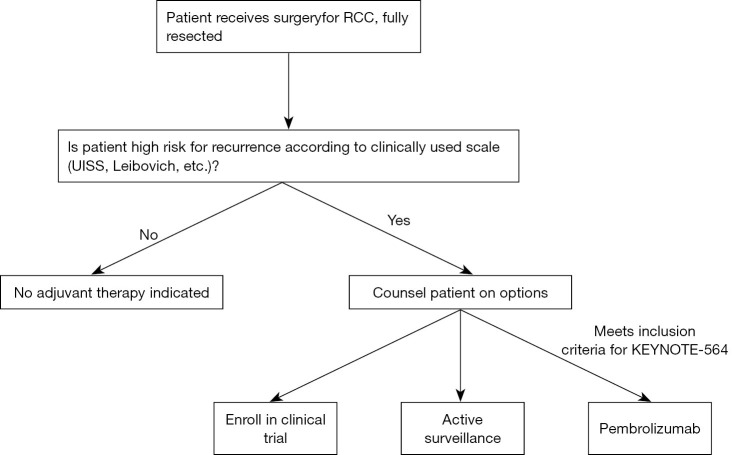
In the United States, there is expected to be about 82,000 cases of renal cell carcinoma (RCC) in 2024. At diagnosis, approximately 65% of patients with RCC will have disease localized to the kidney. For decades, the standard of care for patients with localized RCC has been surgery, which is often curative, followed by radiographic surveillance. However, after nephrectomy, patients may have up to 50% risk of recurrence. Thus, there has been a longstanding effort to reduce the recurrence of kidney cancer in the adjuvant setting after nephrectomy and/or metastasectomy. Over the past 30 years, a number of different therapeutic agents have been tested in the adjuvant setting including cytokines, autologous tumor cell vaccines, vascular endothelial growth factor (VEGF) pathway inhibitors, mammalian target of rapamycin (mTOR) inhibitors, and most recently immune checkpoint inhibitors (ICIs). The vast majority of these adjuvant trials in RCC have shown no significant clinical benefit for patients. In 2021, the KEYNOTE-564 trial demonstrated that adjuvant pembrolizumab improved progression-free survival and more recently showed an overall survival benefit for patients with high risk of recurrence of clear cell RCC (ccRCC). These findings have ushered in a new standard of care for patients with ccRCC at high risk of recurrence after nephrectomy. Here, we provide an overview of the major adjuvant trials in RCC, with a focus on ccRCC, and provide a framework for the management of patients with high risk localized ccRCC.
在美国,预计2024年肾细胞癌(RCC)病例约有82000例。在确诊时,约65%的RCC患者疾病局限于肾脏。几十年来,局限性RCC患者的标准治疗方法一直是手术,手术通常可治愈,术后进行影像学监测。然而,肾切除术后,患者复发风险高达50%。因此,长期以来一直在努力降低肾切除和/或转移灶切除术后辅助治疗中肾癌的复发率。在过去30年里,多种不同的治疗药物在辅助治疗中进行了试验,包括细胞因子、自体肿瘤细胞疫苗、血管内皮生长因子(VEGF)通路抑制剂、雷帕霉素靶蛋白(mTOR)抑制剂,以及最近的免疫检查点抑制剂(ICI)。这些RCC辅助试验绝大多数对患者未显示出显著的临床益处。2021年,KEYNOTE-564试验表明,辅助使用帕博利珠单抗可改善无进展生存期,最近还显示对透明细胞RCC(ccRCC)复发高危患者有总生存期益处。这些发现为肾切除术后复发高危的ccRCC患者带来了新的治疗标准。在此,我们概述了RCC的主要辅助试验,重点是ccRCC,并为高危局限性ccRCC患者的管理提供了一个框架。