Hansen Emil Deleuran, Torp Nikolaj, Johansen Stine, Hansen Johanne Kragh, Bergmann Marianne Lerbæk, Hansen Camilla Dalby, Detlefsen Sönke, Andersen Peter, Villesen Ida, Bech Katrine, Thorhauge Katrine, Jensen Gitte Hedegaard, Lindvig Katrine Prier, Hansen Torben, Tsochatzis Emmanuel A, Trebicka Jonel, Thiele Maja, Krag Aleksander, Israelsen Mads
Department of Gastroenterology and Hepatology, Odense, Denmark.
Institute of Clinical Research, Faculty of Health Sciences, University of Southern Denmark, Odense, Denmark.
JHEP Rep. 2024 Sep 2;7(1):101200. doi: 10.1016/j.jhepr.2024.101200. eCollection 2025 Jan.
BACKGROUND & AIMS: Quantifying alcohol intake is crucial for subclassifying participants with steatotic liver disease (SLD) and interpreting clinical trials of alcohol-related liver disease (ALD) and metabolic and alcohol-related liver disease (MetALD). However, the accuracy of self-reported alcohol intake is considered imprecise. We compared the diagnostic and prognostic utility of self-reported alcohol intake with blood-based biomarkers of alcohol intake: phosphatidylethanol (PEth) and carbohydrate-deficient transferrin (CDT).
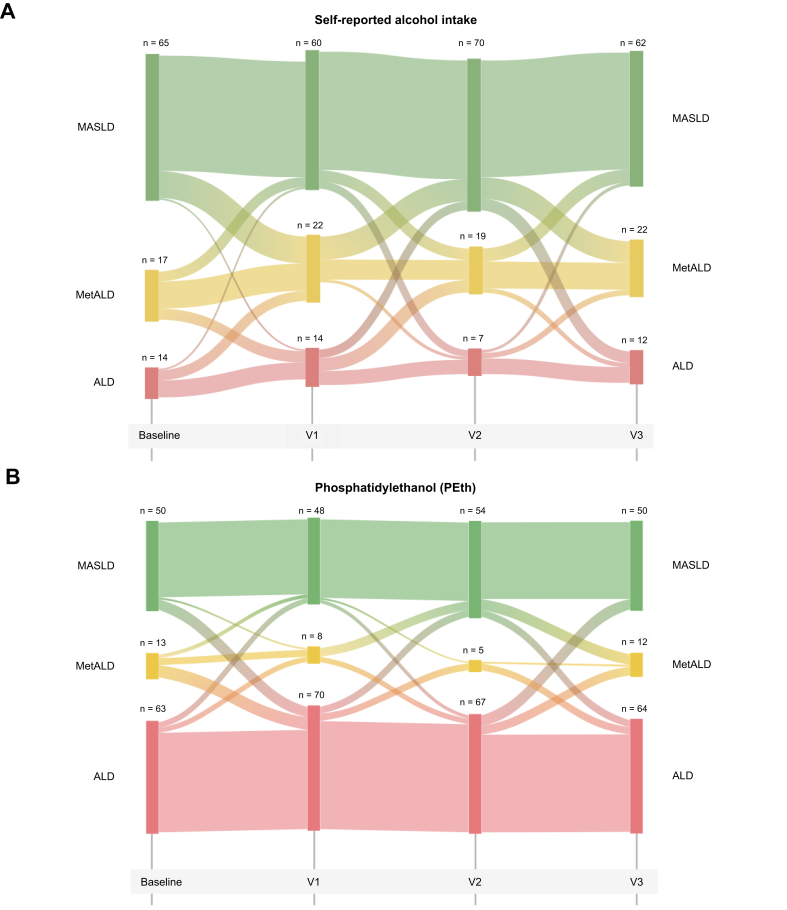
We studied 192 participants from two randomized controlled trials on MetALD and ALD, all with current or former excessive alcohol intake (≥24/36 [♀/♂] grams daily for at least 1 year) and biopsy-proven liver disease. We assessed self-reported alcohol intake, PEth, and CDT at four time points. We collected follow-up data on hepatic decompensation and death manually through electronic medical records.
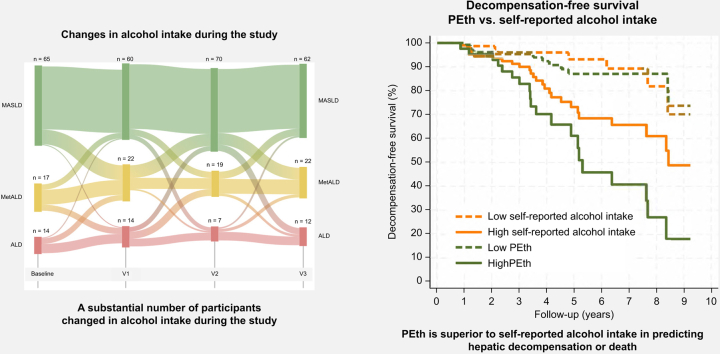
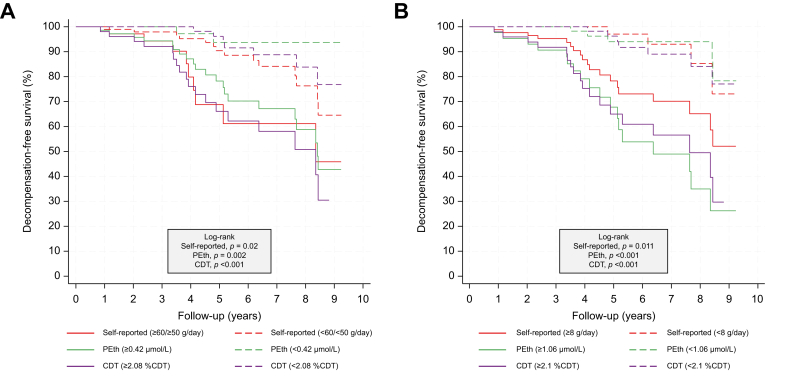
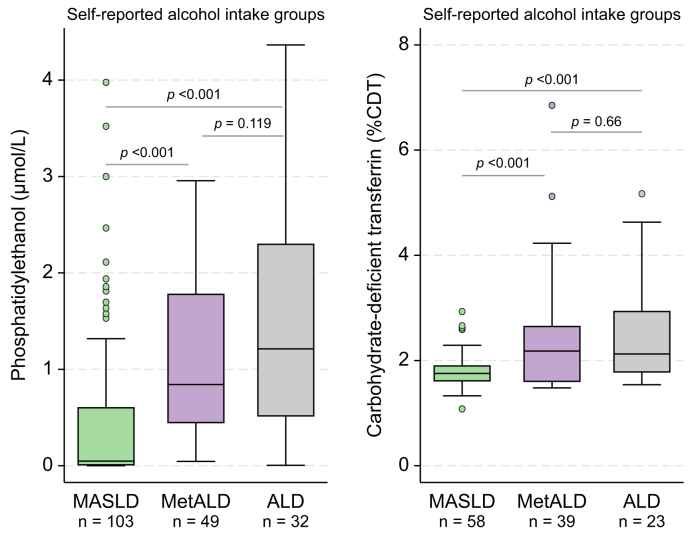
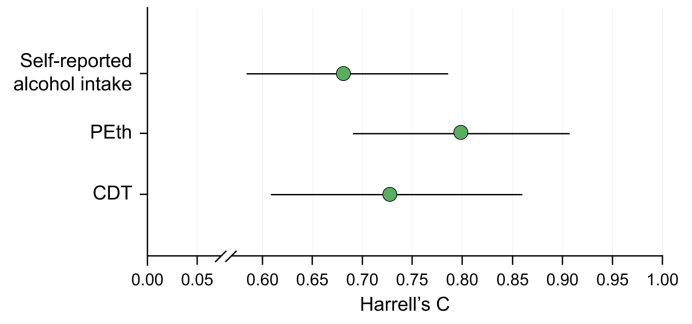
Most participants were male (n = 161, 84%) with a mean age of 59 (SD 9) years and 73 participants reported 1-week abstinence before inclusion; the remaining reported a median alcohol intake of 43 g/day. Median PEth was 0.5 μmol/L (IQR: 0.0-1.3) and %CDT = 1.9 (IQR: 1.6-2.3). Of 32 patients reporting at least 6 months of abstinence; 27 (84%) was confirmed by PEth <0.05 μmol/L. Self-reported alcohol intake correlated well with PEth (r = 0.617) and moderately with CDT (r = 0.316). Self-reported alcohol intake, PEth, and CDT all predicted hepatic decompensation and death. However, PEth showed the highest prediction, surpassing self-reported alcohol intake (Harrel's C, PEth = 0.80 self-reported = 0.68, = 0.026).
Self-reported abstinence can be considered reliable in clinical trials. However, PEth is superior in predicting hepatic decompensation and death in patients with MetALD and ALD.
An accurate quantification of alcohol intake is crucial in the clinical phenotyping of patients with steatotic liver disease and when designing clinical trials. This study found self-reported abstinence to be reliable but phosphatidylethanol was a more accurate prognostic biomarker of hepatic decompensation and death in a clinical trial setting. Findings may inform the design of future trials in patients with steatotic liver disease.
对酒精摄入量进行量化,对于对脂肪性肝病(SLD)患者进行亚分类以及解读酒精性肝病(ALD)和代谢性与酒精相关肝病(MetALD)的临床试验至关重要。然而,自我报告的酒精摄入量的准确性被认为不够精确。我们比较了自我报告的酒精摄入量与基于血液的酒精摄入生物标志物:磷脂酰乙醇(PEth)和缺糖转铁蛋白(CDT)的诊断和预后效用。
我们研究了来自两项关于MetALD和ALD的随机对照试验的192名参与者,所有参与者目前或既往有过量饮酒史(女性≥24克/天,男性≥36克/天,至少持续1年)且经活检证实患有肝病。我们在四个时间点评估了自我报告的酒精摄入量、PEth和CDT。我们通过电子病历手动收集了关于肝失代偿和死亡的随访数据。
大多数参与者为男性(n = 161,84%),平均年龄59(标准差9)岁,73名参与者报告在纳入研究前已戒酒1周;其余参与者报告的酒精摄入量中位数为43克/天。PEth中位数为0.5微摩尔/升(四分位间距:0.0 - 1.3),%CDT = 1.9(四分位间距:1.6 - 2.3)。在32名报告至少戒酒6个月的患者中,27名(84%)经PEth<0.05微摩尔/升得到证实。自我报告的酒精摄入量与PEth相关性良好(r = 0.617),与CDT中度相关(r = 0.316)。自我报告的酒精摄入量、PEth和CDT均能预测肝失代偿和死亡。然而,PEth显示出最高的预测能力,超过了自我报告的酒精摄入量(Harrel's C,PEth = 0.80,自我报告 = 0.68,P = 0.026)。
在临床试验中,自我报告的戒酒情况可被认为是可靠的。然而,在预测MetALD和ALD患者的肝失代偿和死亡方面,PEth更具优势。
准确量化酒精摄入量在脂肪性肝病患者的临床表型分析以及设计临床试验时至关重要。本研究发现自我报告的戒酒情况是可靠的,但在临床试验环境中,磷脂酰乙醇是肝失代偿和死亡更准确的预后生物标志物。研究结果可能为未来脂肪性肝病患者的试验设计提供参考。