Akbar Naveed, Luciani Evelyn Grace, Ahmad Raheel, Lee Dasol, Veiga Sara, Rabe Daniel Christopher, Stott Shannon Leigh
Division of Cardiovascular Medicine, Radcliffe Department of Medicine, University of Oxford, Oxford OX3 9DU, UK.
Center for Engineering in Medicine & Surgery, Massachusetts General Hospital Cancer Center, Harvard Medical School, Charlestown - Boston, MA 02129, USA.
Extracell Vesicles Circ Nucl Acids. 2024 Feb 8;5(1):83-94. doi: 10.20517/evcna.2023.51. eCollection 2024.
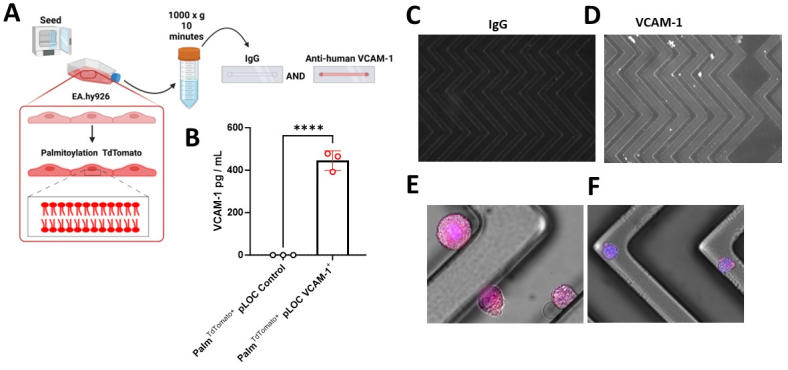
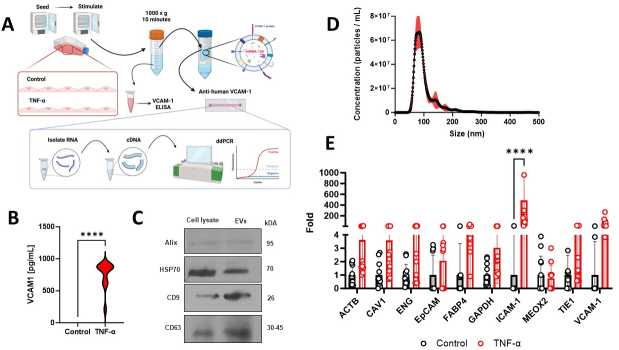
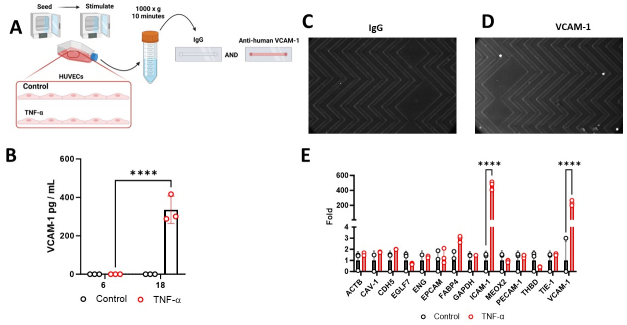
Vascular cell adhesion molecule-1 (VCAM-1) endothelial cell-derived extracellular vesicles (EC-EVs) are augmented in cardiovascular disease, where they can signal the deployment of immune cells from the splenic reserve. Endothelial cells in culture activated with pro-inflammatory tumor necrosis factor-α (TNF-a) also release VCAM-1 EC-EVs. However, isolating VCAM-1 EC-EVs from conditioned cell culture media for subsequent in-depth analysis remains challenging. We utilized the extracellular vesicles (EV) microfluidics herringbone chip (HB-Chip), coated with anti-VCAM-1 antibodies, for selective capture of VCAM-1 cells and EC-EVs. Engineered EA.hy926 endothelial cells overexpressing VCAM-1 ( < 0.001 versus control) showed increased binding to the VCAM-1- HB-Chip versus an IgG device. TNF-α-stimulated human umbilical cord vein endothelial cells (HUVECs) exhibited elevated VCAM-1 protein levels ( < 0.001) and preferential binding to the VCAM-1- HB-Chip versus the IgG device. HUVECs stimulated with TNF-α showed differential gene expression of intercellular adhesion molecule-1 (ICAM-1) ( < 0.001) and VCAM-1 ( < 0.001) by digital droplet PCR versus control cells. HUVEC-derived EC-EVs were positive for CD9, CD63, HSP70, and ALIX and had a modal size of 83.5 nm. Control and TNF-α-stimulated HUVEC-derived EC-EV cultures were captured on the VCAM-1- HB-Chip, demonstrating selective capture. VCAM-1 EC-EV were significantly enriched for ICAM-1 ( < 0.001) mRNA transcripts. This study presents a novel approach using the HB-Chip, coated with anti-VCAM-1 antibodies and digital droplet PCR for the study of VCAM-1 EC-EVs. Isolation of VCAM-1 EC-EV from heterogeneous sources such as conditioned cell culture media holds promise for subsequent detailed characterization, and may facilitate the study of VCAM-1 EC-EVs in cardiovascular and metabolic diseases, for disease monitoring and therapeutic insights.
血管细胞黏附分子-1(VCAM-1)内皮细胞衍生的细胞外囊泡(EC-EVs)在心血管疾病中增多,在该疾病中它们可发出信号促使脾储备中的免疫细胞部署。用促炎性肿瘤坏死因子-α(TNF-α)激活的培养内皮细胞也会释放VCAM-1 EC-EVs。然而,从条件细胞培养基中分离VCAM-1 EC-EVs以进行后续深入分析仍然具有挑战性。我们利用涂有抗VCAM-1抗体的细胞外囊泡(EV)微流控人字纹芯片(HB-Chip)来选择性捕获VCAM-1细胞和EC-EVs。与对照相比,过表达VCAM-1的工程化EA.hy926内皮细胞(<0.001)显示出与VCAM-1-HB-Chip的结合增加,而与IgG装置相比。TNF-α刺激的人脐静脉内皮细胞(HUVECs)表现出升高的VCAM-1蛋白水平(<0.001),并且与IgG装置相比,它们与VCAM-1-HB-Chip的结合更具选择性。与对照细胞相比,经TNF-α刺激的HUVECs通过数字液滴PCR显示细胞间黏附分子-1(ICAM-1)(<0.00)和VCAM-1(<0.001)的基因表达存在差异。HUVEC衍生的EC-EVs对CD9、CD63、HSP70和ALIX呈阳性,模态大小为83.5nm。对照和TNF-α刺激的HUVEC衍生的EC-EV培养物被捕获在VCAM-1-HB-Chip上,证明了选择性捕获。VCAM-1 EC-EV中ICAM-1(<0.001)mRNA转录本显著富集。本研究提出了一种使用涂有抗VCAM-1抗体的HB-Chip和数字液滴PCR来研究VCAM-1 EC-EVs的新方法。从诸如条件细胞培养基等异质来源中分离VCAM-1 EC-EV有望进行后续详细表征,并可能有助于研究心血管和代谢疾病中的VCAM-1 EC-EVs,以用于疾病监测和治疗洞察。