Bortot Barbara, Di Florio Roberta, Merighi Simona, Peacock Ben, Lees Rebecca, Valle Francesco, Brucale Marco, Mangogna Alessandro, Di Lorenzo Giovanni, Romano Federico, Zito Gabriella, Zanconati Fabrizio, Ricci Giuseppe, Cancila Valeria, Belmonte Beatrice, Biffi Stefania
Institute for Maternal and Child Health, IRCCS Burlo Garofolo, Trieste, Italy.
Tumor Immunology Unit, Department of Health Promotion, Mother and Child Care, Internal Medicine and Medical Specialties "G. D'Alessandro", University of Palermo, Palermo, Italy.
FASEB J. 2024 Dec 13;38(24):e70267. doi: 10.1096/fj.202402499R.
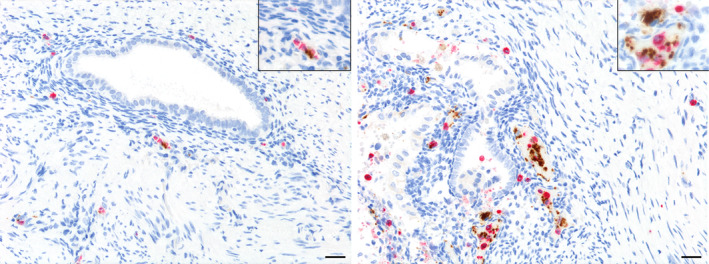
Endometriosis is a chronic inflammatory condition characterized by the presence of endometrium-like tissue outside the uterus, primarily affecting pelvic organs and tissues. In this study, we explored platelet activation in endometriosis. We utilized the STRING database to analyze the functional interactions among proteins previously identified in small extracellular vesicles (EVs) isolated from the peritoneal fluid of endometriosis patients and controls. The bioinformatic analysis indicated enriched signaling pathways related to platelet activation, hemostasis, and neutrophil degranulation. Double immunohistochemistry analysis for CD61 and MPO revealed a significant presence of neutrophils and platelets in close contact infiltrating endometriotic lesions, suggesting potential cell-cell interactions. Subsequently, we isolated small EVs from the peritoneal fluid of women diagnosed with endometriosis and from women without endometriosis who underwent surgery for non-inflammatory benign diseases. We performed single-particle phenotyping analysis based on platelet biomarkers GPIIb/IIIa and PF4 using nanoflow cytometry, as well as single-particle morphological and nanomechanical characterization through atomic force microscopy. The study demonstrated that patients with endometriosis had a notably higher proportion of particles testing positive for platelet biomarkers compared to the total number of EVs. This finding implies a potential role for platelets in the pathogenesis of endometriosis. Further research is necessary to delve into the mechanisms underlying this phenomenon and its implications for disease progression.
子宫内膜异位症是一种慢性炎症性疾病,其特征是子宫外存在类似子宫内膜的组织,主要影响盆腔器官和组织。在本研究中,我们探讨了子宫内膜异位症中的血小板活化情况。我们利用STRING数据库分析了先前在从子宫内膜异位症患者和对照组的腹腔液中分离出的小细胞外囊泡(EVs)中鉴定出的蛋白质之间的功能相互作用。生物信息学分析表明,与血小板活化、止血和中性粒细胞脱颗粒相关的信号通路富集。对CD61和MPO进行双重免疫组织化学分析显示,在浸润子宫内膜异位病变的部位,有大量紧密接触的中性粒细胞和血小板,提示可能存在细胞间相互作用。随后,我们从被诊断为子宫内膜异位症的女性以及因非炎症性良性疾病接受手术的非子宫内膜异位症女性的腹腔液中分离出小细胞外囊泡。我们使用纳米流式细胞术基于血小板生物标志物GPIIb/IIIa和PF4进行单颗粒表型分析,并通过原子力显微镜进行单颗粒形态和纳米力学表征。该研究表明,与细胞外囊泡总数相比,子宫内膜异位症患者中血小板生物标志物检测呈阳性的颗粒比例显著更高。这一发现暗示血小板在子宫内膜异位症发病机制中可能发挥作用。有必要进一步研究深入探究这一现象背后的机制及其对疾病进展的影响。