Li Yue-Rong, Dang Zhao-Hui, Li Shan-Shan, Li Guang-Ya, Cai Hao-Bin, Lu Yun-Wei, Xie Lin-Lin, Li Li-Ling, Huang Liu-Ling, Qin Xiu-De, Bu Fan
Department of Neurology & Psychology, Shenzhen Traditional Chinese Medicine Hospital, The Fourth Clinical Medical College of Guangzhou University of Chinese Medicine, Shenzhen, Guangdong.
Int J Immunopathol Pharmacol. 2024 Jan-Dec;38:3946320241309220. doi: 10.1177/03946320241309220.
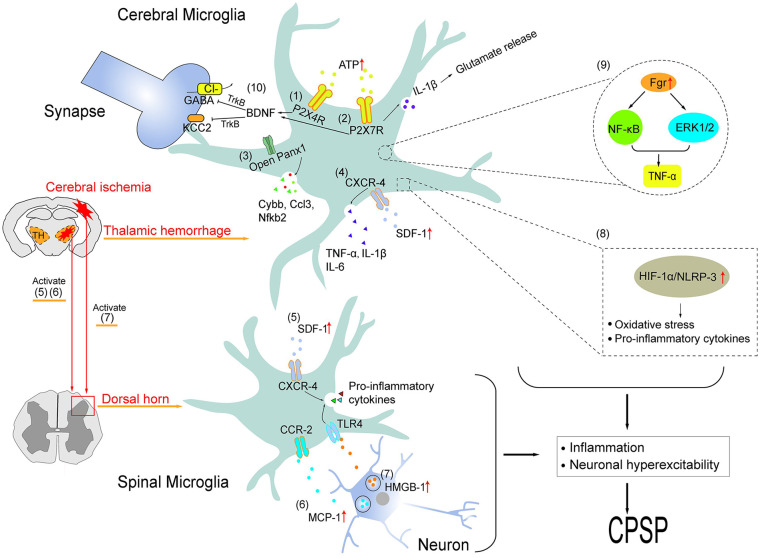
Central post-stroke pain (CPSP) is a chronic neuropathic pain syndrome that commonly occurs after cerebral stroke, and it severely impairs the daily activities of stroke patients. A number of fundamental and clinical studies support the theory that CPSP is mainly caused by ischemic and hemorrhagic injury of the spinal-thalamic-cortical neural pathway. However, the underlying reasons of CPSP genesis and development are far from clear. In recent years, the majority of research focused on microglia, the main resident immune cells of the central nervous system, which highlighted its critical role in the regulation of CPSP. The present article concentrated on exciting discoveries of microglia in mediating CPSP from the perspectives of their bioactive factors, cellular receptors, and signaling pathways, in order to offer a convenient and easy-to-digest overview. In addition, the potential and challenges of several agents in clinical translation of CPSP treatment was discussed based on recent preclinical studies.
中风后中枢性疼痛(CPSP)是一种常见于脑中风后的慢性神经性疼痛综合征,严重影响中风患者的日常活动。大量基础和临床研究支持CPSP主要由脊髓丘脑皮质神经通路的缺血性和出血性损伤引起这一理论。然而,CPSP发生和发展的根本原因仍远未明确。近年来,大多数研究聚焦于小胶质细胞,它是中枢神经系统主要的常驻免疫细胞,这突出了其在CPSP调节中的关键作用。本文从生物活性因子、细胞受体和信号通路等角度,集中探讨了小胶质细胞在介导CPSP方面的激动人心的发现,以便提供一个方便且易于理解的概述。此外,还基于近期的临床前研究讨论了几种药物在CPSP治疗临床转化中的潜力和挑战。