Li Xue, Wang Ling, Lin Jinghuan, Gu Yingjuan, Liu Zhihua, Hu Jing
Department of Laboratory Medicine, Zhujiang Hospital, Southern Medical University, Guangzhou, Guangdong, China.
Department of Nosocomial Infection Administration, Zhujiang Hospital, Southern Medical University, Guangzhou, Guangdong, China.
Microbiol Spectr. 2025 Feb 4;13(2):e0000924. doi: 10.1128/spectrum.00009-24. Epub 2024 Dec 19.
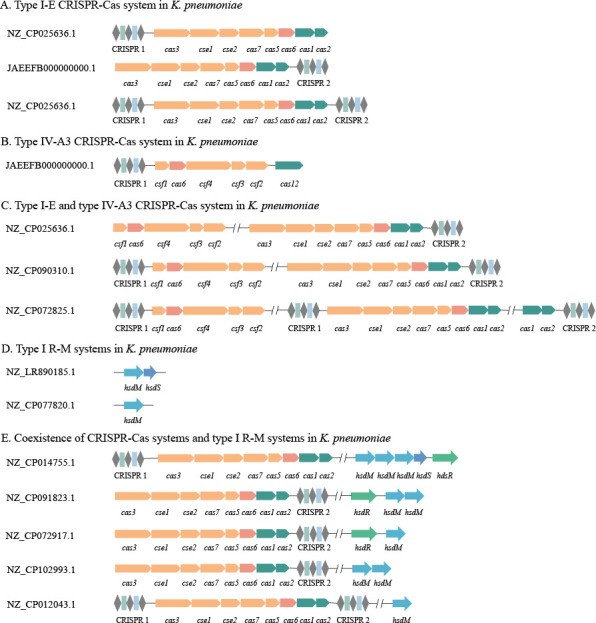
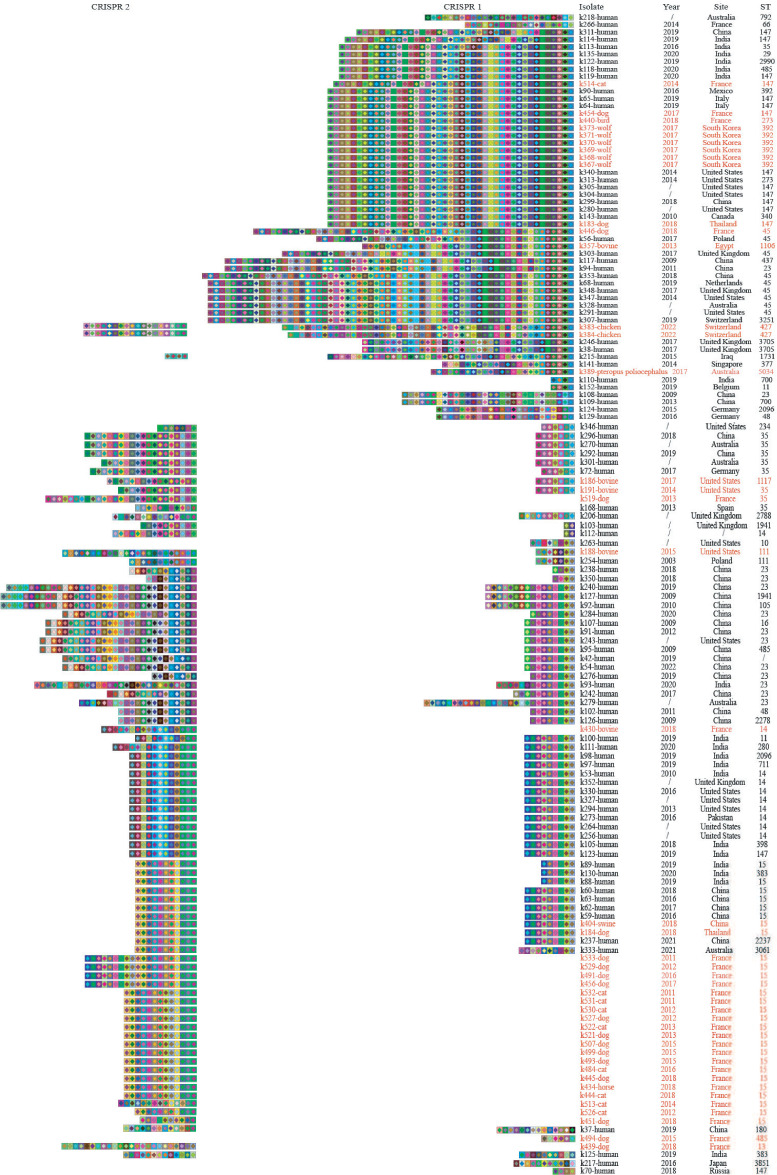
The clustered regularly interspaced short palindromic repeats (CRISPR)‒CRISPR-associated protein (Cas) and restriction‒modification (R-M) systems are important immune systems in bacteria. Information about the distributions of these two systems in from different hosts and their mutual effect on antibiotic resistance and virulence is still limited. In this study, the whole genomes of 520 strains of from GenBank, including 325 from humans and 195 from animals, were collected for CRISPR‒Cas systems and type I R-M systems, virulence genes, antibiotic resistance genes, and multilocus sequence typing detection. The results showed that host origin had no obvious influence on the distributions of the two systems (CRISPR‒Cas systems in 29.8% and 24.1%, type I R-M systems in 9.8% and 11.8% of human-origin and animal-origin strains, respectively) in . Identical spacer sequences from different hosts demonstrated there was a risk of human-animal transmission. All virulence genes (yersiniabactin, colibactin, aerobactin, salmochelin, , and ) detection rates were higher when only the CRISPR‒Cas systems were present but were all reduced when coexisting with type I R-M systems. However, a lower prevalence of most antibiotic-resistance genes was found when the CRISPR‒Cas systems were alone, and when type I R-M systems were coexisting, some of the antibiotic resistance gene incidence rates were even lower (quinolones, macrolides, tetracyclines and carbapenems), and some of them were higher instead (aminoglycosides, clindamycins, rifampicin-associated, sulfonamides, methotrexates, beta-lactamases and ultrabroad-spectrum beta-lactamases). The synergistic and opposed effects of the two systems on virulence and antibiotic-resistance genes need further study.IMPORTANCE is an important opportunistic pathogen responsible for both human and animal infections, and the emergence of hypervirulent and multidrug-resistant has made it difficult to control this pathogen worldwide. Here, we find that CRISPR‒Cas and restriction-modification systems, which function as adaptive and innate immune systems in bacteria, have synergistic and opposed effects on virulence and antibiotic resistance genes in . Moreover, this study provides insights into the distributions of the two systems in from different hosts, and there is no significant difference in the prevalence of the two systems among spp. In addition, this study also characterizes the CRISPR arrays of from different hosts, suggesting that the strains sharing the same spacer sequences have the potential to spread between humans and animals.
成簇规律间隔短回文重复序列(CRISPR)-CRISPR相关蛋白(Cas)系统和限制-修饰(R-M)系统是细菌中重要的免疫系统。关于这两种系统在不同宿主来源的[细菌名称未给出]中的分布及其对抗生素耐药性和毒力的相互影响的信息仍然有限。在本研究中,从GenBank收集了520株[细菌名称未给出]的全基因组,包括325株来自人类的菌株和195株来自动物的菌株,用于CRISPR-Cas系统和I型R-M系统、毒力基因、抗生素耐药基因以及多位点序列分型检测。结果表明,宿主来源对这两种系统的分布没有明显影响(CRISPR-Cas系统在人类来源和动物来源菌株中的比例分别为29.8%和24.1%,I型R-M系统分别为9.8%和11.8%)。来自不同宿主的相同间隔序列表明存在人畜传播的风险。当仅存在CRISPR-Cas系统时,所有毒力基因(yersiniabactin、colibactin、aerobactin、salmochelin等)的检测率较高,但与I型R-M系统共存时均降低。然而,当单独存在CRISPR-Cas系统时,大多数抗生素耐药基因的流行率较低,而当与I型R-M系统共存时,一些抗生素耐药基因的发生率甚至更低(喹诺酮类、大环内酯类、四环素类和碳青霉烯类),而有些则更高(氨基糖苷类、克林霉素、利福平相关、磺胺类、甲氨蝶呤、β-内酰胺酶和超广谱β-内酰胺酶)。这两种系统对毒力和抗生素耐药基因的协同和拮抗作用需要进一步研究。重要性:[细菌名称未给出]是一种重要的机会致病菌,可导致人类和动物感染,高毒力和多重耐药[细菌名称未给出]的出现使得在全球范围内控制这种病原体变得困难。在这里,我们发现作为细菌中的适应性和先天性免疫系统的CRISPR-Cas和限制修饰系统对[细菌名称未给出]的毒力和抗生素耐药基因具有协同和拮抗作用。此外,本研究深入了解了这两种系统在不同宿主来源的[细菌名称未给出]中的分布情况,并且在[细菌名称未给出]属中这两种系统的流行率没有显著差异。此外,本研究还对来自不同宿主的[细菌名称未给出]的CRISPR阵列进行了表征,表明共享相同间隔序列的菌株有可能在人类和动物之间传播。