Zhang Yijie, Gao Shuzhan, Liang Chuang, Bustillo Juan, Kochunov Peter, Turner Jessica A, Calhoun Vince D, Wu Lei, Fu Zening, Jiang Rongtao, Zhang Daoqiang, Jiang Jing, Wu Fan, Peng Ting, Xu Xijia, Qi Shile
College of Artificial Intelligence, Nanjing University of Aeronautics and Astronautics, Nanjing, China; The Key Laboratory of Brain-Machine Intelligence Technology, Ministry of Education, Nanjing University of Aeronautics and Astronautics, Nanjing, China.
Department of Psychiatry, the Affiliated Brain Hospital of Nanjing Medical University, Nanjing, China.
Neuroimage Clin. 2025;45:103726. doi: 10.1016/j.nicl.2024.103726. Epub 2024 Dec 12.
Treatment-resistant schizophrenia (TR-SZ) and non-treatment-resistant schizophrenia (NTR-SZ) lack specific biomarkers to distinguish from each other. This investigation aims to identify consistent dysfunctional brain connections with different atlases, multiple feature selection strategies, and several classifiers in distinguishing TR-SZ and NTR-SZ.
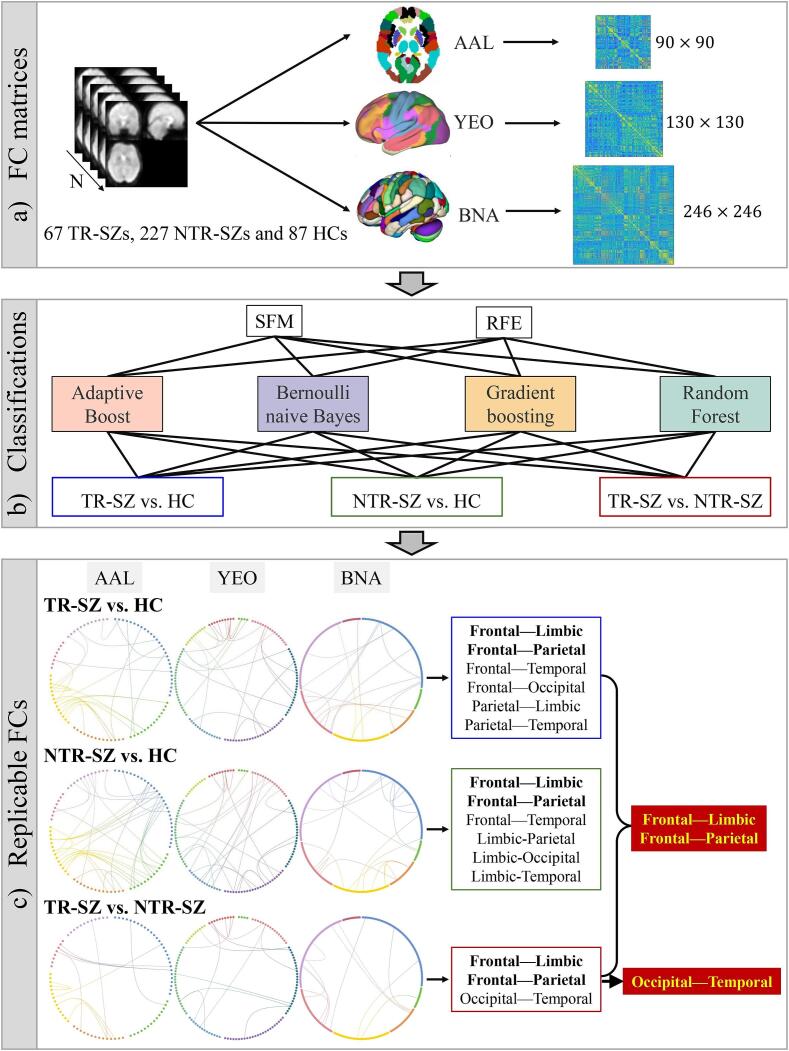
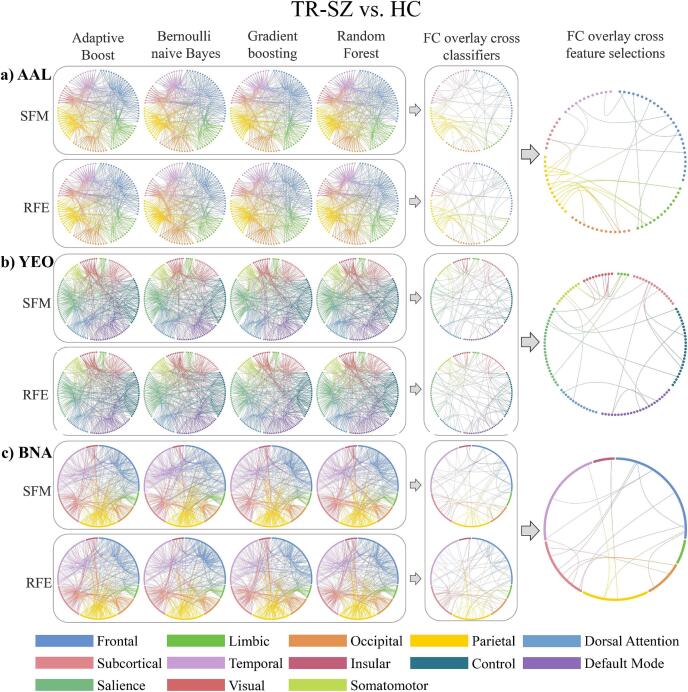
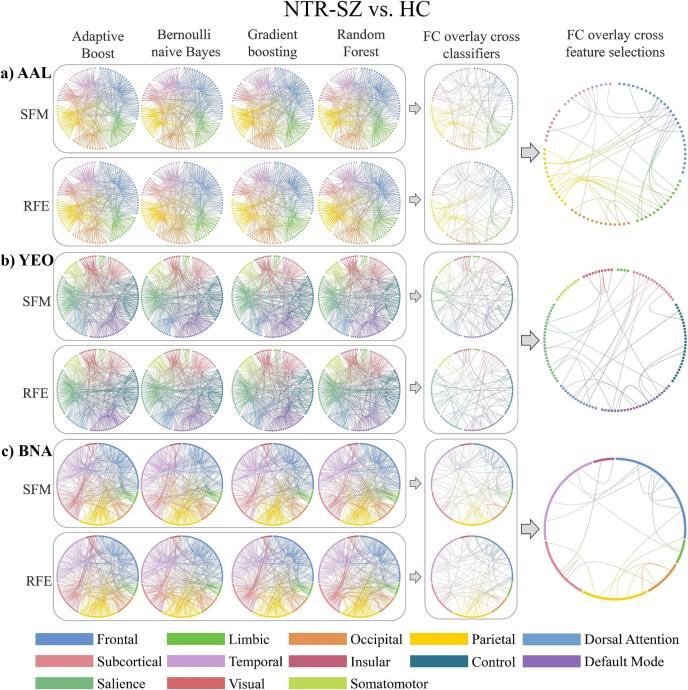
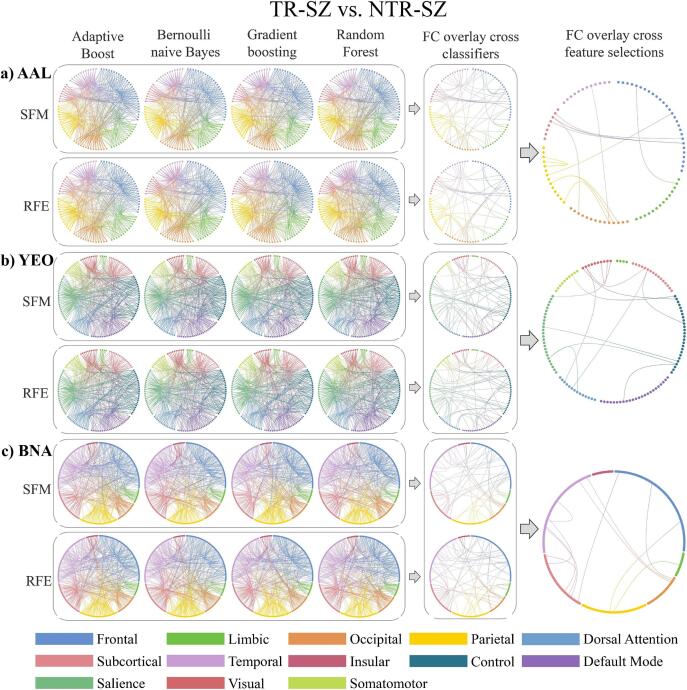
55 TR-SZs, 239 NTR-SZs, and 87 healthy controls (HCs) were recruited from the Affiliated Brain Hospital of Nanjing Medical University. Resting-state functional connection (FC) matrices were constructed from automated anatomical labeling (AAL), Yeo-Networks (YEO) and Brainnetome (BNA) atlases. Two feature selection methods (Select From Model and Recursive Feature Elimination) and four classifiers (Adaptive Boost, Bernoulli Naïve Bayes, Gradient Boosting and Random Forest) were combined to identify the consistent FCs in distinguishing TR-SZ and HC, NTR-SZ and HC, TR-SZ and NTR-SZ.
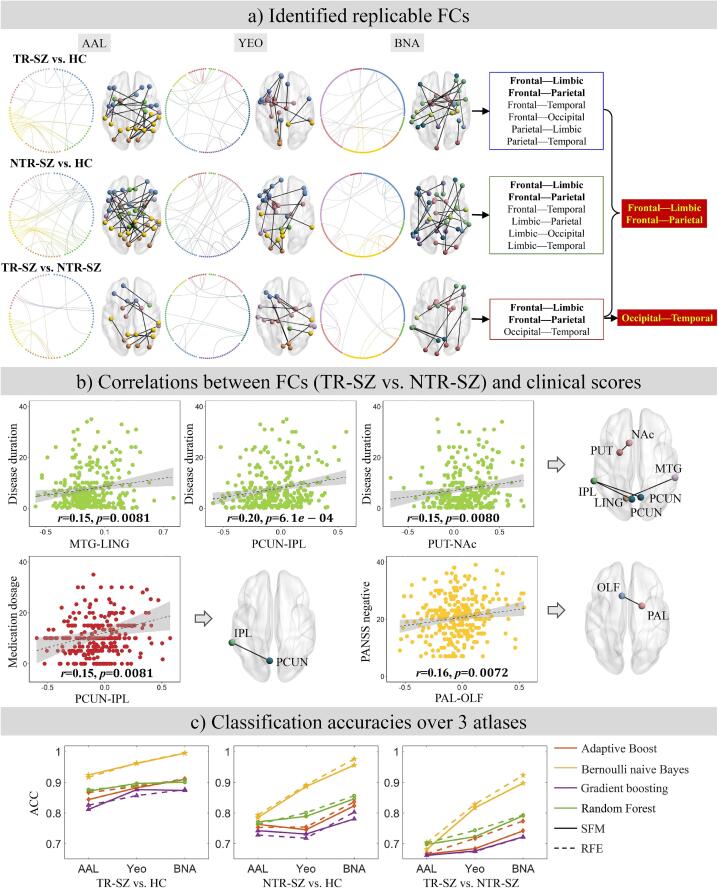
The whole brain FCs, except the temporal-occipital FC, were consistent in distinguishing SZ and HC. Abnormal frontal-limbic, frontal-parietal and occipital-temporal FCs were consistent in distinguishing TR-SZ and NTR-SZ, that were further correlated with disease progression, symptoms and medication dosage. Moreover, the frontal-limbic and frontal-parietal FCs were highly consistent for the diagnosis of SZ (TR-SZ vs. HC, NTR-SZ vs. HC and TR-SZ vs. NTR-SZ). The BNA atlas achieved the highest classification accuracy (>90 %) comparing with AAL and YEO in the most diagnostic tasks.
These results indicate that the frontal-limbic and the frontal-parietal FCs are the robust neural pathways in the diagnosis of SZ, whereas the frontal-limbic, frontal-parietal and occipital-temporal FCs may be informative in recognizing those TR-SZ in the clinical practice.
难治性精神分裂症(TR-SZ)和非难治性精神分裂症(NTR-SZ)缺乏相互区分的特异性生物标志物。本研究旨在通过不同图谱、多种特征选择策略以及多种分类器来识别区分TR-SZ和NTR-SZ时一致的功能失调脑连接。
从南京医科大学附属脑科医院招募了55例TR-SZ患者、239例NTR-SZ患者和87名健康对照(HC)。基于自动解剖标记(AAL)图谱、Yeo网络(YEO)图谱和脑网络组(BNA)图谱构建静息态功能连接(FC)矩阵。将两种特征选择方法(基于模型选择和递归特征消除)和四种分类器(自适应增强、伯努利朴素贝叶斯、梯度提升和随机森林)相结合,以识别区分TR-SZ与HC、NTR-SZ与HC、TR-SZ与NTR-SZ时一致的FC。
除颞枕叶FC外,全脑FC在区分精神分裂症患者和健康对照时具有一致性。异常的额边缘叶、额顶叶和枕颞叶FC在区分TR-SZ和NTR-SZ时具有一致性,且进一步与疾病进展、症状及药物剂量相关。此外,额边缘叶和额顶叶FC在精神分裂症诊断(TR-SZ与HC、NTR-SZ与HC以及TR-SZ与NTR-SZ)中具有高度一致性。在大多数诊断任务中,与AAL和YEO图谱相比,BNA图谱实现了最高的分类准确率(>90%)。
这些结果表明,额边缘叶和额顶叶FC是精神分裂症诊断中可靠的神经通路,而额边缘叶、额顶叶和枕颞叶FC在临床实践中识别TR-SZ患者时可能具有参考价值。