• 文献检索
  • 文档翻译
  • 深度研究
  • 学术资讯
  • Suppr Zotero 插件Zotero 插件
  • 邀请有礼
  • 套餐&价格
  • 历史记录
应用&插件
Suppr Zotero 插件Zotero 插件浏览器插件Mac 客户端Windows 客户端微信小程序
定价
高级版会员购买积分包购买API积分包
服务
文献检索文档翻译深度研究API 文档MCP 服务
关于我们
关于 Suppr公司介绍联系我们用户协议隐私条款
关注我们

Suppr 超能文献

核心技术专利:CN118964589B侵权必究
粤ICP备2023148730 号-1Suppr @ 2026

文献检索

告别复杂PubMed语法,用中文像聊天一样搜索,搜遍4000万医学文献。AI智能推荐,让科研检索更轻松。

立即免费搜索

文件翻译

保留排版,准确专业,支持PDF/Word/PPT等文件格式,支持 12+语言互译。

免费翻译文档

深度研究

AI帮你快速写综述,25分钟生成高质量综述,智能提取关键信息,辅助科研写作。

立即免费体验

肥胖与多囊卵巢综合征

Obesity and Polycystic Ovary Syndrome.

作者信息

Kim Jin Ju

机构信息

Department of Obstetrics and Gynecology, Seoul National University Hospital Healthcare System Gangnam Center, Seoul, Korea.

Department of Obstetrics and Gynecology, Seoul National University College of Medicine, Seoul, Korea.

出版信息

J Obes Metab Syndr. 2024 Dec 30;33(4):289-301. doi: 10.7570/jomes24035. Epub 2024 Dec 20.

DOI:10.7570/jomes24035
PMID:39701598
原文链接:https://pmc.ncbi.nlm.nih.gov/articles/PMC11704221/
Abstract

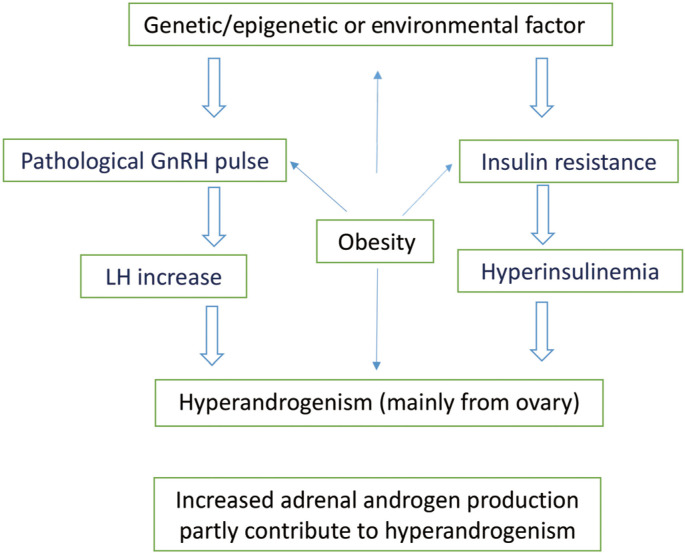
The core pathophysiology of polycystic ovary syndrome involves an overproduction of androgens primarily originating from ovarian thecal cells. Two major external triggers promote androgen overproduction in the ovaries: the increased secretion of luteinizing hormone, a consequence of aberrant hypothalamic gonadotropin-releasing hormone secretion dynamics, and compensatory hyperinsulinemia resulting from insulin resistance. Obesity interacts with polycystic ovary syndrome in multiple ways, but a major role of obesity in its pathophysiology is the exacerbation of insulin resistance. Additionally, obesity contributes to polycystic ovary syndrome by facilitating the conversion of precursor hormones to testosterone within adipose cells. Moreover, obesity can lead to relative hyperandrogenemia, which is marked by lower levels of sex hormone binding globulin and increased availability of free testosterone to target tissues. Also, obesity affects the secretion of gonadotropins, resulting in heightened luteinizing hormone secretion or increased sensitivity of thecal cells to luteinizing hormone. Obesity-related insulin resistance might be amplified by alterations in adipokine and inflammatory cytokine production. Ultimately, obesity and polycystic ovary syndrome might share a common genetic predisposition. The cornerstone of managing polycystic ovary syndrome is to address individual symptoms such as hyperandrogenism (hirsutism, acne, and female type boldness), menstrual irregularities, and infertility stemming from anovulation. However, obesity is integral to the pathophysiology of polycystic ovary syndrome and exacerbates all of its features. Therefore, lifestyle modifications aimed at weight reduction should be the primary strategy in overweight or obese women with polycystic ovary syndrome.

摘要

多囊卵巢综合征的核心病理生理学涉及主要源自卵巢卵泡膜细胞的雄激素过度产生。两个主要的外部触发因素促进卵巢雄激素过度产生:促黄体生成素分泌增加,这是下丘脑促性腺激素释放激素分泌动力学异常的结果,以及胰岛素抵抗导致的代偿性高胰岛素血症。肥胖通过多种方式与多囊卵巢综合征相互作用,但其在病理生理学中的主要作用是加剧胰岛素抵抗。此外,肥胖通过促进脂肪细胞内前体激素向睾酮的转化而导致多囊卵巢综合征。此外,肥胖可导致相对性高雄激素血症,其特征是性激素结合球蛋白水平降低,游离睾酮向靶组织的可利用性增加。此外,肥胖会影响促性腺激素的分泌,导致促黄体生成素分泌增加或卵泡膜细胞对促黄体生成素的敏感性增加。肥胖相关的胰岛素抵抗可能因脂肪因子和炎性细胞因子产生的改变而加剧。最终,肥胖和多囊卵巢综合征可能存在共同的遗传易感性。管理多囊卵巢综合征的基石是解决个体症状,如高雄激素血症(多毛、痤疮和女性型脱发)、月经不规律以及无排卵导致的不孕。然而,肥胖是多囊卵巢综合征病理生理学的一个组成部分,并加剧其所有特征。因此,对于超重或肥胖的多囊卵巢综合征女性,旨在减轻体重的生活方式改变应是主要策略。
https://cdn.ncbi.nlm.nih.gov/pmc/blobs/a01b/11704221/74779bad33a0/jomes-33-4-289-f1.jpg

相似文献

1
Obesity and Polycystic Ovary Syndrome.肥胖与多囊卵巢综合征
J Obes Metab Syndr. 2024 Dec 30;33(4):289-301. doi: 10.7570/jomes24035. Epub 2024 Dec 20.
2
AMERICAN ASSOCIATION OF CLINICAL ENDOCRINOLOGISTS, AMERICAN COLLEGE OF ENDOCRINOLOGY, AND ANDROGEN EXCESS AND PCOS SOCIETY DISEASE STATE CLINICAL REVIEW: GUIDE TO THE BEST PRACTICES IN THE EVALUATION AND TREATMENT OF POLYCYSTIC OVARY SYNDROME--PART 1.美国临床内分泌医师协会、美国内分泌学会以及雄激素过多与多囊卵巢综合征协会疾病状态临床综述:多囊卵巢综合征评估与治疗最佳实践指南——第1部分。
Endocr Pract. 2015 Nov;21(11):1291-300. doi: 10.4158/EP15748.DSC.
3
Thiazolidinediones for the therapeutic management of polycystic ovary syndrome : impact on metabolic and reproductive abnormalities.噻唑烷二酮类药物用于多囊卵巢综合征的治疗管理:对代谢和生殖异常的影响
Treat Endocrinol. 2006;5(3):171-87. doi: 10.2165/00024677-200605030-00005.
4
Obesity and the polycystic ovary syndrome.肥胖与多囊卵巢综合征
Int J Obes Relat Metab Disord. 2002 Jul;26(7):883-96. doi: 10.1038/sj.ijo.0801994.
5
Polycystic ovary syndrome.多囊卵巢综合征
Endocrinol Metab Clin North Am. 1997 Dec;26(4):893-912. doi: 10.1016/s0889-8529(05)70286-3.
6
Polycystic Ovary Syndrome.多囊卵巢综合征。
Obstet Gynecol. 2018 Aug;132(2):321-336. doi: 10.1097/AOG.0000000000002698.
7
Comparison Of Free Androgen Index In Polycystic Ovary Syndrome And Non-Polycystic Ovary Syndrome Infertile Patients.多囊卵巢综合征与非多囊卵巢综合征不孕患者游离雄激素指数的比较。
J Ayub Med Coll Abbottabad. 2021 Oct-Dec;33(4):577-581.
8
Polycystic ovary syndrome.多囊卵巢综合征
Lancet. 2007 Aug 25;370(9588):685-97. doi: 10.1016/S0140-6736(07)61345-2.
9
Women With Polycystic Ovary Syndrome: A Review of Susceptibility to Type 2 Diabetes.多囊卵巢综合征女性:2型糖尿病易感性综述
Cureus. 2023 Jan 5;15(1):e33390. doi: 10.7759/cureus.33390. eCollection 2023 Jan.
10
Clinical characteristics, metabolic features, and phenotype of Chinese women with polycystic ovary syndrome: a large-scale case-control study.中国多囊卵巢综合征女性的临床特征、代谢特征和表型:一项大规模病例对照研究。
Arch Gynecol Obstet. 2013 Mar;287(3):525-31. doi: 10.1007/s00404-012-2568-z. Epub 2012 Oct 30.

引用本文的文献

1
The Role of Pharmacists in Identifying and Preventing Drug-Related Problems in PCOS Management.药剂师在多囊卵巢综合征管理中识别和预防药物相关问题的作用。
Pharmacy (Basel). 2025 Jul 11;13(4):95. doi: 10.3390/pharmacy13040095.
2
The Anti-Mullerian Hormone as a Biomarker of Effectiveness of Metformin Hydrochloride Therapy in Polycystic Ovarian Syndrome and Insulin Resistance.抗苗勒管激素作为盐酸二甲双胍治疗多囊卵巢综合征和胰岛素抵抗有效性的生物标志物。
Healthcare (Basel). 2025 Apr 11;13(8):884. doi: 10.3390/healthcare13080884.

本文引用的文献

1
Risk of cardiocerebrovascular diseases is increased in Korean women with polycystic ovary syndrome: a nationwide cohort study.多囊卵巢综合征韩国女性患心脑血管疾病的风险增加:一项全国性队列研究。
Sci Rep. 2024 Jan 11;14(1):1055. doi: 10.1038/s41598-023-50650-y.
2
Recommendations From the 2023 International Evidence-based Guideline for the Assessment and Management of Polycystic Ovary Syndrome.2023 年多囊卵巢综合征评估和管理国际循证指南推荐。
J Clin Endocrinol Metab. 2023 Sep 18;108(10):2447-2469. doi: 10.1210/clinem/dgad463.
3
Adolescent PCOS: a postpubertal central obesity syndrome.
青春期多囊卵巢综合征:一种青春期后中心性肥胖综合征。
Trends Mol Med. 2023 May;29(5):354-363. doi: 10.1016/j.molmed.2023.02.006. Epub 2023 Mar 22.
4
Molecular basis of normal and pathological puberty: from basic mechanisms to clinical implications.正常和病理性青春期的分子基础:从基础机制到临床意义。
Lancet Diabetes Endocrinol. 2023 Mar;11(3):203-216. doi: 10.1016/S2213-8587(22)00339-4. Epub 2023 Jan 5.
5
Early programming of reproductive health and fertility: novel neuroendocrine mechanisms and implications in reproductive medicine.生殖健康和生育的早期编程:新的神经内分泌机制及其在生殖医学中的意义。
Hum Reprod Update. 2022 May 2;28(3):346-375. doi: 10.1093/humupd/dmac005.
6
On the rising incidence of early breast development: puberty as an adaptive escape from ectopic adiposity in mismatch girls.论青春期前乳房过早发育发病率上升:青春期是发育失调女孩异位脂肪堆积的适应性逃避机制。
Eur J Endocrinol. 2021 May 28;185(1):L1-L2. doi: 10.1530/EJE-21-0287.
7
Updated adolescent diagnostic criteria for polycystic ovary syndrome: impact on prevalence and longitudinal body mass index trajectories from birth to adulthood.更新的多囊卵巢综合征青少年诊断标准:对从出生到成年的患病率和纵向体重指数轨迹的影响。
BMC Med. 2020 Dec 11;18(1):389. doi: 10.1186/s12916-020-01861-x.
8
Prevalence and clinical characteristics of isolated forms of central precocious puberty: a cohort study at a single academic center.孤立型中枢性性早熟的患病率及临床特征:单中心队列研究。
Eur J Endocrinol. 2021 Feb;184(2):243-251. doi: 10.1530/EJE-20-0862.
9
Phenotype and genotype of polycystic ovary syndrome in Asia: Ethnic differences.亚洲多囊卵巢综合征的表型与基因型:种族差异
J Obstet Gynaecol Res. 2019 Dec;45(12):2330-2337. doi: 10.1111/jog.14132. Epub 2019 Oct 7.
10
Obesity and Polycystic Ovary Syndrome: Implications for Pathogenesis and Novel Management Strategies.肥胖与多囊卵巢综合征:对发病机制及新型管理策略的影响
Clin Med Insights Reprod Health. 2019 Sep 9;13:1179558119874042. doi: 10.1177/1179558119874042. eCollection 2019.