Kappel Noémi, Palla Balázs, Challa Lavanya, Mozafarian Maryam
Department of Vegetable and Mushroom Growing, Hungarian University of Agriculture and Life Sciences, Villányi Út 29-43, Budapest, Hungary.
Department of Botany, Hungarian University of Agriculture and Life Sciences, Páter K. Utca 1, Gödöllő, Hungary.
BMC Plant Biol. 2024 Dec 19;24(1):1207. doi: 10.1186/s12870-024-05926-4.
The use of vegetable grafting has proven to be effective not only in providing stress resistance but also improving fruit yields. There have been no studies on grafted vegetables' effects on the vascular systems, specifically xylem vessels. This study tested the effects of two groups of rootstocks, Solanum spp., and Solanum lycopersicum, on seedling growth, anatomical parameters, and further plant growth and yield of eggplant cv. Madonna. The experiment was arranged in a completely randomized design with four replications and five plants in each replication.
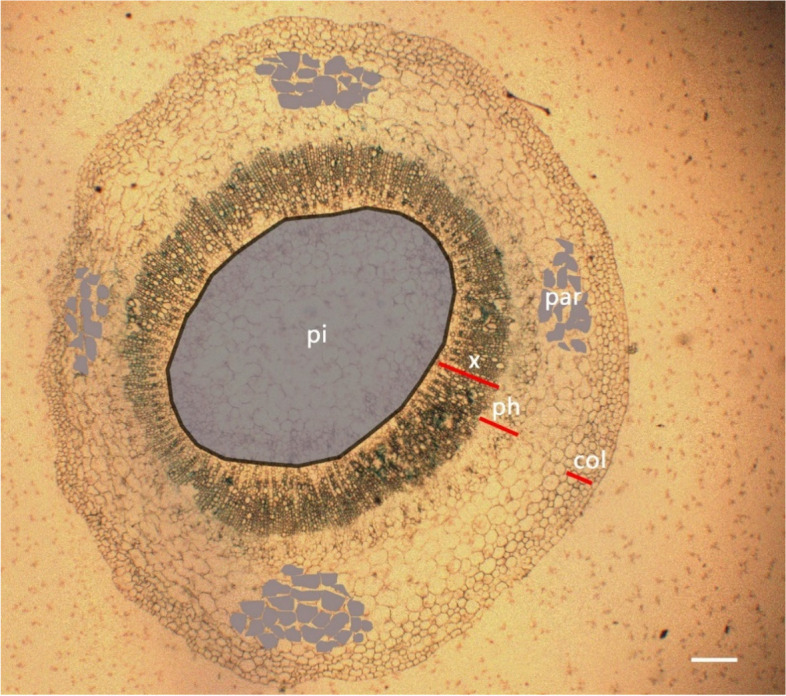
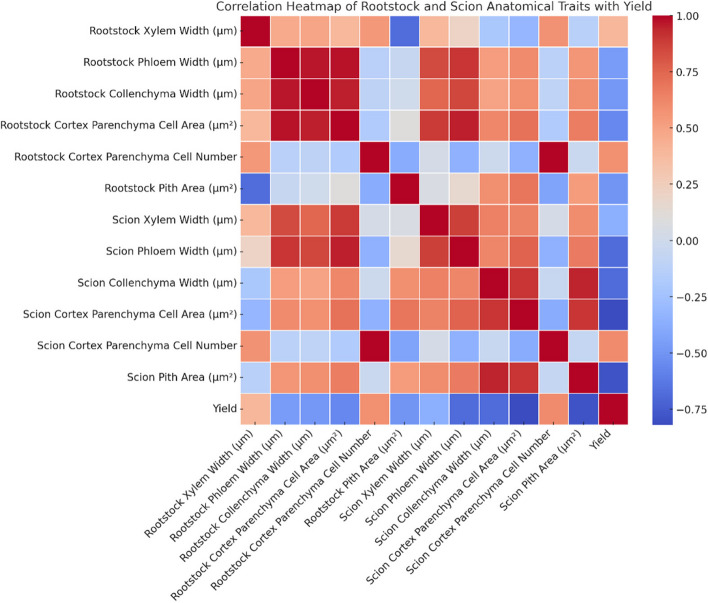
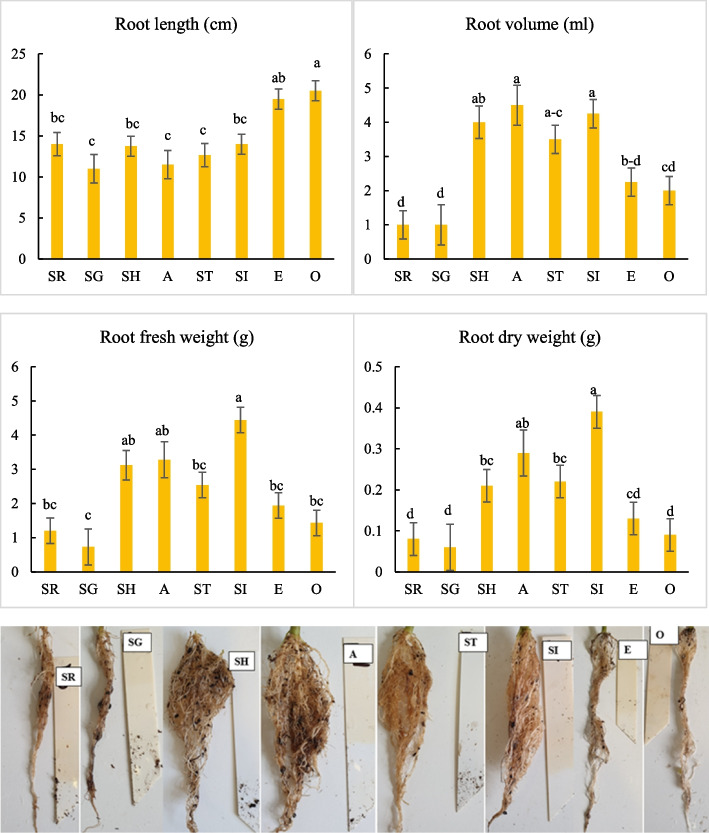
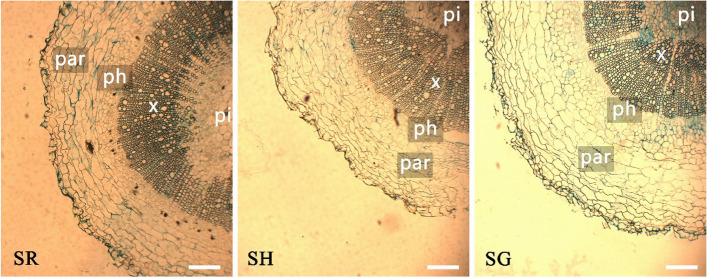
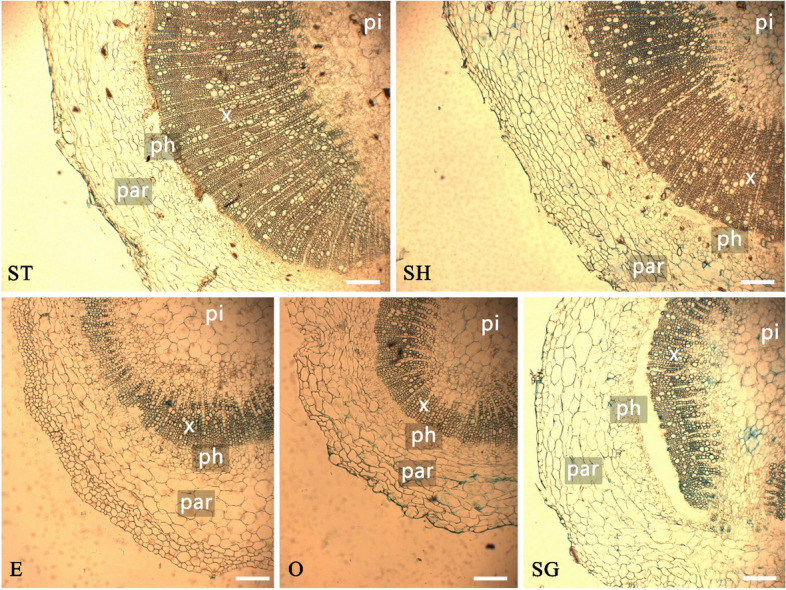
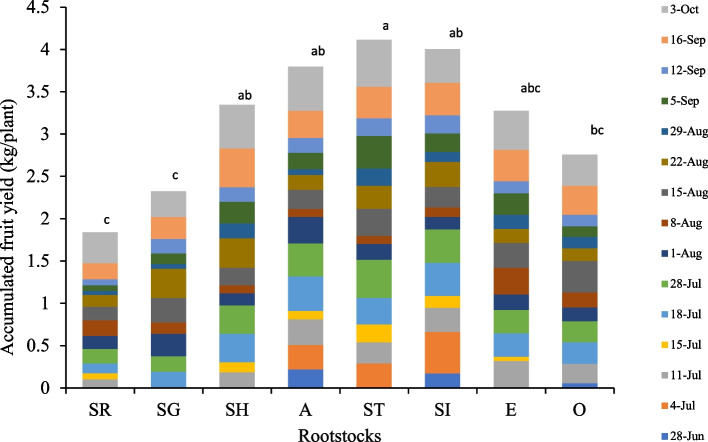
The results showed that seedling growth parameters including height, and stem diameter were significantly different between grafted and non-grafted eggplant plants. In terms of roots, cv. Optifort rootstock had the longest roots, while Solanum spp. rootstocks had the largest root volume. The radial widths of rootstock collenchyma and phloem were significantly greater in SG-self-grafted than in SR-self-rooted and in other rootstocks. Rootstock xylem area was higher in Solanum spp. than in self-rooted seedlings and cv. Emperador rootstock. Correlation analysis showed that rootstock anatomical traits, including xylem width and cortex parenchyma cell number, had significant positive correlations with yield (r = 0.40 and r = 0.58, respectively). Rootstocks such as ST (Solanum torvum) and A (Solanum integrifolium) which had wider xylem and more cortex cells, exhibited higher yields.
Rootstocks with larger xylem widths and higher cortex cell numbers, such as ST and A, promoted greater yield in grafted eggplant. These results emphasize the importance of selecting rootstock-scion combinations with favourable anatomical traits for optimal productivity.
蔬菜嫁接已被证明不仅能有效增强抗逆性,还能提高果实产量。目前尚未有关于嫁接蔬菜对维管系统,特别是木质部导管影响的研究。本研究测试了两组砧木,即茄属植物和番茄,对茄子品种麦当娜幼苗生长、解剖学参数以及后续植株生长和产量的影响。实验采用完全随机设计,共四个重复,每个重复有五株植株。
结果表明,嫁接和未嫁接的茄子植株在包括株高和茎粗在内的幼苗生长参数上存在显著差异。在根系方面,Optifort品种砧木的根最长,而茄属植物砧木的根体积最大。SG - 自嫁接砧木的厚角组织和韧皮部的径向宽度显著大于SR - 自根砧木和其他砧木。茄属植物砧木的木质部面积高于自根幼苗和皇帝品种砧木。相关性分析表明,砧木的解剖学特征,包括木质部宽度和皮层薄壁细胞数量,与产量呈显著正相关(分别为r = 0.40和r = 0.58)。木质部较宽且皮层细胞较多的砧木,如ST(刺茄)和A(少花龙葵),产量较高。
木质部宽度较大且皮层细胞数量较多的砧木,如ST和A,能促进嫁接茄子获得更高产量。这些结果强调了选择具有有利解剖学特征的砧木 - 接穗组合以实现最佳生产力的重要性。