
柑橘树对不同硼有效性的解剖学和生理学反应取决于砧木。
Anatomical and Physiological Responses of Citrus Trees to Varying Boron Availability Are Dependent on Rootstock.
作者信息
Mesquita Geisa L, Zambrosi Fernando C B, Tanaka Francisco A O, Boaretto Rodrigo M, Quaggio José A, Ribeiro Rafael V, Mattos Dirceu
机构信息
Centro de Citricultura Sylvio Moreira, Instituto Agronômico Cordeirópolis, Brazil.
Centro de Solos e Recursos Ambientais, Instituto Agronômico Campinas, Brazil.
出版信息
Front Plant Sci. 2016 Mar 4;7:224. doi: 10.3389/fpls.2016.00224. eCollection 2016.
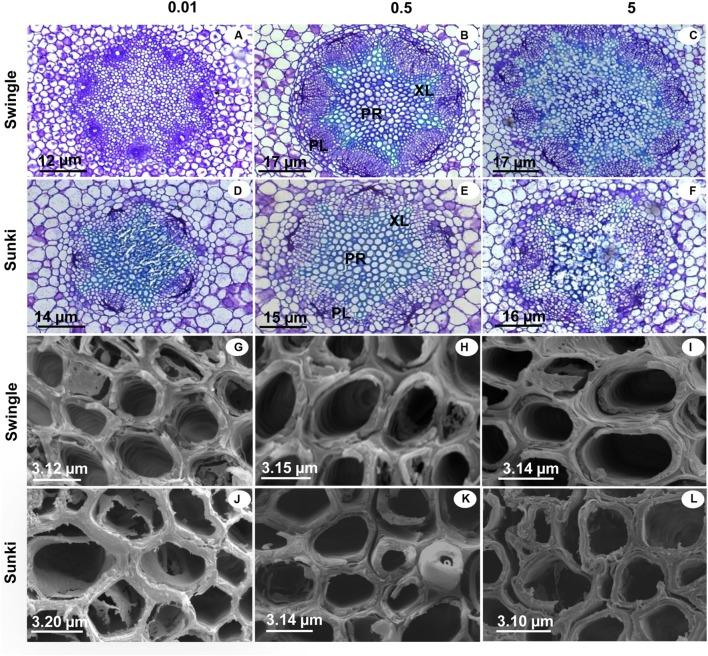
In Citrus, water, nutrient transport and thereby fruit production, are influenced among other factors, by the interaction between rootstock and boron (B) nutrition. This study aimed to investigate how B affects the anatomical structure of roots and leaves as well as leaf gas exchange in sweet orange trees grafted on two contrasting rootstocks in response to B supply. Plants grafted on Swingle citrumelo or Sunki mandarin were grown in a nutrient solution of varying B concentration (deficient, adequate, and excessive). Those grafted on Swingle were more tolerant to both B deficiency and toxicity than those on Sunki, as revealed by higher shoot and root growth. In addition, plants grafted on Sunki exhibited more severe anatomical and physiological damages under B deficiency, showing thickening of xylem cell walls and impairments in whole-plant leaf-specific hydraulic conductance and leaf CO2 assimilation. Our data revealed that trees grafted on Swingle sustain better growth under low B availablitlity in the root medium and still respond positively to increased B levels by combining higher B absorption and root growth as well as better organization of xylem vessels. Taken together, those traits improved water and B transport to the plant canopy. Under B toxicity, Swingle rootstock would also favor plant growth by reducing anatomical and ultrastructural damage to leaf tissue and improving water transport compared with plants grafted on Sunki. From a practical point of view, our results highlight that B management in citrus orchards shall take into account rootstock varieties, of which the Swingle rootstock was characterized by its performance on regulating anatomical and ultrastructural damages, improving water transport and limiting negative impacts of B stress conditions on plant growth.
在柑橘中,水分、养分运输以及果实产量会受到多种因素影响,其中砧木与硼(B)营养之间的相互作用尤为重要。本研究旨在探究硼如何影响嫁接在两种截然不同砧木上的甜橙树根系和叶片的解剖结构以及叶片气体交换,以响应硼的供应情况。将嫁接在枳柚或日向夏橘上的植株种植在硼浓度不同(缺乏、充足和过量)的营养液中。结果表明,嫁接在枳柚上的植株比嫁接在日向夏橘上的植株对硼缺乏和毒性更具耐受性,表现为地上部和根系生长更好。此外,嫁接在日向夏橘上的植株在硼缺乏时表现出更严重的解剖和生理损伤,包括木质部细胞壁增厚以及全株叶片比水力导度和叶片二氧化碳同化受损。我们的数据显示,嫁接在枳柚上的树在根系介质中硼有效性较低的情况下生长更好,并且通过增加硼吸收、根系生长以及更好地组织木质部导管,对硼水平升高仍能做出积极响应。综上所述,这些特性改善了水分和硼向树冠的运输。在硼毒性条件下,与嫁接在日向夏橘上的植株相比,枳柚砧木还通过减少对叶片组织的解剖和超微结构损伤以及改善水分运输来促进植株生长。从实际角度来看,我们的结果突出表明,柑橘果园的硼管理应考虑砧木品种,其中枳柚砧木的特点是在调节解剖和超微结构损伤、改善水分运输以及限制硼胁迫条件对植株生长的负面影响方面表现出色。


 Zotero 插件