Feng Xin, Liu Ming, Song Weie, Ji Yixuan, Luo Feng
State Key Laboratory of Oral Diseases & National Center for Stomatology & National Clinical Research Center for Oral Diseases, West China Hospital of Stomatology, Sichuan University, Chengdu, Sichuan, 610041, China.
Department of Prosthodontics, West China School of Stomatology, Sichuan University, Chengdu, 610041, China.
BMC Oral Health. 2024 Dec 19;24(1):1503. doi: 10.1186/s12903-024-05265-8.
The aim of the present study is to evaluate the accuracy of a digital template on the three-dimensional accuracy of edentulous implantation through a retrospective study to provide more clinical evidence for the use of digital templates in edentulous patient.
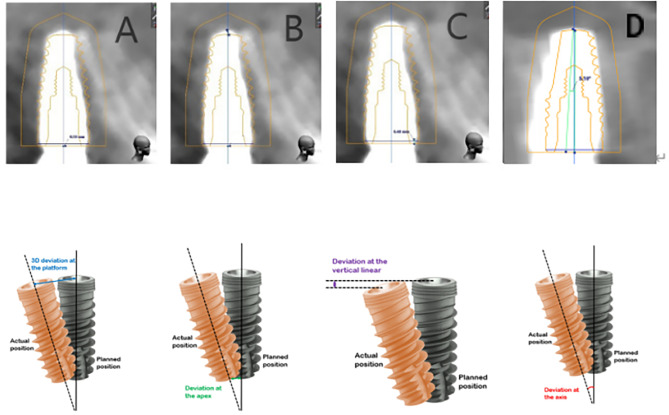
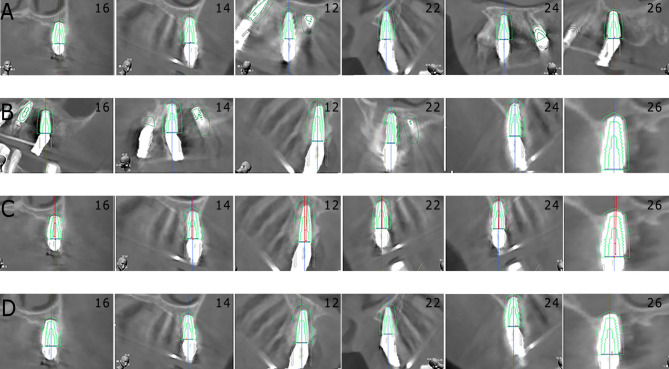
This study evaluates the efficacy of a digital surgical template in edentulous jaws, comparing preoperative plans with postoperative outcomes across four metrics: platform, apex, depth, and angular deviations. Utilizing a patient with an edentulous maxilla as a case study, this research employs CBCT for preoperative and postoperative assessments, with deviations analyzed via 3-Shape software. Comparing these deviations with average deviations in lierature.
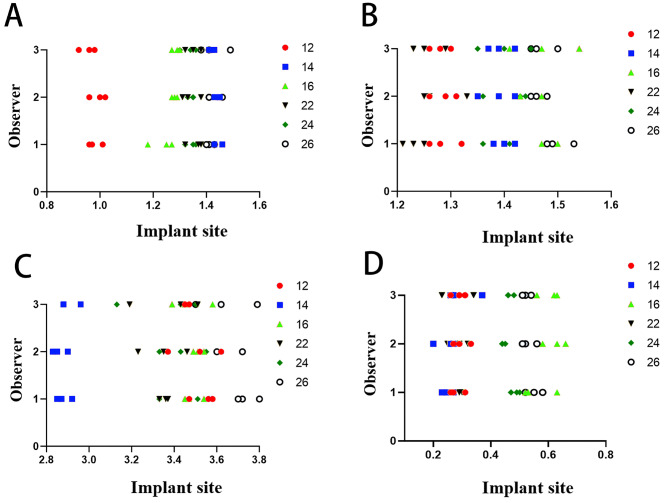
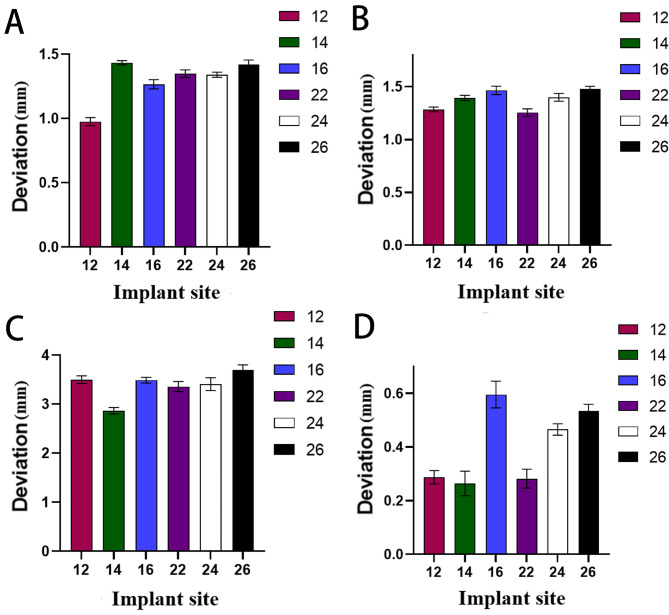
The average platform deviations at positions 12, 14, 16, 22, 24, 26 were 0.98 ± 0.03 mm, 1.43 ± 0.02 mm, 1.27 ± 0.04 mm, 1.35 ± 0.03 mm, 1.34 ± 0.02 mm, and 1.42 ± 0.03 mm, respectively. The average apex deviations were 1.28 ± 0.02 mm, 1.39 ± 0.03 mm, 1.47 ± 0.04 mm, 1.26 ± 0.04 mm, 1.40 ± 0.04 mm, and 1.48 ± 0.03 mm, respectively, the average angular deviations were 3.50°± 0.08°, 2.87°± 0.07°, 3.49°± 0.06°, 3.36°± 0.10°, 3.41°± 0.13°, and 3.69°± 0.11°, and average depth deviations were 0.29 ± 0.03 mm, 0.26 ± 0.05 mm, 0.59 ± 0.05 mm, 0.28 ± 0.04 mm, 0.47 ± 0.02 mm, 0.53 ± 0.03 mm. Compared with a total mean deviation of 1.2 mm (1.04 mm to 1.44 mm) of platform deviation, 1.4 mm (1.28 mm to 1.58 mm) of apex deviation, angular deviation of 3.5°(3.0° to 3.96°) and depth deviation of 0.2 mm (-0.25 mm to 0.57 mm) reported in literature. While all measured deviations fell within clinically acceptable limits, certain parameters exceeded the benchmarks, suggesting areas for improvement in digital surgical planning and execution.
This study indicates that while all measured deviations fell within clinically acceptable limits, certain parameters exceeded the benchmarks, suggesting areas for improvement in digital surgical planning and execution. Based on these data, the potential of digital guide plates to fulfill precision requirements in edentulous jaw implantation can be proved, contributing valuable insights into the optimization of implant surgery protocols.
Now, the digital template is accepted by many doctors. However, clinical research has not thoroughly verified whether the new digital technology is more accurate than traditional technology. So, this study aims to explore the effect of a whole-process digital template on edentulous implantation and provide more clinical evidence.
本研究旨在通过一项回顾性研究评估数字模板在无牙颌种植三维精度方面的准确性,为数字模板在无牙颌患者中的应用提供更多临床证据。
本研究评估数字手术模板在无牙颌中的有效性,通过四个指标(平台、根尖、深度和角度偏差)比较术前计划与术后结果。以一名无牙颌上颌患者为例进行研究,采用CBCT进行术前和术后评估,并通过3-Shape软件分析偏差。将这些偏差与文献中的平均偏差进行比较。
12、14、16、22、24、26位点的平均平台偏差分别为0.98±0.03mm、1.43±0.02mm、1.27±0.04mm、1.35±0.03mm、1.34±0.02mm和1.42±0.03mm。平均根尖偏差分别为1.28±0.02mm、1.39±0.03mm、1.47±0.04mm、1.26±0.04mm、1.40±0.04mm和1.48±0.03mm,平均角度偏差分别为3.50°±0.08°、2.87°±0.07°、3.49°±0.06°、3.36°±0.10°、3.41°±0.13°和3.69°±0.11°,平均深度偏差分别为0.29±0.03mm、0.26±0.05mm、0.59±0.05mm、0.28±0.04mm、0.47±0.02mm和0.53±0.03mm。与文献报道的平台偏差总平均偏差1.2mm(1.04mm至1.44mm)、根尖偏差1.4mm(1.28mm至1.58mm)、角度偏差3.5°(3.0°至3.96°)和深度偏差0.2mm(-0.25mm至0.57mm)相比。虽然所有测量偏差均在临床可接受范围内,但某些参数超过了基准,表明数字手术规划和执行方面存在改进空间。
本研究表明,虽然所有测量偏差均在临床可接受范围内,但某些参数超过了基准,表明数字手术规划和执行方面存在改进空间。基于这些数据,可以证明数字导板在无牙颌种植中满足精度要求的潜力,为优化种植手术方案提供有价值的见解。
目前,数字模板已被许多医生接受。然而,临床研究尚未充分验证这种新数字技术是否比传统技术更准确。因此,本研究旨在探讨全流程数字模板对无牙颌种植的影响,并提供更多临床证据。