Nuoffer Melanie G, Schindel Anika, Lefebvre Stephanie, Wüthrich Florian, Nadesalingam Niluja, Kyrou Alexandra, Kerkeni Hassen, Kalla Roger, Bernard Jessica, Walther Sebastian
Translational Research Center, University Hospital of Psychiatry and Psychotherapy, University of Bern, Bern, Switzerland.
Graduate School for Health Sciences, University of Bern, Bern, Switzerland.
Schizophrenia (Heidelb). 2024 Dec 19;10(1):118. doi: 10.1038/s41537-024-00534-5.
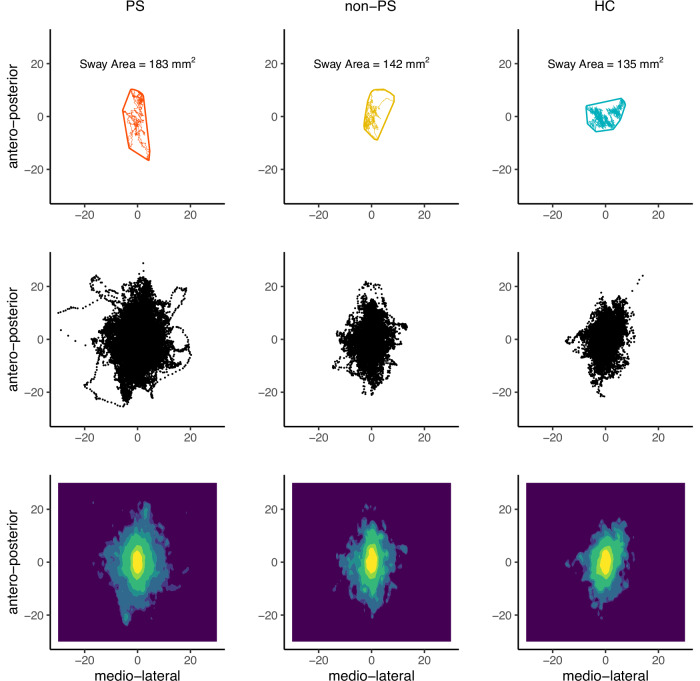
Motor abnormalities, including psychomotor slowing, are prevalent in a large proportion of individuals with schizophrenia. While postural control deficits have been observed in this population, the impact of motor abnormalities on postural stability remains unclear. This study aimed to objectively evaluate postural stability in patients with and without psychomotor slowing and healthy controls. Seventy-three schizophrenia patients with psychomotor slowing (PS; Salpêtrière Retardation Rating Scale (SRRS) ≥ 15), 25 schizophrenia patients without psychomotor slowing (non-PS; SRRS < 15), and 27 healthy controls (HC) performed four conditions on the Kistler force plate: eyes open (EO), eyes closed (EC), head reclined with eyes open (EOHR), and head reclined with eyes closed (ECHR). Larger sway areas and higher Root Mean Square (RMS) values indicate lower postural stability, while a lower Complexity Index (CI) reflects reduced adaptability, flexibility, and dynamic functioning of postural control. PS exhibited larger sway areas and higher RMS compared to the other groups. Both PS and non-PS showed reduced complexity in postural control compared to healthy controls, without differences between the two patient groups. Reduced postural stability and complexity were associated with greater expert-rated motor abnormalities, as well as more severe negative symptoms. Additionally, lower complexity was linked to reduced physical activity levels. These findings suggest that psychomotor slowing is associated with lower postural stability, potentially reflecting impaired cerebellar function. Furthermore, the loss of complexity in postural control highlights reduced flexibility, adaptability, and efficiency in the postural control network of individuals with schizophrenia.
运动异常,包括精神运动迟缓,在很大比例的精神分裂症患者中普遍存在。虽然在这一人群中已观察到姿势控制缺陷,但运动异常对姿势稳定性的影响仍不清楚。本研究旨在客观评估有和没有精神运动迟缓的患者以及健康对照者的姿势稳定性。73名有精神运动迟缓的精神分裂症患者(PS;萨尔佩特里埃迟缓评定量表(SRRS)≥15)、25名无精神运动迟缓的精神分裂症患者(非PS;SRRS<15)和27名健康对照者(HC)在奇石乐测力板上进行了四种条件测试:睁眼(EO)、闭眼(EC)、睁眼时头部后仰(EOHR)和闭眼时头部后仰(ECHR)。更大的摆动面积和更高的均方根(RMS)值表明姿势稳定性较低,而较低的复杂性指数(CI)反映姿势控制的适应性、灵活性和动态功能降低。与其他组相比,PS组表现出更大的摆动面积和更高的RMS值。与健康对照者相比,PS组和非PS组在姿势控制方面均表现出复杂性降低,两组患者之间无差异。姿势稳定性和复杂性降低与专家评定的更严重运动异常以及更严重负性症状相关。此外,较低的复杂性与身体活动水平降低有关。这些发现表明,精神运动迟缓与较低的姿势稳定性相关,这可能反映了小脑功能受损。此外,姿势控制复杂性的丧失突出了精神分裂症患者姿势控制网络的灵活性、适应性和效率降低。