Namireddy Srikar R, Gill Saran S, Peerbhai Amaan, Kamath Abith G, Ramsay Daniele S C, Ponniah Hariharan Subbiah, Salih Ahmed, Jankovic Dragan, Kalasauskas Darius, Neuhoff Jonathan, Kramer Andreas, Russo Salvatore, Thavarajasingam Santhosh G
Imperial Brain & Spine Initiative, Imperial College London, London, UK.
Faculty of Medicine, Imperial College London, London, UK.
Sci Rep. 2024 Dec 19;14(1):30560. doi: 10.1038/s41598-024-75628-2.
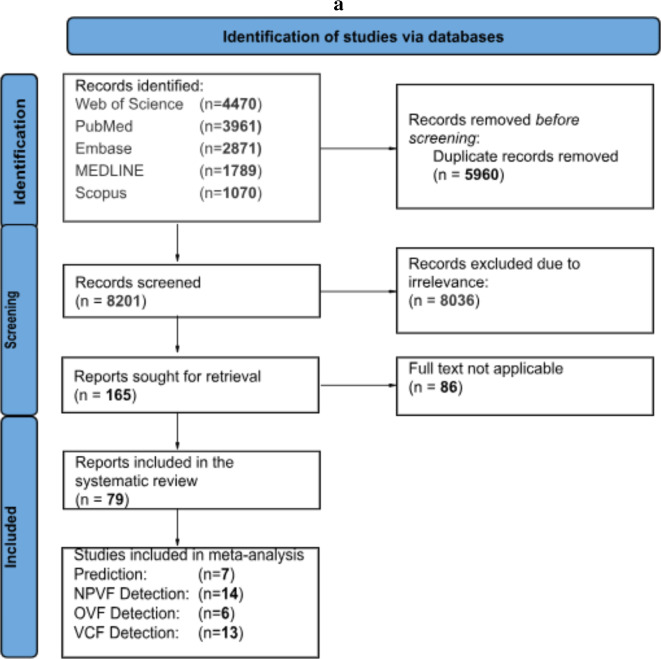
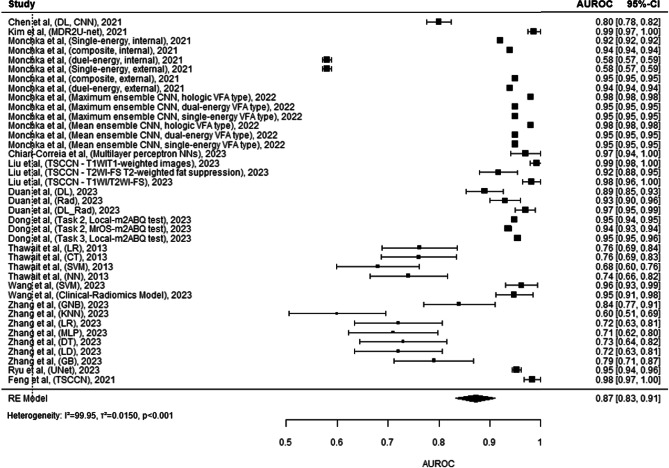
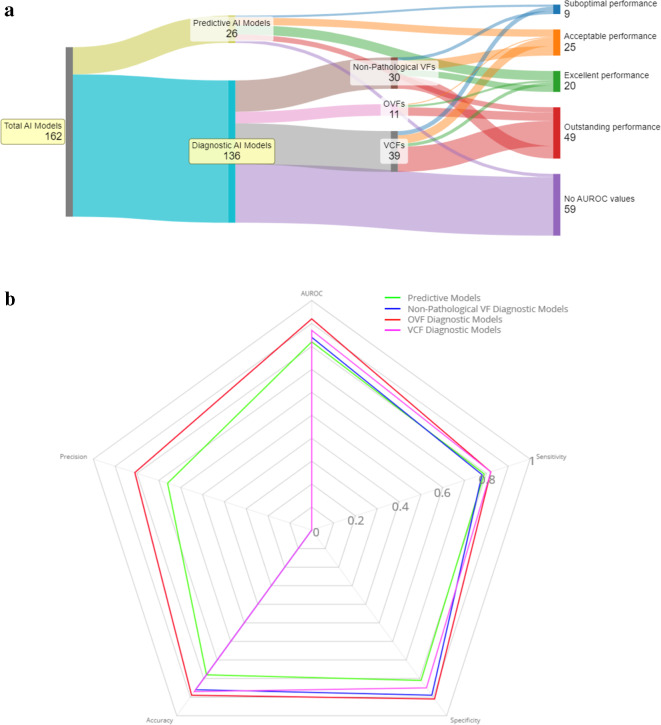
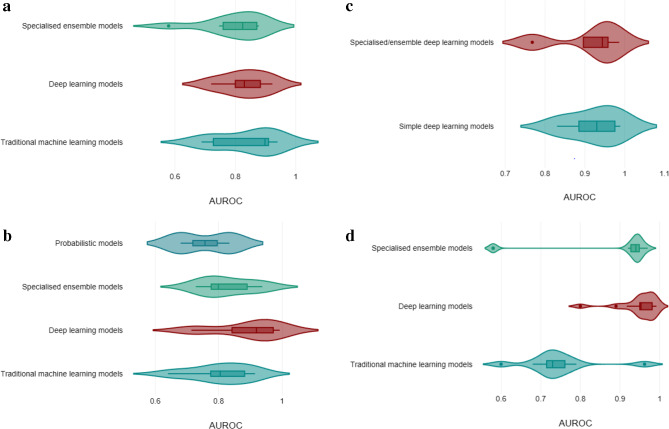
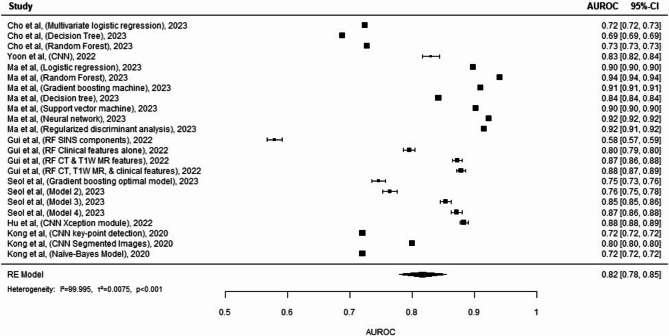
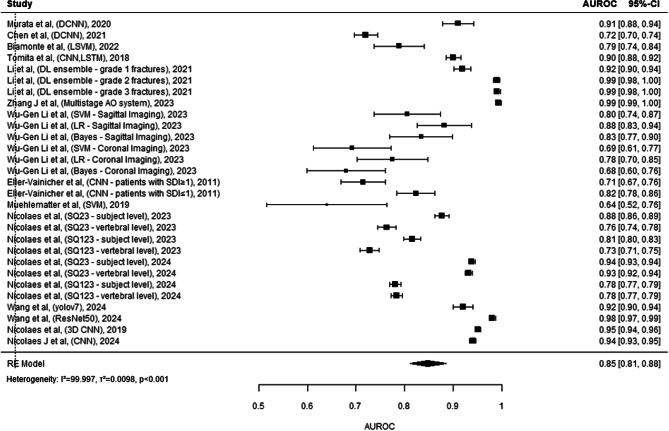
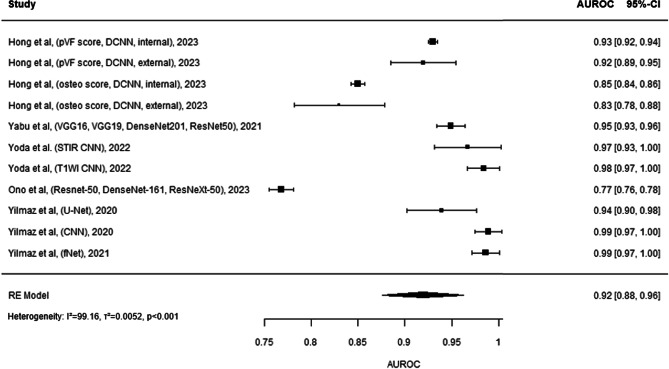
With the increasing prevalence of vertebral fractures, accurate diagnosis and prognostication are essential. This study assesses the effectiveness of AI in diagnosing and predicting vertebral fractures through a systematic review and meta-analysis. A comprehensive search across major databases selected studies utilizing AI for vertebral fracture diagnosis or prognosis. Out of 14,161 studies initially identified, 79 were included, with 40 undergoing meta-analysis. Diagnostic models were stratified by pathology: non-pathological vertebral fractures, osteoporotic vertebral fractures, and vertebral compression fractures. The primary outcome measure was AUROC. AI showed high accuracy in diagnosing and predicting vertebral fractures: predictive AUROC = 0.82, osteoporotic vertebral fracture diagnosis AUROC = 0.92, non-pathological vertebral fracture diagnosis AUROC = 0.85, and vertebral compression fracture diagnosis AUROC = 0.87, all significant (p < 0.001). Traditional models had the highest median AUROC (0.90) for fracture prediction, while deep learning models excelled in diagnosing all fracture types. High heterogeneity (I² > 99%, p < 0.001) indicated significant variation in model design and performance. AI technologies show considerable promise in improving the diagnosis and prognostication of vertebral fractures, with high accuracy. However, observed heterogeneity and study biases necessitate further research. Future efforts should focus on standardizing AI models and validating them across diverse datasets to ensure clinical utility.
随着椎体骨折的患病率不断上升,准确的诊断和预后至关重要。本研究通过系统评价和荟萃分析评估了人工智能在诊断和预测椎体骨折方面的有效性。在主要数据库中进行全面检索,选择使用人工智能进行椎体骨折诊断或预后的研究。在最初确定的14161项研究中,纳入了79项,其中40项进行了荟萃分析。诊断模型按病理分层:非病理性椎体骨折、骨质疏松性椎体骨折和椎体压缩骨折。主要结局指标是受试者工作特征曲线下面积(AUROC)。人工智能在诊断和预测椎体骨折方面显示出高准确性:预测性AUROC = 0.82,骨质疏松性椎体骨折诊断AUROC = 0.92,非病理性椎体骨折诊断AUROC = 0.85,椎体压缩骨折诊断AUROC = 0.87,均具有显著性(p < 0.001)。传统模型在骨折预测方面的中位数AUROC最高(0.90),而深度学习模型在诊断所有骨折类型方面表现出色。高异质性(I² > 99%,p < 0.001)表明模型设计和性能存在显著差异。人工智能技术在提高椎体骨折的诊断和预后方面显示出巨大潜力,具有高准确性。然而,观察到的异质性和研究偏差需要进一步研究。未来的工作应集中在标准化人工智能模型并在不同数据集上进行验证,以确保其临床实用性。