Picetti Edoardo, Marchesini Nicolò, Biffl Walter L, Biffl Susan E, Catena Fausto, Coimbra Raul, Fehlings Michael G, Peul Wilco C, Robba Chiara, Salvagno Michele, Taccone Fabio S, Demetriades Andreas K
Department of Anesthesia and Intensive Care, Parma University Hospital, Parma, Italy.
Department of Neuroscience, Biomedicine and Movement, Section of Neurosurgery, University of Verona, Verona, Italy.
Brain Spine. 2024 Nov 28;4:104146. doi: 10.1016/j.bas.2024.104146. eCollection 2024.
Traumatic spinal cord injury (tSCI) is frequently observed in polytrauma patients.
What is the optimal strategy to manage tSCI in the setting of polytrauma?
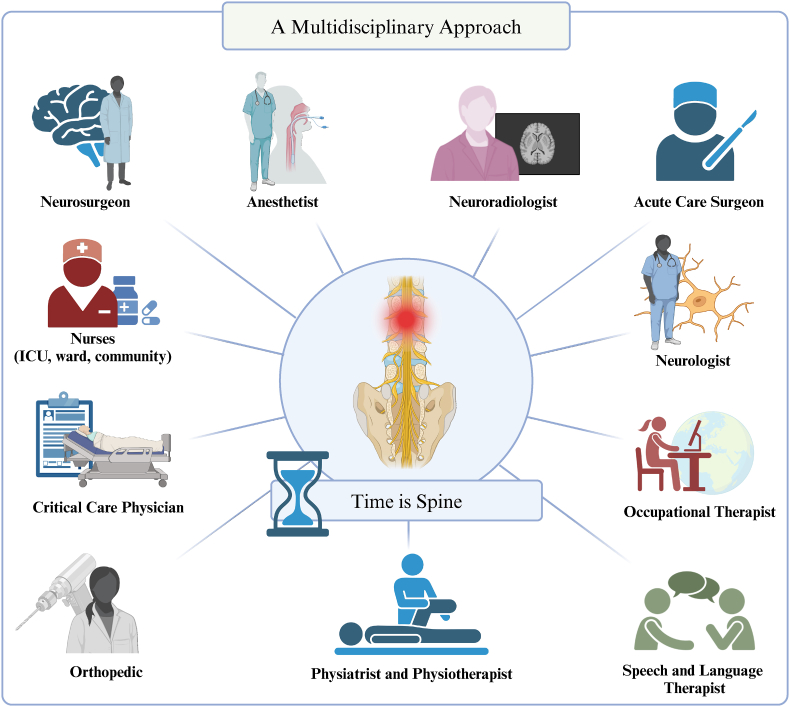
This narrative review focuses on: 1) extraspinal damage control surgery and resuscitation, 2) the perioperative protection of the injured spine during emergency surgery, 3) imaging and timing of spinal surgery in polytrauma, 4) early interventions for skin, bowel and bladder, and 5) the multidisciplinary approach to tSCI polytrauma patients.
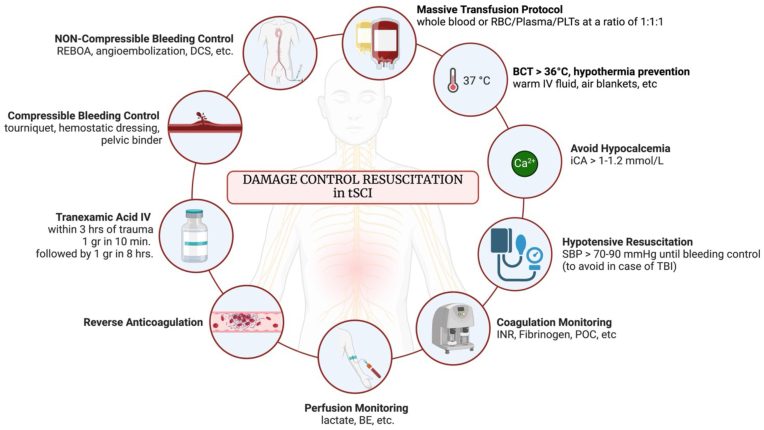
Damage control resuscitation (DCR) and damage control surgery (DCS), aim to prevent/correct post-traumatic physiological derangements to minimize bleeding until definitive hemostasis is achieved. Spinal protection during emergency surgery is of paramount importance to reduce secondary insults to the injured spine. Imaging, especially magnetic resonance imaging (MRI), is useful for decision-making regarding surgical management of the injured spine. Early decompressive surgery (within 24 h from trauma) is associated with better neurological outcomes. Early consultation with a physical medicine and rehabilitation physician is beneficial to optimize recovery. A close collaboration between different medical specialties involved in the early management of tSCI patients with polytrauma is advisable to improve outcome.
This narrative review aims to collate basic knowledge regarding acute phase management of tSCI patients in the context of polytrauma. More evidence and data form well-powered studies are necessary in this setting.
创伤性脊髓损伤(tSCI)在多发伤患者中很常见。
在多发伤情况下,管理tSCI的最佳策略是什么?
本叙述性综述重点关注:1)脊柱外损伤控制手术与复苏;2)急诊手术期间对受伤脊柱的围手术期保护;3)多发伤中脊柱手术的影像学检查与时机;4)皮肤、肠道和膀胱的早期干预;5)tSCI多发伤患者的多学科治疗方法。
损伤控制复苏(DCR)和损伤控制手术(DCS)旨在预防/纠正创伤后生理紊乱,以减少出血,直至实现确定性止血。急诊手术期间的脊柱保护对于减少对受伤脊柱的二次损伤至关重要。影像学检查,尤其是磁共振成像(MRI),有助于对受伤脊柱的手术管理做出决策。早期减压手术(创伤后24小时内)与更好的神经功能结果相关。早期咨询物理医学与康复医师有助于优化恢复。建议参与tSCI多发伤患者早期管理的不同医学专科之间密切合作,以改善治疗结果。
本叙述性综述旨在整理多发伤背景下tSCI患者急性期管理的基础知识。在这种情况下,需要更多来自有力研究的证据和数据。