McKernan Michael J, Diaz Miguel A, Kucharik Michael, Coutelle Nino, Simon Peter, Doarn Michael C
Florida Orthopaedic Institute, Tampa, FL.
Foundation for Orthopaedic Research & Education, Tampa, FL.
J Hand Surg Glob Online. 2024 Sep 20;6(6):898-902. doi: 10.1016/j.jhsg.2024.08.014. eCollection 2024 Nov.
The purpose of this study was to evaluate the biomechanical properties of SutureTape as an alternative technique for arthrodesis of the metacarpophalangeal (MCP) and proximal interphalangeal (PIP) joint arthrodesis when compared with surgical steel wire.
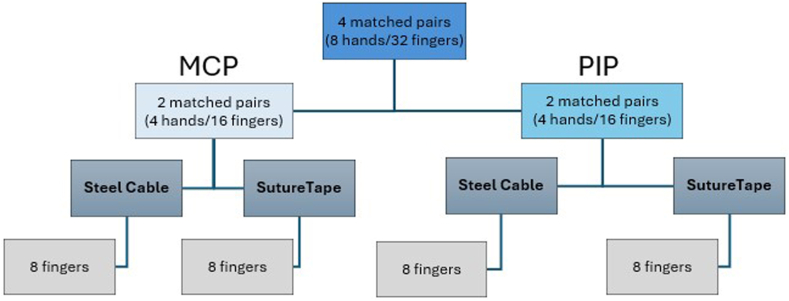
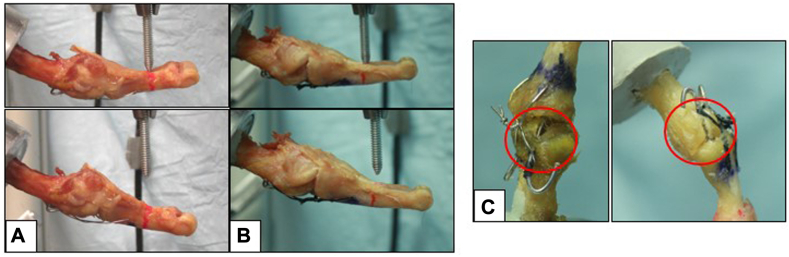
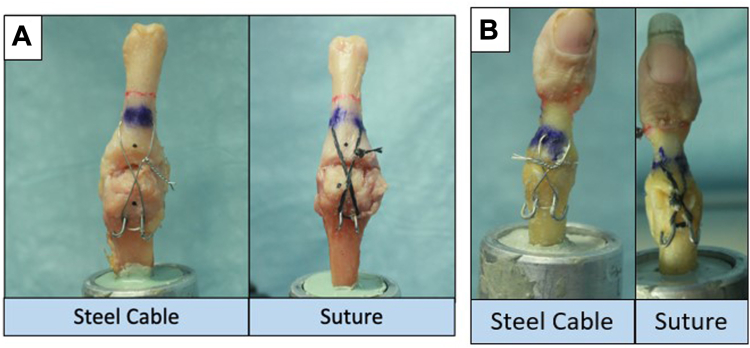
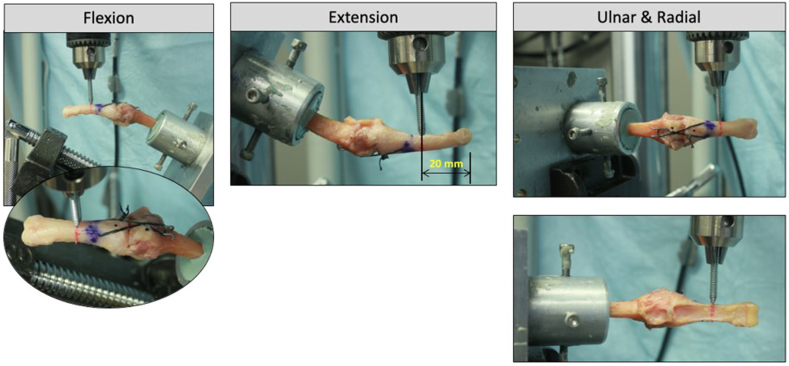
A total of 32 fingers (index, long, ring, and small) from two matched pair cadaveric hands were used. K-wire and surgical steel wire were used for MCP and PIP joint arthrodesis of the control group (group I), whereas K-wire and SutureTape were used for the experimental group (group II). Each sample was potted in high strength resin and secured to a custom fixture mounted to a hydraulic test frame. Each sample underwent cantilever bending in four directions (flexion, extension, ulnar, and radial) at a rate of 0.01 mm/s until a maximum force of 10 N. Thereafter, ramp to failure in extension at a rate of 20 mm/min was performed. Metrics of interest were bending stiffness (N/mm), displacement (mm), and peak load to failure (N), along with failure modes.
For MCP arthrodesis, during cantilever bending in flexion direction, surgical steel construct was found to be stiffer when compared with suture tape ( = .036) and have less displacement ( = .040). No significant differences were detected for stiffness or displacement in extension, ulnar, or radial bending. During the ramp to failure, no significant differences were found for force, stiffness, or displacement. For PIP arthrodesis, the only significant difference detected was for displacement during ulnar bending ( = .035).
For MCP and PIP arthrodesis, the biomechanical performance of the SutureTape arthrodesis was similar to that of the steel wire across all loading conditions except for flexion and ulnar loading.
The use of SutureTape for MCP and PIP joint arthrodesis may provide equivalent biomechanical performance to that of steel wire, making it a viable alternative clinically.
本研究旨在评估与外科钢丝相比,缝合带作为掌指关节(MCP)和近端指间关节(PIP)关节融合术替代技术的生物力学性能。
使用来自两副匹配尸体手的共32根手指(示指、中指、环指和小指)。对照组(I组)的MCP和PIP关节融合术使用克氏针和外科钢丝,而实验组(II组)使用克氏针和缝合带。每个样本被封装在高强度树脂中,并固定到安装在液压测试框架上的定制夹具上。每个样本在四个方向(屈曲、伸展、尺侧和桡侧)以0.01 mm/s的速率进行悬臂弯曲,直至达到10 N的最大力。此后,以20 mm/min的速率进行伸展至破坏的斜坡加载。感兴趣的指标包括弯曲刚度(N/mm)、位移(mm)和破坏峰值载荷(N),以及破坏模式。
对于MCP关节融合术,在屈曲方向的悬臂弯曲过程中,发现外科钢丝结构比缝合带更硬(P = 0.036)且位移更小(P = 0.040)。在伸展、尺侧或桡侧弯曲中,刚度或位移未检测到显著差异。在斜坡加载至破坏过程中,力、刚度或位移未发现显著差异。对于PIP关节融合术,唯一检测到的显著差异是尺侧弯曲时的位移(P = 0.035)。
对于MCP和PIP关节融合术,除屈曲和尺侧加载外,缝合带关节融合术在所有加载条件下的生物力学性能与钢丝相似。
将缝合带用于MCP和PIP关节融合术可能提供与钢丝相当 的生物力学性能,使其在临床上成为一种可行的替代方法。