Bennett Julia C, Deloria Knoll Maria, Kagucia Eunice W, Garcia Quesada Maria, Zeger Scott L, Hetrich Marissa K, Yang Yangyupei, Herbert Carly, Ogyu Anju, Cohen Adam L, Yildirim Inci, Winje Brita A, von Gottberg Anne, Viriot Delphine, van der Linden Mark, Valentiner-Branth Palle, Suga Shigeru, Steens Anneke, Skoczynska Anna, Sinkovec Zorko Nadja, Scott J Anthony, Savulescu Camelia, Savrasova Larisa, Sanz Juan Carlos, Russell Fiona, Ricketson Leah J, Puentes Rodrigo, Nuorti J Pekka, Mereckiene Jolita, McMahon Kimberley, McGeer Allison, Mad'arová Lucia, Mackenzie Grant A, MacDonald Laura, Lepp Tiia, Ladhani Shamez N, Kristinsson Karl G, Kozakova Jana, Klein Nicola P, Jayasinghe Sanjay, Ho Pak-Leung, Hilty Markus, Heyderman Robert S, Hasanuzzaman Md, Hammitt Laura L, Guevara Marcela, Grgic-Vitek Marta, Gierke Ryan, Georgakopoulou Theano, Galloway Yvonne, Diawara Idrissa, Desmet Stefanie, De Wals Philippe, Dagan Ron, Colzani Edoardo, Cohen Cheryl, Ciruela Pilar, Chuluunbat Urtnasan, Chan Guanhao, Camilli Romina, Bruce Michael G, Brandileone Maria-Cristina C, Bigogo Godfrey, Ampofo Krow, O'Brien Katherine L, Feikin Daniel R, Hayford Kyla
Johns Hopkins Bloomberg School of Public Health, Baltimore, MD, USA.
Epidemiology and Demography Department, KEMRI-Wellcome Trust Research Programme, Centre for Geographic Medicine Coast, Kilifi, Kenya.
Lancet Infect Dis. 2025 Apr;25(4):457-470. doi: 10.1016/S1473-3099(24)00665-0. Epub 2024 Dec 17.
Pneumococcal conjugate vaccines (PCVs) that are ten-valent (PCV10) and 13-valent (PCV13) became available in 2010. We evaluated their global impact on invasive pneumococcal disease (IPD) incidence in all ages.
Serotype-specific IPD cases and population denominators were obtained directly from surveillance sites using PCV10 or PCV13 in their national immunisation programmes and with a primary series uptake of at least 50%. Annual incidence rate ratios (IRRs) were estimated comparing the incidence before any PCV with each year post-PCV10 or post-PCV13 introduction using Bayesian multi-level, mixed-effects Poisson regressions, by site and age group. All site-weighted average IRRs were estimated using linear mixed-effects regression, stratified by product and previous seven-valent PCV (PCV7) effect (none, moderate, or substantial).
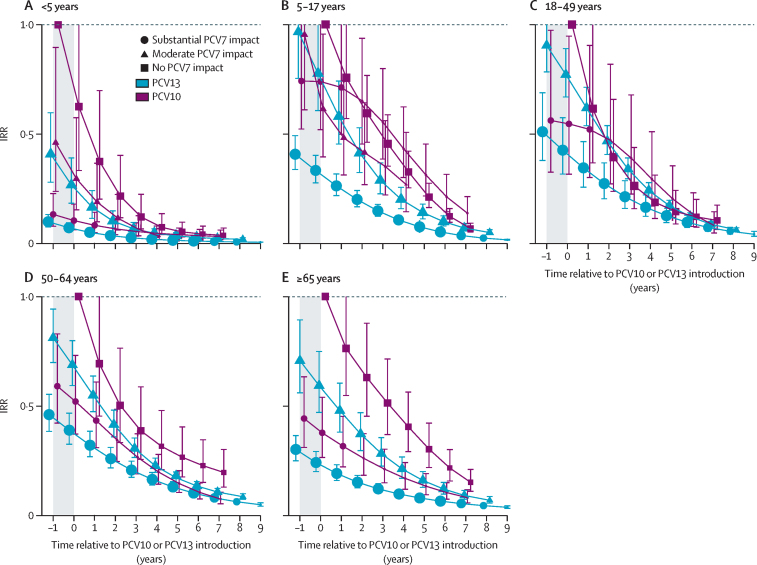
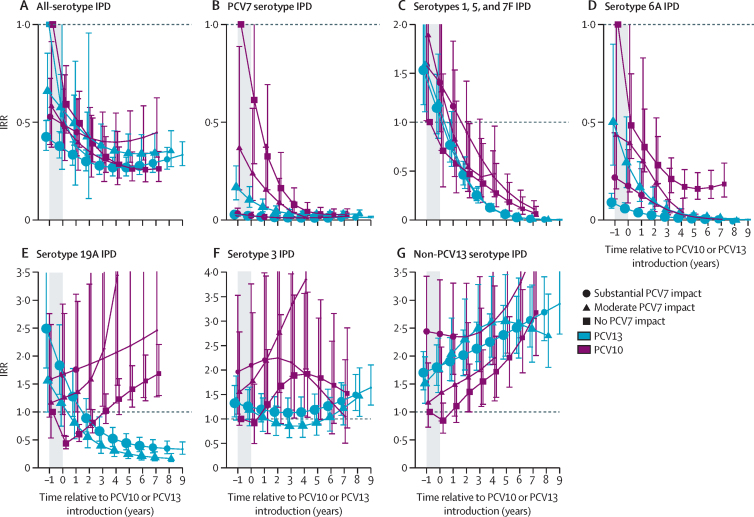
Analyses included 32 PCV13 sites (488 758 cases) and 15 PCV10 sites (46 386 cases) in 30 countries, primarily high income (39 sites), using booster dose schedules (41 sites). By 6 years after PCV10 or PCV13 introduction, IPD due to PCV10-type serotypes and PCV10-related serotype 6A declined substantially for both products (age <5 years: 83-99% decline; ≥65 years: 54-96% decline). PCV7-related serotype 19A increases before PCV10 or PCV13 introduction were reversed at PCV13 sites (age <5 years: 61-79% decline relative to before any PCV; age ≥65 years: 7-26% decline) but increased at PCV10 sites (age <5 years: 1·6-2·3-fold; age ≥65 years: 3·6-4·9-fold). Serotype 3 IRRs had no consistent trends for either product or age group. Non-PCV13-type IPD increased similarly for both products (age <5 years: 2·3-3·3-fold; age ≥65 years: 1·7-2·3-fold). Despite different serotype 19A trends, all-serotype IPD declined similarly between products among children younger than 5 years (58-74%); among adults aged 65 years or older, declines were greater at PCV13 (25-29%) than PCV10 (4-14%) sites, but other differences between sites precluded attribution to product.
Long-term use of PCV10 or PCV13 reduced IPD substantially in young children and more moderately in older ages. Non-vaccine-type serotypes increased approximately two-fold to three-fold by 6 years after introduction of PCV10 or PCV13. Continuing serotype 19A increases at PCV10 sites and declines at PCV13 sites suggest that PCV13 use would further reduce IPD at PCV10 sites.
Bill & Melinda Gates Foundation as part of the WHO Pneumococcal Vaccines Technical Coordination Project.
十价肺炎球菌结合疫苗(PCV10)和十三价肺炎球菌结合疫苗(PCV13)于2010年上市。我们评估了它们对各年龄段侵袭性肺炎球菌病(IPD)发病率的全球影响。
血清型特异性IPD病例和人口分母直接从监测点获取,这些监测点在其国家免疫规划中使用了PCV10或PCV13,且首剂接种率至少为50%。使用贝叶斯多级混合效应泊松回归,按地点和年龄组估计年度发病率比(IRR),比较在引入任何PCV之前与引入PCV10或PCV13之后各年的发病率。所有地点加权平均IRR使用线性混合效应回归进行估计,按产品和先前的七价肺炎球菌结合疫苗(PCV7)效果(无、中等或显著)进行分层。
分析纳入了30个国家的32个PCV13监测点(488758例病例)和15个PCV10监测点(46386例病例),主要为高收入国家(39个监测点),采用加强免疫程序(41个监测点)。在引入PCV10或PCV13后的6年里,两种产品中由PCV10型血清型和PCV10相关血清型6A引起的IPD均大幅下降(年龄<5岁:下降83%-99%;≥65岁:下降54%-96%)。在PCV13监测点,引入PCV10或PCV13之前PCV7相关血清型19A的增加出现逆转(年龄<5岁:相对于引入任何PCV之前下降61%-79%;年龄≥65岁:下降7%-26%),但在PCV10监测点增加(年龄<5岁:增加1.6-2.3倍;年龄≥65岁:增加3.6-4.9倍)。血清型3的IRR在两种产品或年龄组中均无一致趋势。两种产品的非PCV13型IPD均有类似增加(年龄<5岁:增加2.3-3.3倍;年龄≥65岁:增加1.7-2.3倍)。尽管血清型19A趋势不同,但在5岁以下儿童中,两种产品的全血清型IPD下降情况类似(58%-74%);在65岁及以上成年人中,PCV13监测点的下降幅度(25%-29%)大于PCV10监测点(4%-14%),但监测点之间的其他差异使得无法将其归因于产品。
长期使用PCV10或PCV13可大幅降低幼儿的IPD发病率,对老年人的降低幅度较小。在引入PCV10或PCV13后的6年里,非疫苗型血清型增加了约两倍至三倍。PCV10监测点血清型19A持续增加而PCV13监测点下降,这表明使用PCV13将进一步降低PCV10监测点的IPD发病率。
比尔及梅琳达·盖茨基金会,作为世界卫生组织肺炎球菌疫苗技术协调项目的一部分。