Anparasan Libesha, Pilecky Matthias, Ramirez M Isabel, Hobson Keith A, Kainz Martin J, Wassenaar Leonard I
WasserCluster Lunz - Biologische Station GmbH, Dr. Carl Kupelwieser Promenade 5, Lunz am See, A-3293, Austria.
Research Lab for Aquatic Ecosystem Research and Health, Danube University Krems, Dr. Karl Dorrek Straße 30, Krems, A-3500, Austria.
J Comp Physiol A Neuroethol Sens Neural Behav Physiol. 2025 Mar;211(2):221-234. doi: 10.1007/s00359-024-01727-0. Epub 2024 Dec 21.
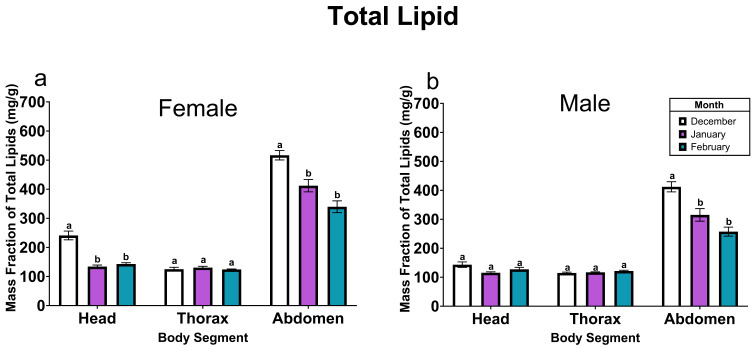
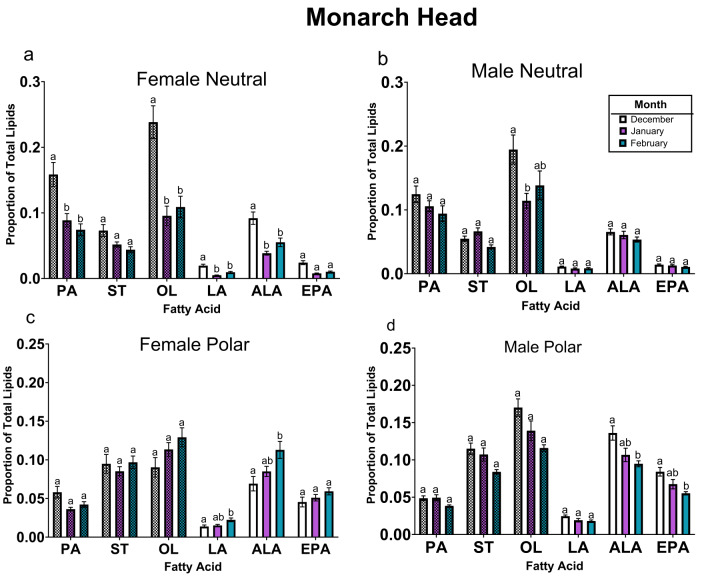
Monarch butterflies (Danaus plexippus) undertake one of the most remarkable long-distance insect migrations, travelling thousands of kilometres to overwinter in the central trans-volcanic belt of Mexico. This study explored how monarch butterflies use essential fatty acids (EFA) and nonessential fatty acids (NFA) during overwintering. We collected 150 (male/female) butterflies from the Sierra Chincua wintering colony from the time of arrival (December 2022) to before departure (February 2023) and analysed their lipid content. Our findings revealed that although females have a higher mass fraction of lipids, male and female monarch butterflies depleted their lipids similarly over time, resulting in low abdominal lipid mass fractions by late February. NFA, including oleic and palmitic acid, were predominantly used for energy during overwintering by male and female butterflies. In contrast, the EFA alpha-linolenic and linoleic acids, critical for reproductive success and cellular functions, were conserved in both sexes. Males began the overwintering period with a higher mass fraction of EFA in the polar components of the head and thorax, which may impact the degree of cold acclimation of these tissues during this period. Strategic lipid utilisation, prioritising the preservation of EFA over NFA and optimizing overwintering survival probably enhance readiness for spring remigration and reproduction. This differential fatty acid use underscores the delicate balance monarch butterflies maintain to survive overwintering and highlights the potential impacts of environmental changes on their lipid dynamics and survival.
黑脉金斑蝶(Danaus plexippus)进行着昆虫界最显著的长途迁徙之一,飞行数千公里前往墨西哥中部跨火山带越冬。本研究探讨了黑脉金斑蝶在越冬期间如何利用必需脂肪酸(EFA)和非必需脂肪酸(NFA)。我们从2022年12月到达至2023年2月出发前,从钦库阿山越冬栖息地收集了150只(雄性/雌性)蝴蝶,并分析了它们的脂质含量。我们的研究结果表明,尽管雌性蝴蝶的脂质质量分数较高,但随着时间的推移,雄性和雌性黑脉金斑蝶的脂质消耗情况相似,到2月底腹部脂质质量分数较低。包括油酸和棕榈酸在内的非必需脂肪酸在越冬期间主要被雄性和雌性蝴蝶用于提供能量。相比之下,对繁殖成功和细胞功能至关重要的必需脂肪酸α-亚麻酸和亚油酸在两性中都得到了保留。雄性蝴蝶在越冬初期头部和胸部极性成分中的必需脂肪酸质量分数较高,这可能会影响这些组织在此期间的冷驯化程度。战略性的脂质利用,优先保存必需脂肪酸而非非必需脂肪酸,并优化越冬存活率,可能会提高春季再次迁徙和繁殖的准备程度。这种脂肪酸利用的差异凸显了黑脉金斑蝶为越冬生存所维持的微妙平衡,并突出了环境变化对其脂质动态和生存的潜在影响。