Zhu Shengrong, Yang Ruijia, Pan Zifeng, Tian Xuan, Ji Hong
Department of Information Management and Big Data Center, Peking University Third Hospital, Beijing, 100191, China.
School of Information Science and Technology, Beijing Forestry University, Beijing, 100083, China.
BMC Bioinformatics. 2024 Dec 20;25(1):387. doi: 10.1186/s12859-024-05998-x.
Diagnostic prediction is a central application that spans various medical specialties and scenarios, sequential diagnosis prediction is the process of predicting future diagnoses based on patients' historical visits. Prior research has underexplored the impact of irregular intervals between patient visits on predictive models, despite its significance.
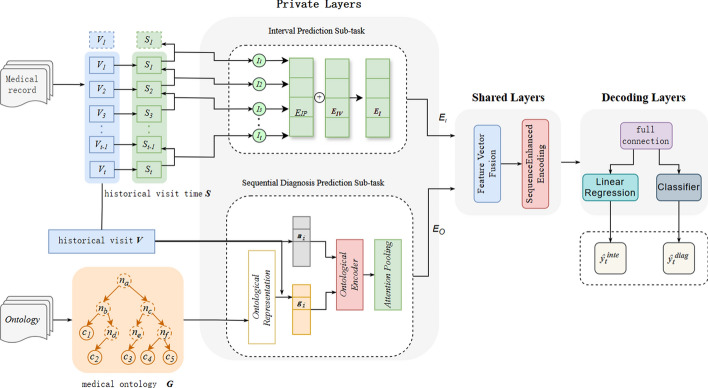
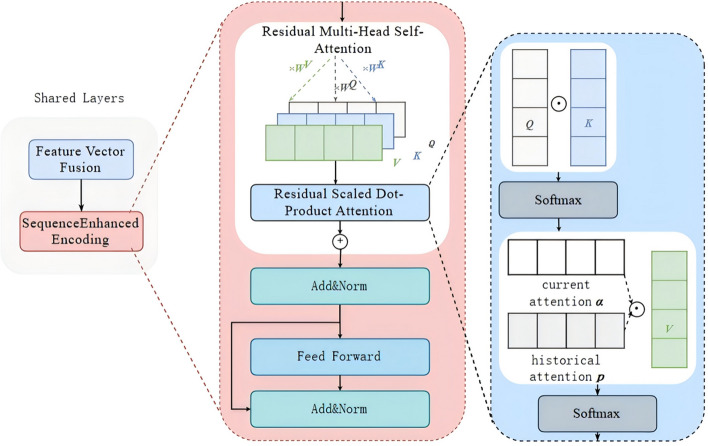
We developed the Multi-task Fusion Visit Interval for Sequential Diagnosis Prediction (MISDP) framework to address this research gap. The MISDP framework integrated sequential diagnosis prediction with visit interval prediction within a multi-task learning paradigm. It uses positional encoding and interval encoding to handle irregular patient visit intervals. Furthermore, it incorporates historical attention residue to enhance the multi-head self-attention mechanism, focusing on extracting long-term dependencies from clinical historical visits.
The MISDP model exhibited superior performance across real-world healthcare dataset, irrespective of the training data scarcity or abundance. With only 20% training data, MISDP achieved a 4. 2% improvement over KAME; when training data ranged from 60 to 80%, MISDP surpassed SETOR, the top baseline, by 0. 8% in accuracy, underscoring its robustness and efficacy in sequential diagnosis prediction task.
The MISDP model significantly improves the accuracy of Sequential Diagnosis Prediction. The result highlights the advantage of multi-task learning in synergistically enhancing the performance of individual sub-task. Notably, irregular visit interval factors and historical attention residue has been particularly instrumental in refining the precision of sequential diagnosis prediction, suggesting a promising avenue for advancing clinical decision-making through data-driven modeling approaches.
诊断预测是一个核心应用,涵盖各种医学专业和场景,序贯诊断预测是基于患者的历史就诊情况预测未来诊断的过程。尽管患者就诊间隔不规律对预测模型的影响具有重要意义,但先前的研究对此关注不足。
我们开发了用于序贯诊断预测的多任务融合就诊间隔(MISDP)框架来填补这一研究空白。MISDP框架在多任务学习范式中将序贯诊断预测与就诊间隔预测相结合。它使用位置编码和间隔编码来处理患者就诊间隔不规律的情况。此外,它还纳入了历史注意力残差以增强多头自注意力机制,专注于从临床历史就诊中提取长期依赖关系。
无论训练数据是稀缺还是丰富,MISDP模型在真实世界医疗数据集上均表现出卓越的性能。仅使用20%的训练数据时,MISDP比KAME提高了4.2%;当训练数据范围为60%至80%时,MISDP在准确率上比顶级基线SETOR高出0.8%,凸显了其在序贯诊断预测任务中的稳健性和有效性。
MISDP模型显著提高了序贯诊断预测的准确性。结果突出了多任务学习在协同提高各个子任务性能方面的优势。值得注意的是,不规律就诊间隔因素和历史注意力残差在提高序贯诊断预测精度方面发挥了特别重要的作用,这表明通过数据驱动的建模方法推进临床决策具有广阔前景。