Berg Lea Jessica, Lee Chung Ku, Matsumura Hideaki, Leinhaas Anke, Konang Rachel, Shaib Ali H, Royero Pedro, Schlee Julia, Sheng Chao, Beck Heinz, Schwarz Martin Karl, Brose Nils, Rhee Jeong Seop, Brüstle Oliver
Institute of Reconstructive Neurobiology, University of Bonn Medical Faculty and University Hospital Bonn, Venusberg-Campus 1, Bonn, 53127, Germany.
Department of Molecular Neurobiology, Max-Planck-Institute for Multidisciplinary Sciences, City Campus, Hermann-Rein-Str. 3, Göttingen, 37075, Germany.
Stem Cell Res Ther. 2024 Dec 20;15(1):488. doi: 10.1186/s13287-024-04110-7.
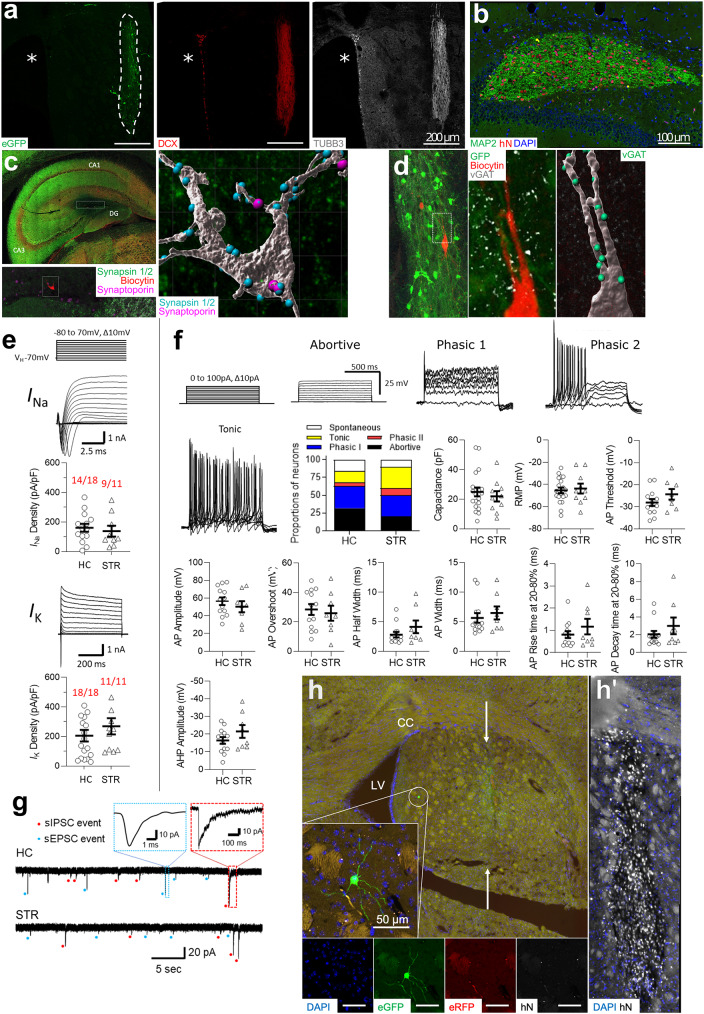
Transplantation of induced pluripotent stem cell-derived neural cells represents a promising strategy for treating neurodegenerative diseases. However, reprogramming of somatic cells and their subsequent neural differentiation is complex and time-consuming, thereby impeding autologous applications. Recently, direct transcription factor-based conversion of blood cells into induced neural stem cells (iNSCs) has emerged as a potential alternative. However, little is known about the functionality of iNSC-derived neurons upon in vivo transplantation. Here, we grafted human iNSCs derived from adult peripheral blood by temporary overexpression of the transcription factors SOX2 and cMYC into the hippocampus or striatum of adult unlesioned immunodeficient Rag2Il2rg mice of both sexes. Engrafted cells gave rise to stable transplants composed of mature neurons displaying extensive neurite outgrowth and dendritic spine formation. Functional analyses of acute slices using patch clamp recordings revealed that already after 12 weeks of in vivo maturation, most of iNSC-derived cells possess unique properties exclusive to neurons and exhibit voltage-dependent ion channel currents as well as action potential firing. Moreover, the formation of spontaneous inhibitory and excitatory postsynaptic currents, along with Rabies virus-based retrograde monosynaptic tracing data, strongly supports the structural and functional integration of graft-derived neurons. Taken together, our data demonstrate that iNSCs directly derived from peripheral blood cells have the inherent capacity to achieve full functional maturation in vivo, qualifying them as an alternative potential donor source for restorative applications and deserving further investigation.
诱导多能干细胞衍生神经细胞的移植是治疗神经退行性疾病的一种有前景的策略。然而,体细胞的重编程及其随后的神经分化复杂且耗时,从而阻碍了自体应用。最近,基于直接转录因子将血细胞转化为诱导神经干细胞(iNSCs)已成为一种潜在的替代方法。然而,关于iNSC衍生神经元在体内移植后的功能知之甚少。在此,我们通过短暂过表达转录因子SOX2和cMYC,将源自成人外周血的人iNSCs移植到成年未受损的免疫缺陷Rag2Il2rg雌雄小鼠的海马体或纹状体中。移植的细胞形成了稳定的移植物,由成熟神经元组成,这些神经元显示出广泛的神经突生长和树突棘形成。使用膜片钳记录对急性切片进行功能分析表明,在体内成熟12周后,大多数iNSC衍生的细胞具有神经元特有的独特特性,并表现出电压依赖性离子通道电流以及动作电位发放。此外,自发抑制性和兴奋性突触后电流的形成,以及基于狂犬病病毒的逆行单突触追踪数据,有力地支持了移植衍生神经元的结构和功能整合。综上所述,我们的数据表明,直接源自外周血细胞的iNSCs具有在体内实现完全功能成熟的内在能力,使其有资格作为恢复性应用的替代潜在供体来源,值得进一步研究。