Xie Zhenhui, Zhang Qingwei, Zhang Ranying, Zhao Yuxuan, Zhang Wang, Song Yang, Yu Dexin, Lin Jiang, Li Xiaobo, Suo Shiteng, Zhou Yan
Department of Radiology, Renji Hospital, School of Medicine, Shanghai Jiao Tong University, Pujian Road 160, Pudong District, 200127, Shanghai, China.
Division of Gastroenterology and Hepatology, Key Laboratory of Gastroenterology and Hepatology, Ministry of Health, Renji Hospital, School of Medicine, Shanghai Jiao Tong University, Shanghai Institute of Digestive Disease, Pujian Road 160, Pudong District, 200127, Shanghai, China.
Cancer Imaging. 2024 Dec 20;24(1):169. doi: 10.1186/s40644-024-00815-3.
Gastrointestinal stromal tumors (GISTs) are the most common mesenchymal tumors of the gastrointestinal tract. Recent advent of tyrosine kinase inhibitors (TKIs) has significantly improved the prognosis of GIST patients. However, responses to TKI therapy can vary depending on the specific gene mutation. D842V, which is the most common mutation in platelet-derived growth factor receptor alpha exon 18, shows no response to imatinib and sunitinib. Radiomics features based on venous-phase contrast-enhanced computed tomography (CECT) have shown potential in non-invasive prediction of GIST genotypes. This study sought to determine whether radiomics features could help distinguish GISTs with D842V mutations.
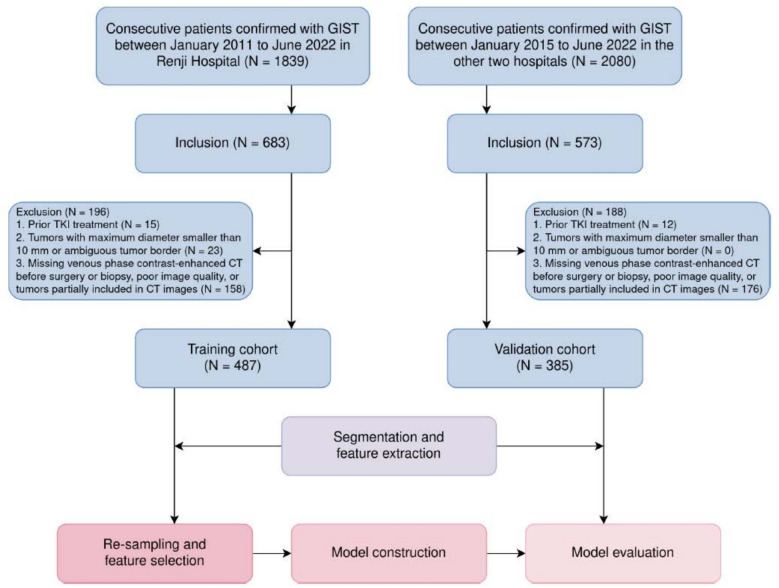
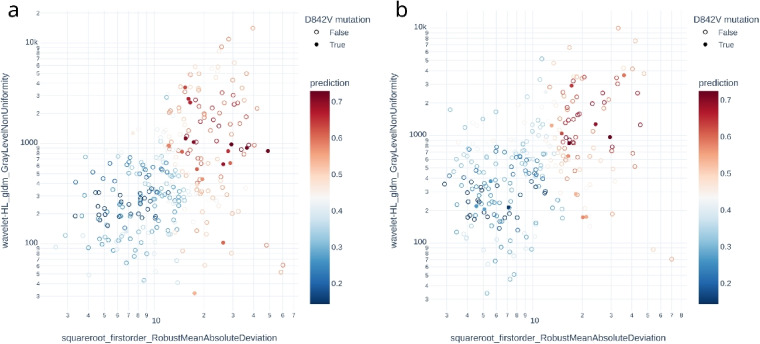
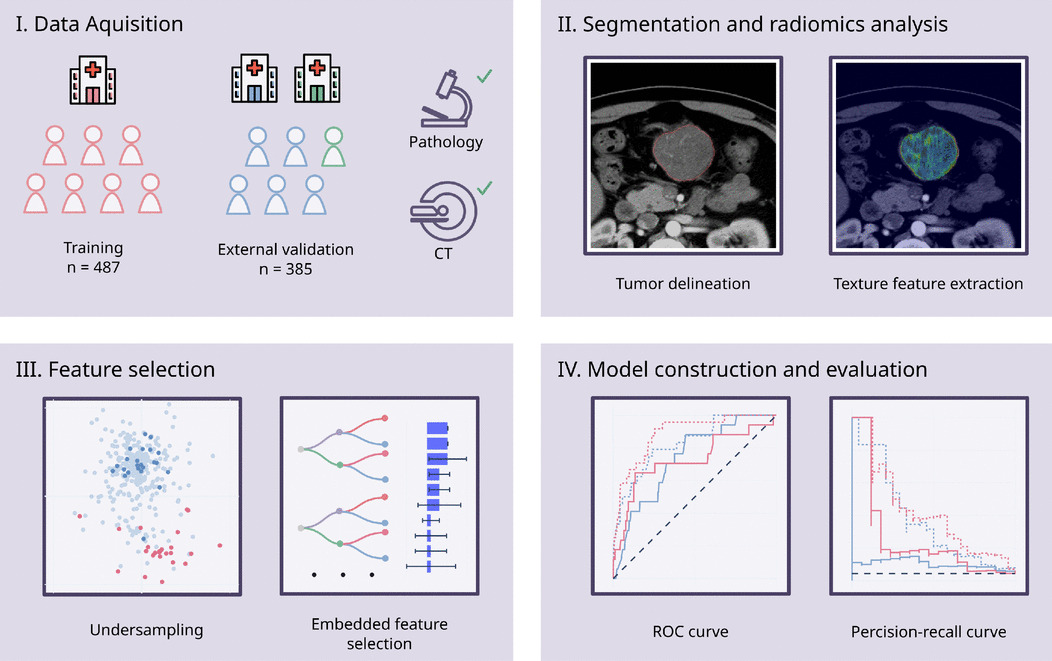
A total of 872 pathologically confirmed GIST patients with CECT data available from three independent centers were included and divided into the training cohort ( ) and the external validation cohort ( ). Clinical features including age, sex, tumor size and location were collected. Radiomics features on the largest axial image of venous-phase CECT were analyzed and a total of two radiomics features were selected after feature selection. Random forest models trained on non-radiomics features only (the non-radiomics model) and on both non-radiomics and radiomics features (the combined model) were compared.
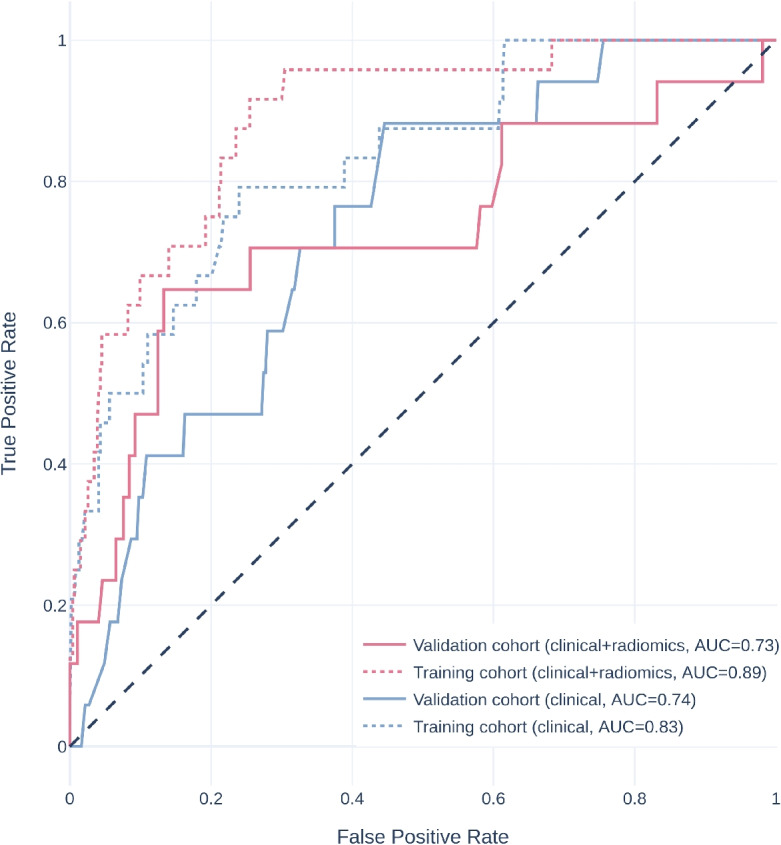
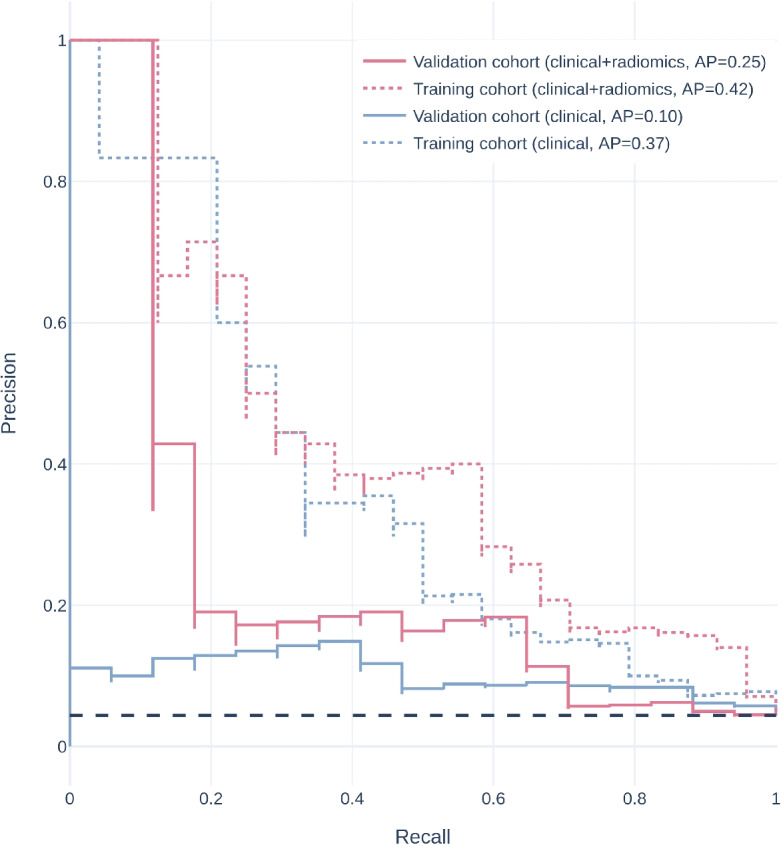
The combined model showed better average precision (0.250 vs. 0.102, p = 0.039) and F1 score (0.253 vs. 0.155, p = 0.012) than the non-radiomics model. There was no significant difference in ROC-AUC (0.728 vs. 0.737, p = 0.836) and geometric mean (0.737 vs. 0.681, p = 0.352).
This study demonstrated the potential of radiomics features based on venous-phase CECT images to identify D842V mutation in GISTs. Our model may provide an alternative approach to guide TKI therapy for patients inaccessible to sequence variant testing, potentially improving treatment outcomes for GIST patients especially in resource-limited settings.
胃肠道间质瘤(GISTs)是胃肠道最常见的间叶组织肿瘤。酪氨酸激酶抑制剂(TKIs)的出现显著改善了GIST患者的预后。然而,对TKI治疗的反应可能因特定基因突变而异。D842V是血小板衍生生长因子受体α第18外显子中最常见的突变,对伊马替尼和舒尼替尼无反应。基于静脉期对比增强计算机断层扫描(CECT)的放射组学特征在GIST基因型的无创预测中显示出潜力。本研究旨在确定放射组学特征是否有助于区分具有D842V突变的GISTs。
纳入872例来自三个独立中心且有CECT数据的经病理证实的GIST患者,并分为训练队列( )和外部验证队列( )。收集包括年龄、性别、肿瘤大小和位置在内的临床特征。分析静脉期CECT最大轴位图像上的放射组学特征,经过特征选择后共选择了两个放射组学特征。比较仅基于非放射组学特征训练的随机森林模型(非放射组学模型)和基于非放射组学及放射组学特征训练的随机森林模型(联合模型)。
联合模型显示出比非放射组学模型更好的平均精度(0.250对0.102,p = 0.039)和F1分数(0.253对0.155,p = 0.012)。ROC-AUC(0.728对0.737,p = 0.836)和几何均值(0.737对0.681,p = 0.352)无显著差异。
本研究证明了基于静脉期CECT图像的放射组学特征在识别GISTs中D842V突变方面的潜力。我们的模型可能为无法进行序列变异检测的患者提供一种指导TKI治疗的替代方法,有可能改善GIST患者的治疗结果,尤其是在资源有限的环境中。