Singh Srishti, Singh Alok Kumar, Pradhan Bhubaneswar, Tripathi Sudipta, Kumar Kewat Sanjay, Chand Sasmita, Rout Prangya Ranjan, Shahid Muhammad Kashif
Department of Botany, CMP Degree College, University of Allahabad, Uttar Pradesh, Prayagraj, 211002, India.
Division of Agricultural Biotechnology, School of Agriculture and Rural Development, Ramakrishna Mission Vivekananda Educational and Research Institute, Narendrapur Campus, Kolkata, 700103, West Bengal, India.
Microb Ecol. 2024 Dec 21;87(1):158. doi: 10.1007/s00248-024-02472-2.
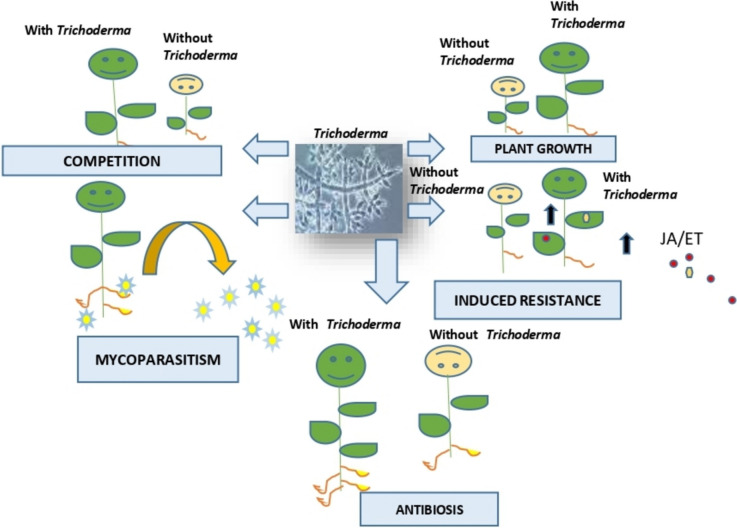
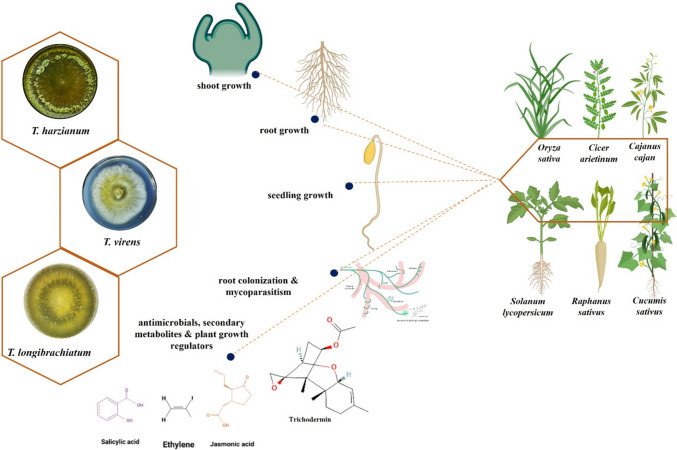
Maintaining and enhancing agricultural productivity for food security while preserving the ecology and environment from the harmful effects of toxicants is the main challenge in modern monoculture farming systems. Microbial biological agents can be a promising substitute for traditional synthetic pesticides to manage plant diseases. Trichoderma spp. are soil-dwelling ascomycete fungi and are common biocontrol agents against diverse phytopathogens. Trichoderma-based biocontrol techniques can regulate and control soil-borne plant diseases through mechanisms such as mycoparasitism, the production of antibiotics and hydrolytic enzymes, rhizo-sphere competence, the effective competition for available resources, induction of plant resistance and facilitation of plant growth. Numerous secondary metabolites produced by Trichoderma spp. are reported to prevent the development of soil-borne plant disease. Thus, Trichoderma spp. may have direct and indirect biological impacts on the targeted plant pathogens. Furthermore, this review discusses the convenient implications and challenges of applying Trichoderma-based strategies in agricultural settings. Overall, the assessment underscores the potential of Trichoderma as a sustainable and effective tool for mitigating soil-borne pathogens, highlighting avenues for future research and applications.
在保障粮食安全的同时维持并提高农业生产力,同时保护生态环境免受有毒物质的有害影响,这是现代单一栽培农业系统面临的主要挑战。微生物生物制剂有望替代传统的合成农药来防治植物病害。木霉菌属是一类土壤栖息的子囊菌真菌,是针对多种植物病原体的常见生物防治剂。基于木霉菌的生物防治技术可以通过菌寄生、抗生素和水解酶的产生、根际竞争力、对可用资源的有效竞争、诱导植物抗性以及促进植物生长等机制来调节和控制土传植物病害。据报道,木霉菌属产生的多种次生代谢产物可预防土传植物病害的发生。因此,木霉菌属可能对目标植物病原体产生直接和间接的生物学影响。此外,本综述讨论了在农业环境中应用基于木霉菌的策略的便利之处和挑战。总体而言,评估强调了木霉菌作为减轻土传病原体的可持续有效工具的潜力,突出了未来研究和应用的途径。