Wu Chunchen, Zhang Yanfang, Liang Ao, Wu Xiaoxue, Zhu Yaqi, Huang Zhaoxuan, Wang Jun, Deng Yali, Pan Lixian, Wang Anbang, Deng Fei, Xia Jianbo
Department of Laboratory Medicine, Maternal and Child Health Hospital of Hubei Province, Tongji Medical College, Huazhong University of Science and Technology, Wuhan 430070, China.
Key Laboratory of Virology and Biosafety and National Virus Resource Center, Wuhan Institute of Virology, Chinese Academy of Sciences, Wuhan 430071, China.
Virol Sin. 2025 Feb;40(1):50-60. doi: 10.1016/j.virs.2024.12.004. Epub 2024 Dec 20.
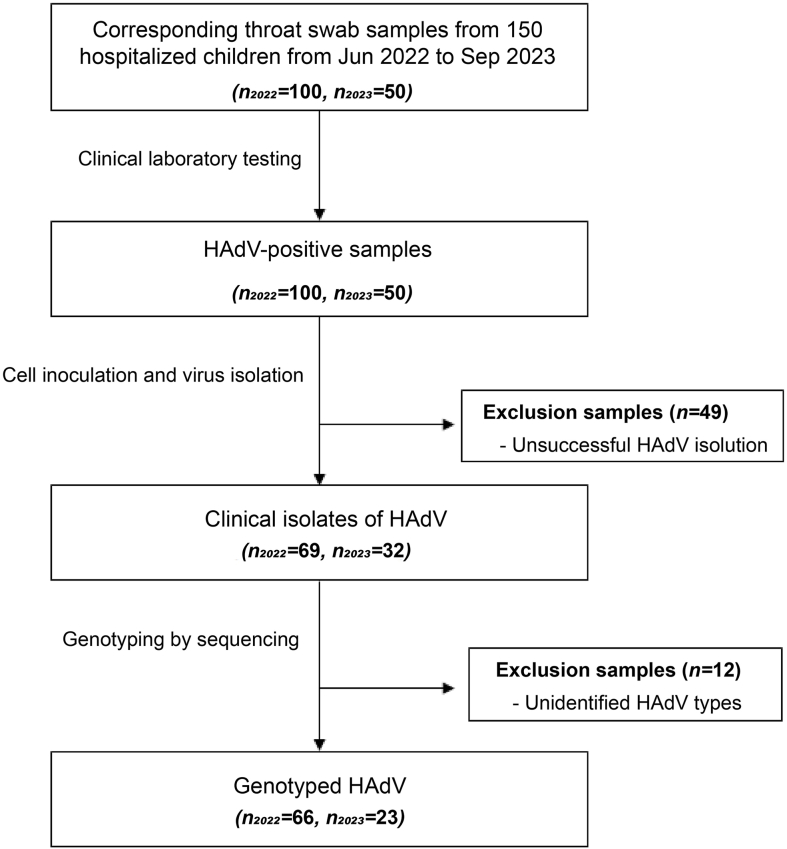
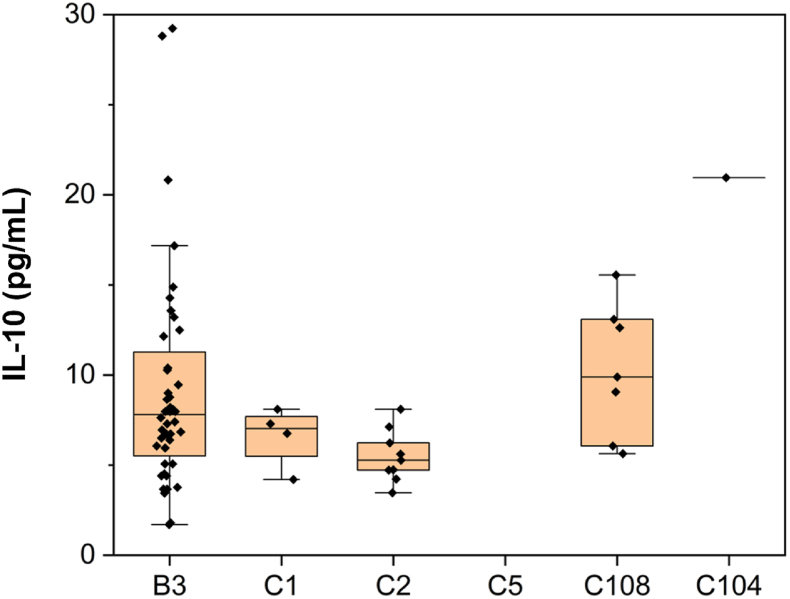
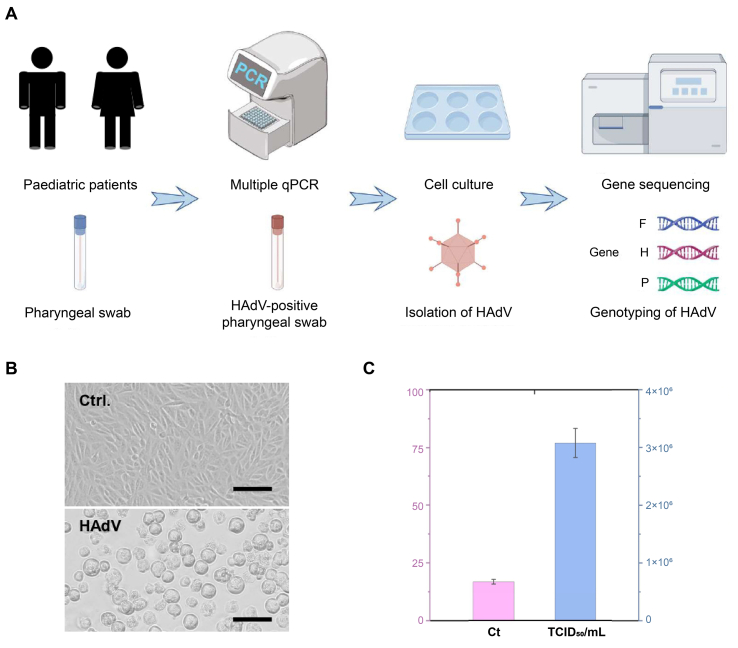
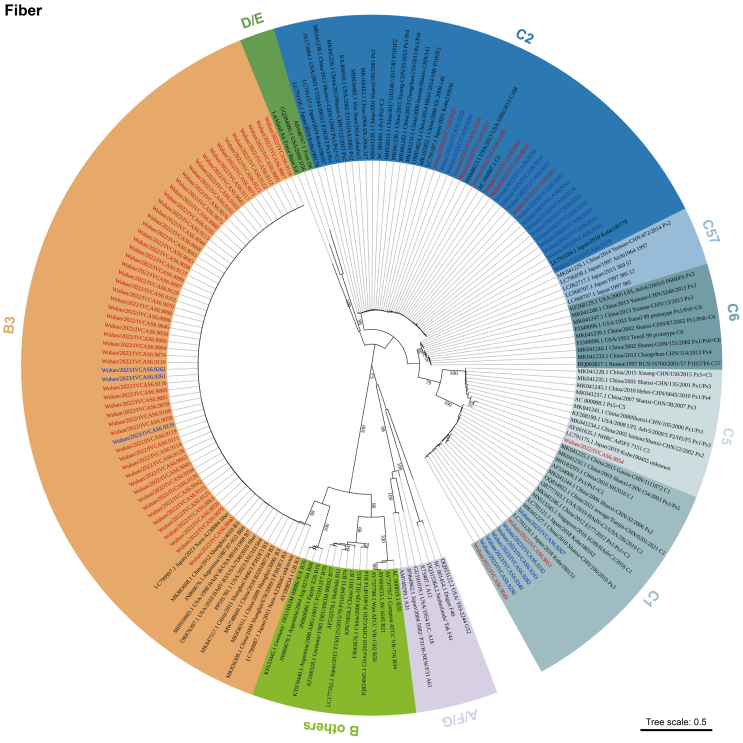
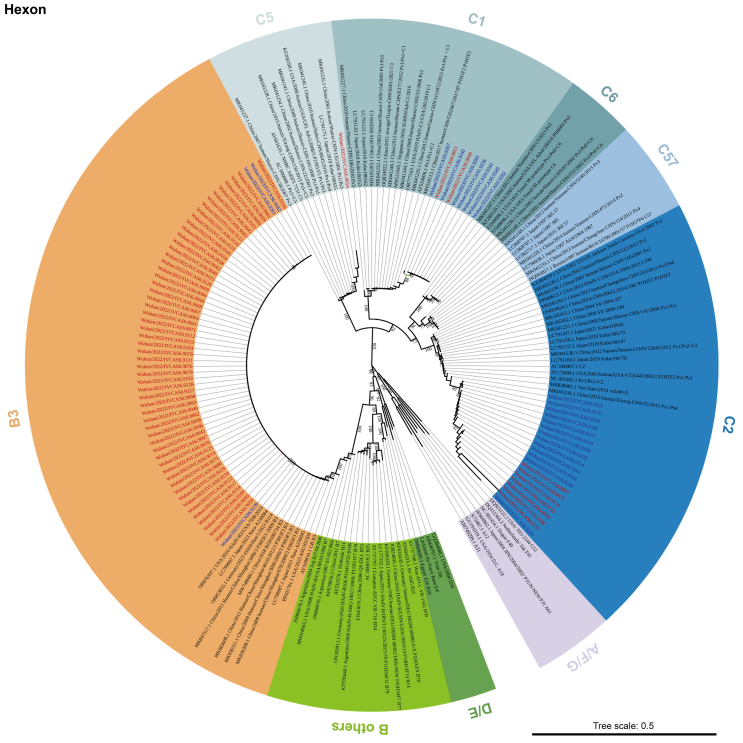
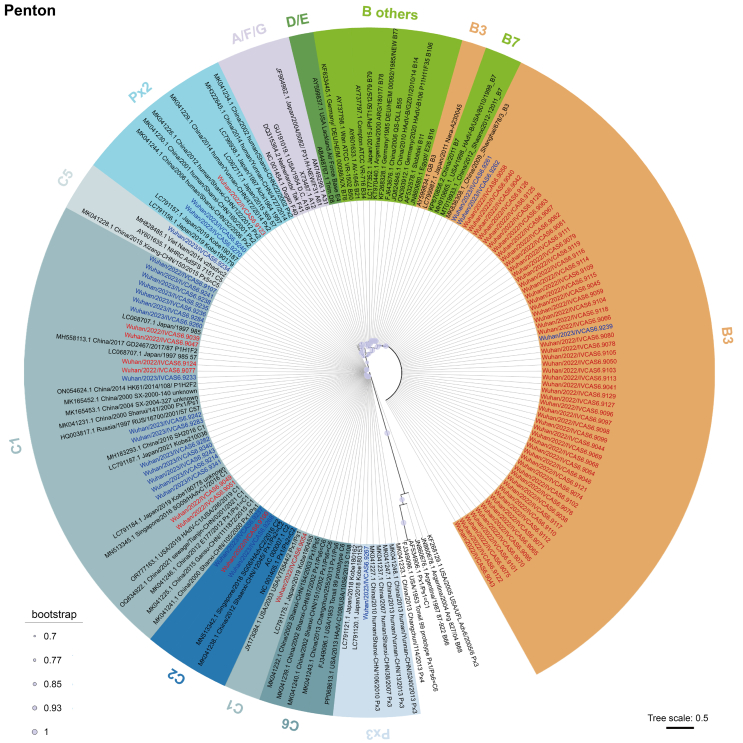
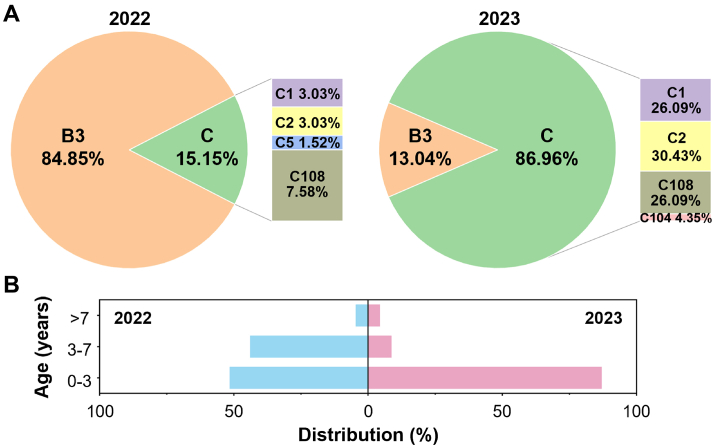
Acute respiratory tract infections (ARTIs) are among the leading causes of morbidity and mortality in children worldwide. Human adenovirus (HAdV) infections are estimated to account for at least 5% of pediatric ARTIs. The circulated genotypes of HAdV and the correlation between genotype and clinical manifestations in Wuhan, China, before and after the complete relaxation of nonpharmaceutical interventions against severe acute respiratory syndrome coronavirus 2, remain unknown. Here, 101 HAdV strains were isolated from throat swab samples collected from hospitalized children with ARTIs who tested positive for HAdV nucleic acid. Of these, sixty-six strains from 2022 to twenty-three strains from 2023 were successfully genotyped and subjected to phylogenetic analysis based on the hexon, penton base, and fiber genes. Six genotypes, B3, C1, C2, C5, C104, and C108 were identified. HAdV-B3 (84.85%) was the most prevalent type in 2022, while HAdV-C (86.96%), including C1, C2, C108, and C104, was the most prevalent in 2023. These strains were phylogenetically related to strains from Japan, China, and the United States in recent years. When comparing clinical characteristics, pediatric patients infected with B3, C1, C2, C5, C104, or C108 exhibited similar clinical manifestations, primarily fever and cough, but varying interleukin (IL)-10 levels. In conclusion, from June 2022 to September 2023, the circulated genotypes of HAdV in Wuhan included B3, C1, C2, C108, C5, and C104. The endemic pattern of HAdV in Wuhan, China, shifted from species B as the dominant type in 2022 to species C in 2023.
急性呼吸道感染(ARTIs)是全球儿童发病和死亡的主要原因之一。据估计,人类腺病毒(HAdV)感染至少占儿童ARTIs的5%。在针对严重急性呼吸综合征冠状病毒2的非药物干预措施完全放宽前后,中国武汉HAdV的流行基因型以及基因型与临床表现之间的相关性仍不清楚。在此,从因ARTIs住院且HAdV核酸检测呈阳性的儿童的咽拭子样本中分离出101株HAdV菌株。其中,2022年的66株菌株和2023年的23株菌株成功进行了基因分型,并基于六邻体、五邻体基座和纤维基因进行了系统发育分析。鉴定出6种基因型,即B3、C1、C2、C5、C104和C108。HAdV-B3(84.85%)是2022年最流行的类型,而HAdV-C(86.96%),包括C1、C2、C108和C104,是2023年最流行的类型。这些菌株在系统发育上与近年来来自日本、中国和美国的菌株相关。在比较临床特征时,感染B3、C1、C2、C5、C104或C108的儿科患者表现出相似的临床表现,主要为发热和咳嗽,但白细胞介素(IL)-10水平有所不同。总之,2022年6月至2023年9月,武汉HAdV的流行基因型包括B3、C1、C2、C108、C5和C104。中国武汉HAdV的流行模式从2022年以B型为主转变为2023年以C型为主。