Dan Shozen, Tegegne Joshua, Chen Yu, Ling Zhi, Jaeger Veronika K, Karch André, Mishra Swapnil, Ratmann Oliver
Imperial College London, Department of Mathematics, United Kingdom.
National University of Singapore, Saw Swee Hock School of Public Health, Singapore.
Res Sq. 2024 Dec 11:rs.3.rs-5182601. doi: 10.21203/rs.3.rs-5182601/v1.
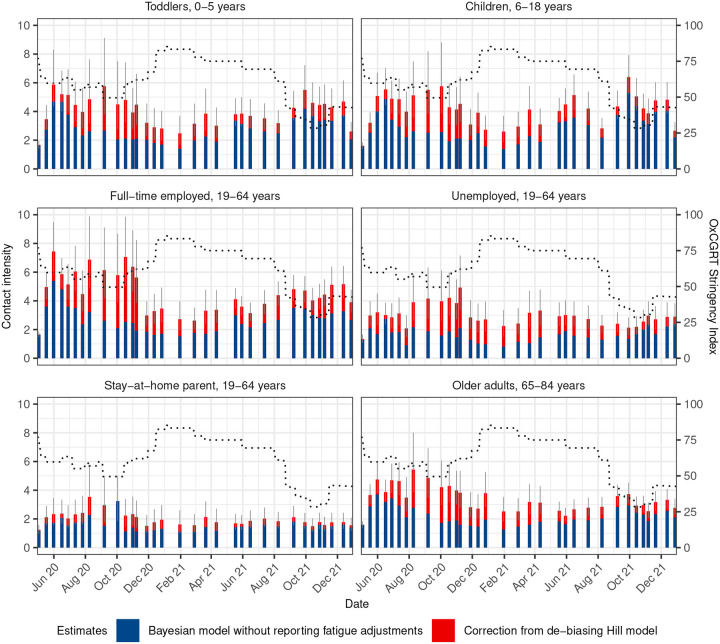
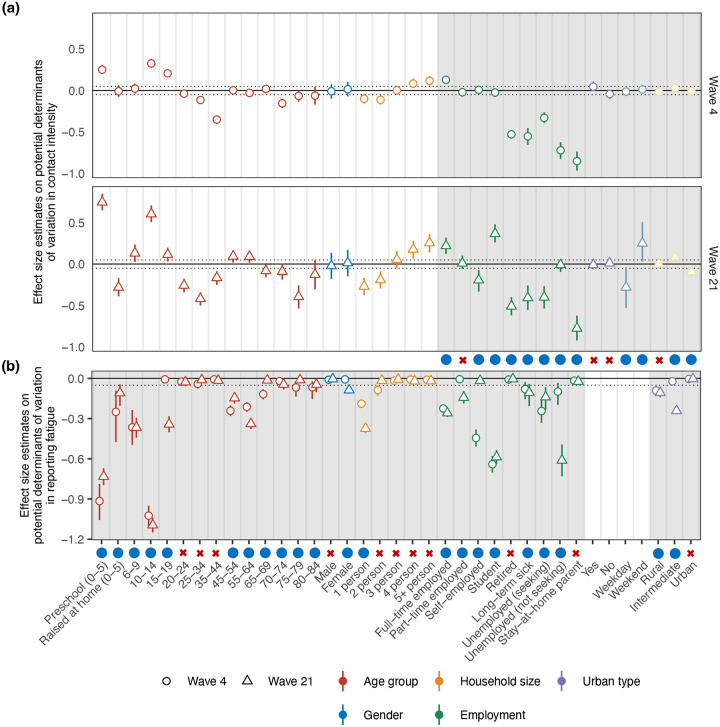
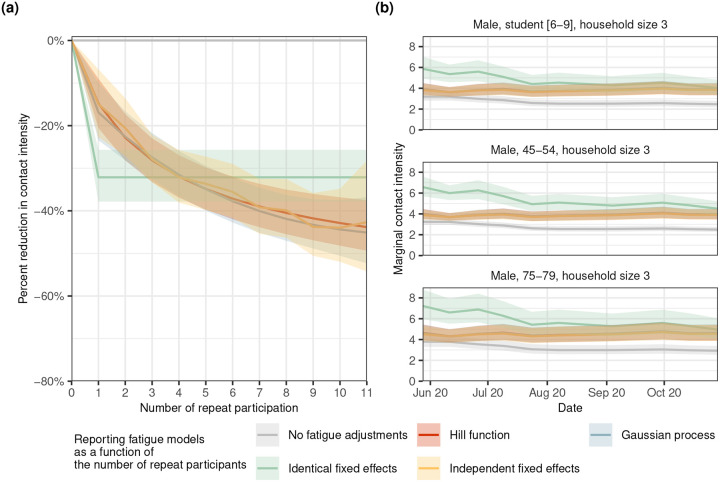
Social contact surveys are an important tool to assess infection risks within populations, and the effect of non-pharmaceutical interventions on social behaviour during disease outbreaks, epidemics, and pandemics. Numerous longitudinal social contact surveys were conducted during the COVID-19 era, however data analysis is plagued by reporting fatigue, a phenomenon whereby the average number of social contacts reported declines with the number of repeat participations and as participants' engagement decreases over time. Using data from the German COVIMOD Study between April 2020 to December 2021, we demonstrate that reporting fatigue varied considerably by sociodemographic factors and was consistently strongest among parents reporting children contacts (parental proxy reporting), students, middle-aged individuals, those in full-time employment and those self-employed. We find further that, when using data from first-time participants as gold standard, statistical models incorporating a simple logistic function to control for reporting fatigue were associated with substantially improved estimation accuracy relative to models with no reporting fatigue adjustments, and that no cap on the number of repeat participations was required. These results indicate that existing longitudinal contact survey data can be meaningfully interpreted under an easy-to-implement statistical approach adressing reporting fatigue confounding, and that longitudinal designs including repeat participants are a viable option for future social contact survey designs.
社交接触调查是评估人群感染风险以及在疾病爆发、流行和大流行期间非药物干预对社会行为影响的重要工具。在新冠疫情期间进行了大量纵向社交接触调查,然而数据分析受到报告疲劳的困扰,报告疲劳是指随着重复参与次数的增加以及参与者参与度随时间下降,报告的社交接触平均数量会减少的一种现象。利用2020年4月至2021年12月德国COVIMOD研究的数据,我们证明报告疲劳在社会人口学因素方面差异很大,在报告与孩子接触的父母(父母代理报告)、学生、中年个体、全职工作者和自雇人士中始终最为明显。我们进一步发现,当将首次参与者的数据作为金标准时,相对于未进行报告疲劳调整的模型,纳入简单逻辑函数以控制报告疲劳的统计模型在估计准确性方面有显著提高,并且不需要对重复参与次数设限。这些结果表明,现有的纵向接触调查数据可以通过一种易于实施的统计方法来有效解释,该方法可解决报告疲劳带来的混淆问题,并且包括重复参与者的纵向设计对于未来的社交接触调查设计是一个可行的选择。