Institute of Epidemiology and Social Medicine, University of Münster, Münster, Germany.
Immunization Unit, Robert Koch Institute, Berlin, Germany.
BMC Med. 2021 Oct 14;19(1):271. doi: 10.1186/s12916-021-02139-6.
The effect of contact reduction measures on infectious disease transmission can only be assessed indirectly and with considerable delay. However, individual social contact data and population mobility data can offer near real-time proxy information. The aim of this study is to compare social contact data and population mobility data with respect to their ability to reflect transmission dynamics during the first wave of the SARS-CoV-2 pandemic in Germany.
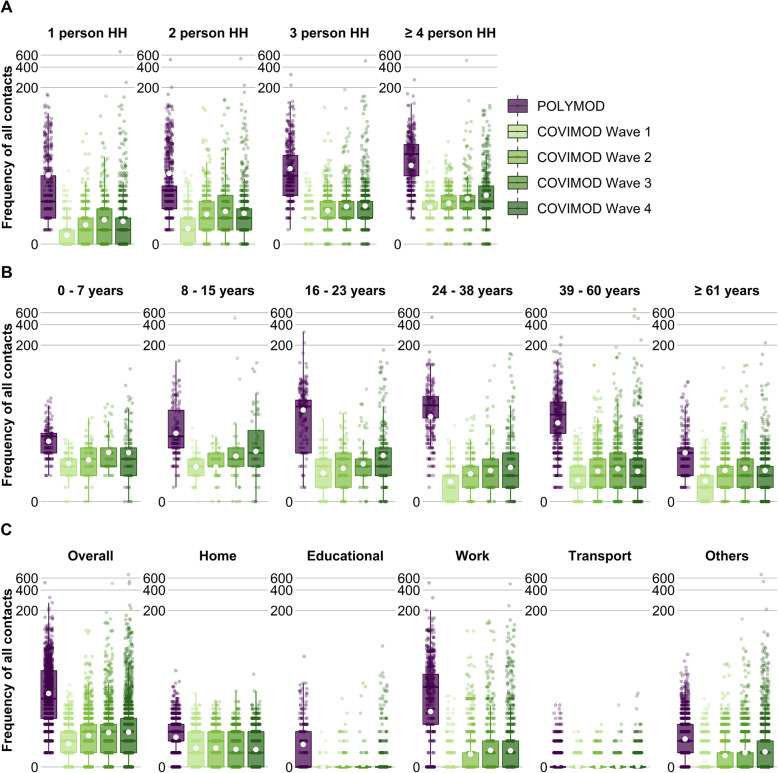
We quantified the change in social contact patterns derived from self-reported contact survey data collected by the German COVIMOD study from 04/2020 to 06/2020 (compared to the pre-pandemic period from previous studies) and estimated the percentage mean reduction over time. We compared these results as well as the percentage mean reduction in population mobility data (corrected for pre-pandemic mobility) with and without the introduction of scaling factors and specific weights for different types of contacts and mobility to the relative reduction in transmission dynamics measured by changes in R values provided by the German Public Health Institute.
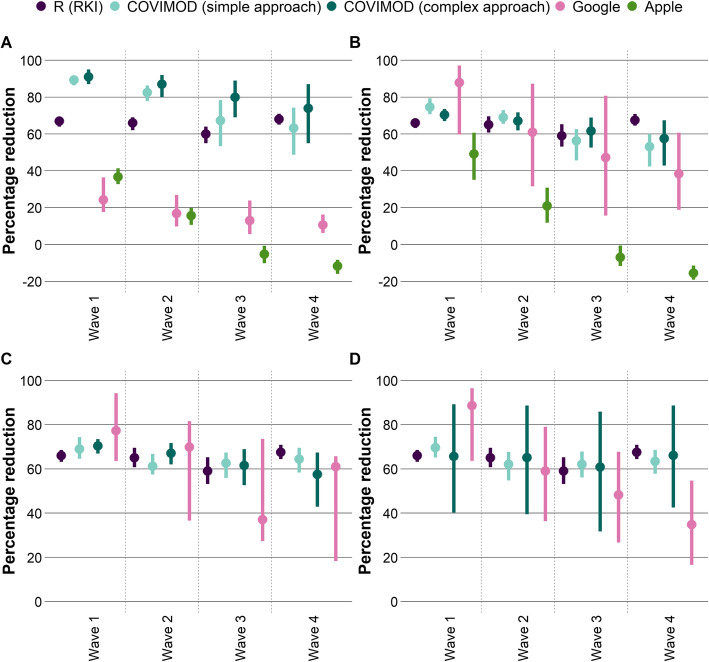
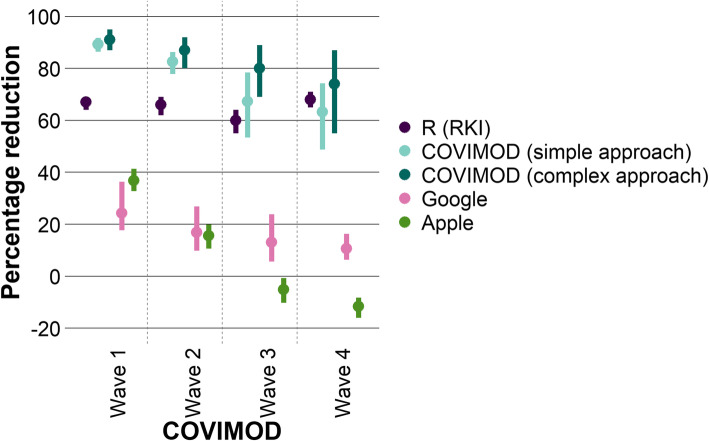
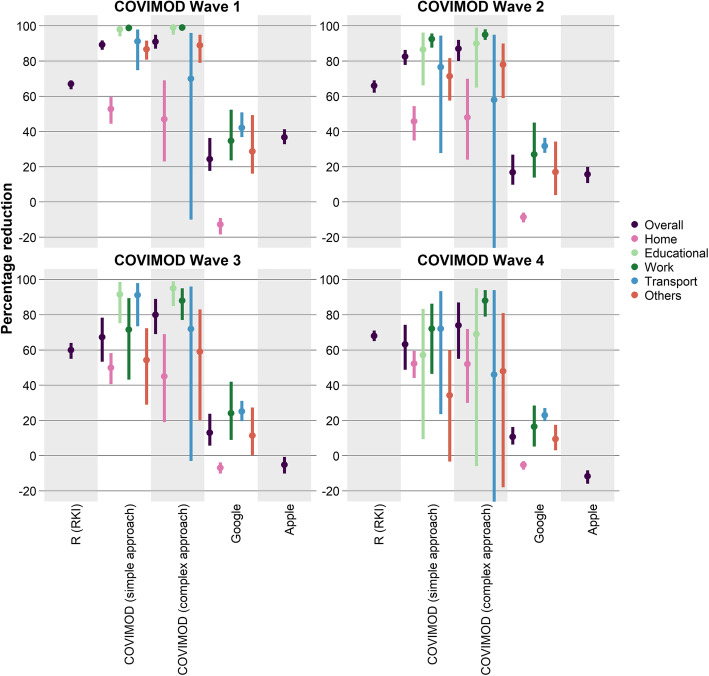
We observed the largest reduction in social contacts (90%, compared to pre-pandemic data) in late April corresponding to the strictest contact reduction measures. Thereafter, the reduction in contacts dropped continuously to a minimum of 73% in late June. Relative reduction of infection dynamics derived from contact survey data underestimated the one based on reported R values in the time of strictest contact reduction measures but reflected it well thereafter. Relative reduction of infection dynamics derived from mobility data overestimated the one based on reported R values considerably throughout the study. After the introduction of a scaling factor, specific weights for different types of contacts and mobility reduced the mean absolute percentage error considerably; in all analyses, estimates based on contact data reflected measured R values better than those based on mobility.
Contact survey data reflected infection dynamics better than population mobility data, indicating that both data sources cover different dimensions of infection dynamics. The use of contact type-specific weights reduced the mean absolute percentage errors to less than 1%. Measuring the changes in mobility alone is not sufficient for understanding the changes in transmission dynamics triggered by public health measures.
接触减少措施对传染病传播的影响只能通过间接且延迟较大的方式进行评估。然而,个体社会接触数据和人口流动数据可以提供近乎实时的代理信息。本研究的目的是比较社会接触数据和人口流动数据在反映德国 SARS-CoV-2 大流行第一波期间传播动态方面的能力。
我们量化了从德国 COVIMOD 研究中收集的自我报告接触调查数据中得出的社会接触模式变化,该数据来自 2020 年 4 月至 6 月(与之前研究中的大流行前时期相比),并估计了随时间的平均减少百分比。我们比较了这些结果以及人口流动数据(校正大流行前的流动数据)的平均减少百分比,同时还比较了引入不同类型接触和流动的比例因子和特定权重与德国公共卫生研究所提供的 R 值变化所衡量的传播动态相对减少之间的关系。
我们观察到 4 月下旬接触减少最多(与大流行前数据相比减少 90%),这与最严格的接触减少措施相对应。此后,接触减少持续下降,6 月下旬降至最低 73%。接触调查数据得出的感染动态相对减少在最严格的接触减少措施时期低估了基于报告的 R 值得出的结果,但此后反映得很好。整个研究期间,移动数据得出的感染动态相对减少大大高估了基于报告的 R 值得出的结果。引入比例因子、不同类型接触和流动的特定权重后,平均绝对百分比误差大大降低;在所有分析中,基于接触数据的估计都比基于流动数据的估计更好地反映了测量的 R 值。
接触调查数据比人口流动数据更好地反映了感染动态,表明这两种数据源涵盖了感染动态的不同方面。使用接触类型特定权重可将平均绝对百分比误差降低到 1%以下。仅测量流动性的变化不足以了解公共卫生措施引发的传播动态变化。