D'Alto Michele, Romeo Emanuele, Argiento Paola, Vergara Andrea, Caiazza Eleonora, Orlando Antonio, Franzese Rosa, Scognamiglio Giancarlo, Sarubbi Berardo, Dimopoulos Konstantinos
Adult Congenital Heart Disease Unit, Department of Cardiology, Monaldi Hospital, Naples, Italy.
Royal Brompton Hospital, Part of Guys St Thomas NHS Trust, and National Heart and Lung Institute, Imperial College London, London, United Kingdom.
Int J Cardiol Congenit Heart Dis. 2024 Jul 11;17:100526. doi: 10.1016/j.ijcchd.2024.100526. eCollection 2024 Sep.
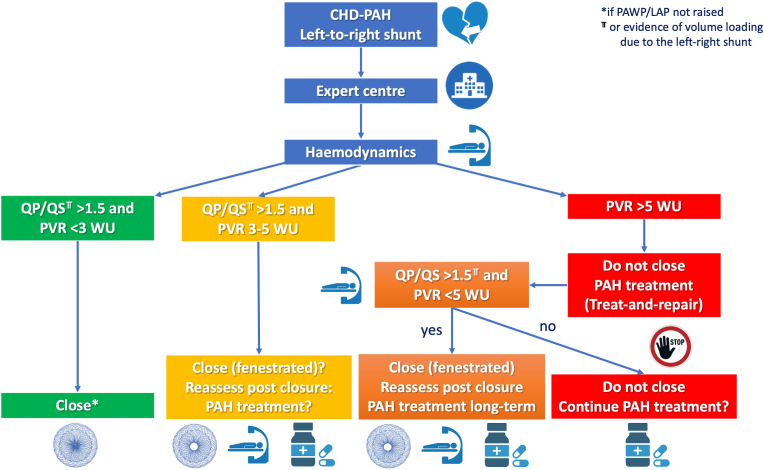
Pulmonary arterial hypertension (PAH) is defined as increase in mean pulmonary arterial pressure and pulmonary vascular resistance (PVR). It can be associated with congenital heart disease (CHD) with the following subtypes: 1) uncorrected left-to-right (L-R) intracardiac shunt leading to overload of the pulmonary circulation and a progressive increase of PVR; 2) Eisenmenger syndrome, appearing when a large post-tricuspid shunt is left uncorrected and pulmonary vascular disease (PVD) is severe, so the shunt becomes bidirectional or right-to-left, causing cyanosis; 3) PAH after shunt closure, when PVR arises after a defect correction; and 4) PAH associated with small or coincidental defects. While the treatment of patients with Eisenmenger syndrome is well established, the treatment of patients with PAH in whom there is a L-R shunt (with no cyanosis) remains unclear and requires expertise. In such patients, correction of the defect may be contemplated if there is mild PVD and a significant L-R shunt. Others may benefit from a "treat and repair" strategy, which involves the use of PAH therapy to achieve a drop in PVR, with the aim of achieving operability criteria. Cardiac catheterization is at the center of the evaluation and follow-up of these patients, collecting "baseline" data and providing the opportunity to challenge the pulmonary circulation, manipulate the loading status, or temporarily occlude the defect. This article provides a detailed overview of the pathophysiology and treatment options for patients with PAH associated with a L-R congenital shunt, including current approaches to operability and the use of PAH therapies.
肺动脉高压(PAH)定义为平均肺动脉压和肺血管阻力(PVR)升高。它可与先天性心脏病(CHD)相关,具有以下亚型:1)未纠正的左向右(L-R)心内分流导致肺循环负荷过重和PVR逐渐升高;2)艾森曼格综合征,当大型三尖瓣后分流未得到纠正且肺血管疾病(PVD)严重时出现,此时分流变为双向或右向左,导致发绀;3)分流关闭后发生的PAH,即缺陷纠正后出现PVR升高;4)与小的或巧合的缺陷相关的PAH。虽然艾森曼格综合征患者的治疗方法已很成熟,但对于存在L-R分流(无发绀)的PAH患者的治疗仍不明确,需要专业知识。对于此类患者,如果存在轻度PVD和显著的L-R分流,可考虑纠正缺陷。其他患者可能受益于“治疗并修复”策略,该策略包括使用PAH治疗以降低PVR,目的是达到可手术标准。心导管检查是这些患者评估和随访的核心,收集“基线”数据,并提供挑战肺循环、控制负荷状态或暂时封堵缺陷的机会。本文详细概述了与L-R先天性分流相关的PAH患者的病理生理学和治疗选择,包括目前的可手术性方法和PAH治疗的应用。